Doc cooks up tasteful portrait of unlikely culinary icon

Film an exuberant chronicle of Julia Child’s contribution to American cuisine

Advertisement

Advertise with us

This charming, cheering and deeply affectionate Julia Child documentary is as enthusiastic as its subject, and that’s saying something.

Read this article for free:


By clicking the button above, an account will be created and you will begin to receive some of our recommended newsletters. You may opt out of any newsletter by visiting your Email and Communication Preferences page or by clicking "unsubscribe" at the bottom of any email.

or

Already have an account? Log in here »

To continue reading, please subscribe:

Digital Subscription

One year of digital access for only $1.44 a week*

  • Enjoy unlimited reading on winnipegfreepress.com
  • Read the E-Edition, our digital replica newspaper
  • Access News Break, our award-winning app
  • Play interactive puzzles

*Billed as $5.77 plus GST every four weeks. After 52 weeks, price increases to the regular rate of $19.95 plus GST every four weeks. Offer available to new and qualified returning subscribers only. Cancel any time.

To continue reading, please subscribe:

Add Free Press access to your Brandon Sun subscription for only an additional

$1 for the first 4 weeks*

  • Enjoy unlimited reading on winnipegfreepress.com
  • Read the E-Edition, our digital replica newspaper
  • Access News Break, our award-winning app
  • Play interactive puzzles
Start now

*Your next Brandon Sun subscription payment will increase by $1.00 and you will be charged $17.95 plus GST for four weeks. After four weeks, your payment will increase to $24.95 plus GST every four weeks.

Hey there, time traveller!
This article was published 10/12/2021 (1786 days ago), so information in it may no longer be current.

This charming, cheering and deeply affectionate Julia Child documentary is as enthusiastic as its subject, and that’s saying something.

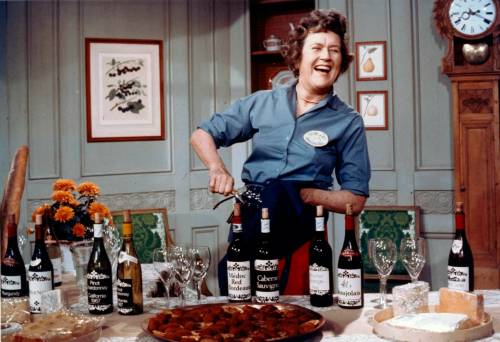
Filmmakers Betsy West and Julia Cohen, who also celebrated Ruth Bader Ginsburg in 2018’s RBG, employ a brisk mix of archival footage, family photographs, talking-head interviews and up-tempo music to chronicle the life and work of the woman who helped change the way North Americans cooked and ate.

Drawing heavily on book sources, including My Life in France by Julia Child and Alex Prud’homme, The French Chef in America by Alex Prud’homme, and Dearie: The Remarkable Life of Julia Child by Bob Spitz, the doc doesn’t really break cinematic ground. But with its straight-up chronology and crowd-pleasing mood, it will appeal to Julia fans. (For viewers of the 2009 dramedy Julie & Julia who only liked the Meryl Streep parts, this is the film for you.)

The doc starts with Julia’s childhood in a wealthy and conservative enclave in Pasadena, Calif., where she was expected to marry well and then while away her time at the country club. Instead, she signed up for war work, doing clerical duties for the OSS, the precursor to the CIA. (She was “too tall,” she felt, at six foot, three inches, to be a spy.)

There she met her future husband, Paul Child. Despite inauspicious beginnings — she thought his moustache “unbecoming;” he thought she giggled too much — this became a fulfilling lifelong love affair, often marked by wonderful food.

After Paul’s diplomatic posting to France, Julia had her famous meeting with a dish of sole meuniere, from which there was no going back. She became the only woman in a Cordon Bleu cooking course, “a masculine club invaded by a dame,” as Paul wrote in a letter home.

Julia later began 12 years of meticulous work on her ground-breaking cookbook, Mastering the Art of French Cooking, with co-contributors Louisette Bertholle and Simone Beck, which would help bring that Gallic attitude to food to the United State. As contrast, West and Cohen offer up a queasy-looking parade of postwar American food, including an assortment of jellied salads and spam with pineapple and maraschino cherries.

Julia championed French cooking — including a mysterious recipe mentioned only in passing that requires six-and-a-half sticks of butter (!) — but she was also determined that home cooks would be able to make these dishes with ingredients acquired at an average American supermarket.
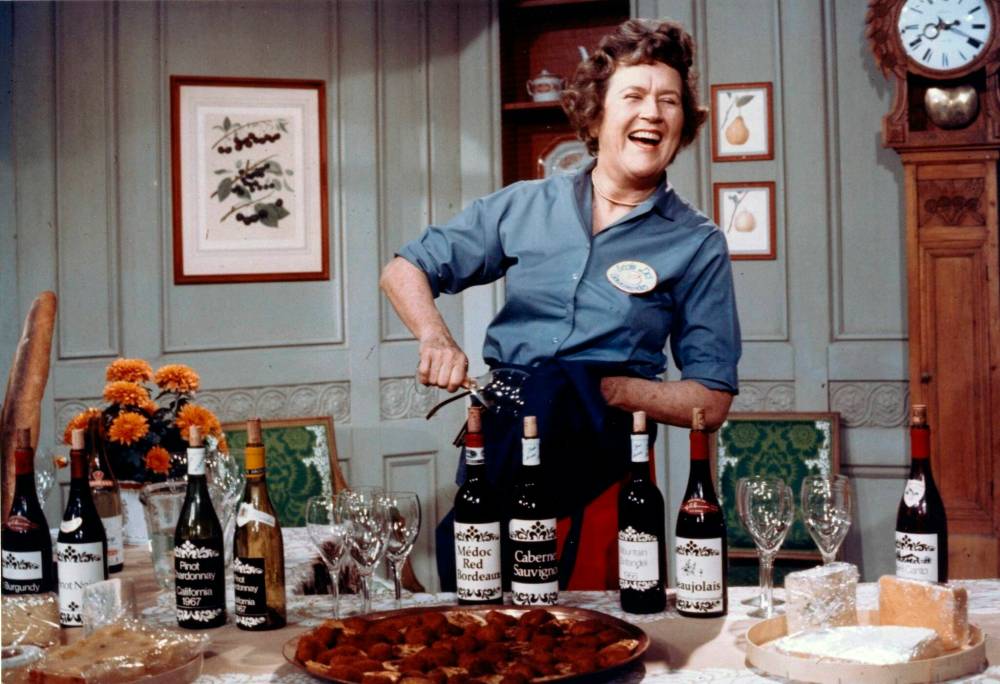
Paul Child/Schlesinger Library, Radcliffe Institute, Harvard University/Sony Pictures Classics
Julia Child was the first woman to study in a Cordon Bleu cooking course.
Paul Child/Schlesinger Library, Radcliffe Institute, Harvard University/Sony Pictures Classics Julia Child was the first woman to study in a Cordon Bleu cooking course.

That democratic approach extended to her first TV series, which helped educational public television find a much larger audience. While meticulously planned, the show was live-to-tape, which meant that Julia’s occasional flubs and fails were broadcast to the audience, along with her trilling assurances that mistakes were nothing to be afraid of.

That a crucial lesson from a woman who, into her 90s, was always learning and endlessly curious, her ongoing engagement with the world rooted in her passionate love of good food.

Cohen and West match that love with some really delicious food cinematography. Don’t be surprised if you head home and start thinking about making boeuf bourguignon.

Just ensure the beef is seared and not steamed! Don’t crowd the pan! And “bon appetit,” as Julia herself would say.

alison.gillmor@freepress.mb.ca
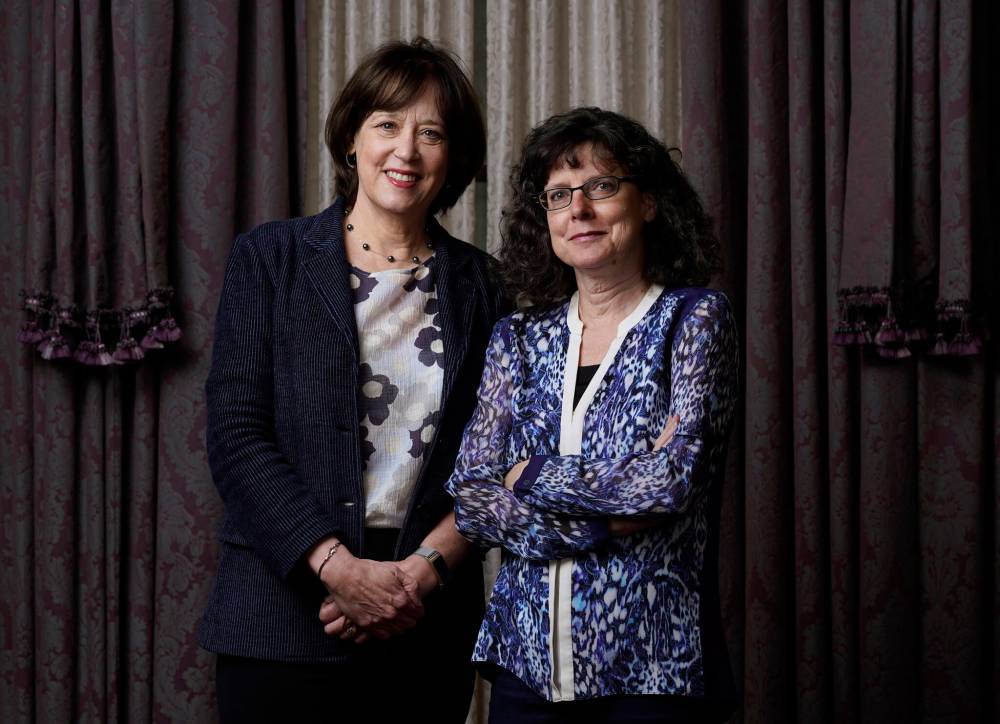
FILE - Betsy West, left, and Julie Cohen, the co-directors of the documentary film “Julia,” pose during the Toronto International Film Festival, on Sunday, Sept. 12, 2021, in Toronto. (AP Photo/Chris Pizzello, File)
Alison Gillmor

Alison Gillmor
Writer

Studying at the University of Winnipeg and later Toronto’s York University, Alison Gillmor planned to become an art historian. She ended up catching the journalism bug when she started as visual arts reviewer at the Winnipeg Free Press in 1992.

Our newsroom depends on a growing audience of readers to power our journalism. If you are not a paid reader, please consider becoming a subscriber.

Our newsroom depends on its audience of readers to power our journalism. Thank you for your support.

Report Error Submit a Tip

More Stories

Human rights museum responds to reopening backlash

Julia-Simone Rutgers 4 minute read Preview

Human rights museum responds to reopening backlash

Julia-Simone Rutgers 4 minute read Thursday, Jul. 29, 2021

The Canadian Museum for Human Rights reopened to fully vaccinated members of the public this week, drawing cries of discrimination from those who have chosen not to get vaccinated against COVID-19.

While the some of the backlash has been “disturbing,” museum CEO Isha Khan said the conflict has opened room for a conversation about human rights during the pandemic.

“We made the decision to open in compliance with that law, really because we’re a public institution and we saw it as our responsibility to open as soon as we could to the public — within the restrictions as they currently are,” Khan said Thursday.

“But it’s really important to us, as the Canadian Museum for Human Rights we have a mandate for human rights education, that we’re trying to ground the conversation in human rights principles.”

Read
Thursday, Jul. 29, 2021

Court ruling concludes Canadian Wheat Board saga

Laura Rance-Unger 4 minute read Preview

Court ruling concludes Canadian Wheat Board saga

Laura Rance-Unger 4 minute read 2:01 AM CDT

It remains to be seen whether the recent court ruling in a lawsuit filed after Canadian Wheat Board’s dissolution in 2012 puts the whole debate to rest, as some no doubt hope.

But either way, the dust has settled on the post-CWB world. The sun still rises and a new generation of farmers on the land only knows by name an institution that for generations influenced every aspect of Prairie grain farming.

The first Rural Revival column I wrote for this newspaper more than 30 years ago was about a thousand farmers from Western Canada demonstrating in support of the Wheat Board. It was in the aftermath of the Western Grain Marketing Panel report, one of several efforts that eventually included a plebiscite to help the federal government decide what to do about a vocal minority of farmers who wanted marketing “freedom.”

The polls at the time suggested about two-thirds of farmers were comfortable enough with the single-desk system for food wheat and barley to keep it around. It served as a counterbalance to canola, which they sold on the open market. They essentially had a dual market.

Read
2:01 AM CDT

Submit a news tip

1 minute read Monday, Mar. 16, 2026

Submit a news tip

Doc cooks up tasteful portrait of unlikely culinary icon

Alison Gillmor 4 minute read Preview

Doc cooks up tasteful portrait of unlikely culinary icon

Alison Gillmor 4 minute read Friday, Dec. 10, 2021

This charming, cheering and deeply affectionate Julia Child documentary is as enthusiastic as its subject, and that’s saying something.

Filmmakers Betsy West and Julia Cohen, who also celebrated Ruth Bader Ginsburg in 2018’s RBG, employ a brisk mix of archival footage, family photographs, talking-head interviews and up-tempo music to chronicle the life and work of the woman who helped change the way North Americans cooked and ate.

Drawing heavily on book sources, including My Life in France by Julia Child and Alex Prud’homme, The French Chef in America by Alex Prud’homme, and Dearie: The Remarkable Life of Julia Child by Bob Spitz, the doc doesn’t really break cinematic ground. But with its straight-up chronology and crowd-pleasing mood, it will appeal to Julia fans. (For viewers of the 2009 dramedy Julie & Julia who only liked the Meryl Streep parts, this is the film for you.)

The doc starts with Julia’s childhood in a wealthy and conservative enclave in Pasadena, Calif., where she was expected to marry well and then while away her time at the country club. Instead, she signed up for war work, doing clerical duties for the OSS, the precursor to the CIA. (She was “too tall,” she felt, at six foot, three inches, to be a spy.)

Read
Friday, Dec. 10, 2021

Province’s first female dentist took skill, insight wherever needed

David Sanderson    25 minute read Preview

Province’s first female dentist took skill, insight wherever needed

David Sanderson    25 minute read Saturday, Apr. 3, 2021

Some stories take longer to get around to than others.

In the fall of 2011 I hooked up with Fiona Odlum at an Academy Road Starbucks for a lighthearted feature about people who report on traffic for a living. Odlum, currently a contributor at CBC Saskatchewan, was working for 680 CJOB at the time, clueing rush-hour commuters in on stalls, lane closures and fender-benders they’d be wise to avoid.

Odlum turned the tables at one point by asking a few questions of her own including, “So, what’s your main beat?”

I don’t really have one, I told her, but if pressed, I would probably go with human-interest pieces.

Read
Saturday, Apr. 3, 2021

Doctor’s departure stressful for teen

Kevin Rollason 6 minute read Preview

Doctor’s departure stressful for teen

Kevin Rollason 6 minute read Sunday, Oct. 24, 2021

Morgan Walker is a typical teen — but only because a piece of his brain the size of a deck of cards was removed four years ago.

Walker, who had seizures multiple times a day before his surgery, fears other people might not be so lucky.

That’s because his surgeon, Dr. Demitre Serletis, is leaving the province and Health Sciences Centre. Serletis will start practising at the Cleveland Clinic in the new year.

“I was kind of shocked, but I understood why,” Walker said from his home in Brandon. “The government really hasn’t been respecting doctors.”

Read
Sunday, Oct. 24, 2021