Beach volleyballer Sarah Pavan finds new fans through love of anime series ‘Haikyuu’

Advertisement

Advertise with us

As Sarah Pavan faces the world on the beach volleyball court in Tokyo, she's garnering support from an unexpected demographic: fans of Japanese animation.

Read this article for free:


By clicking the button above, an account will be created and you will begin to receive some of our recommended newsletters. You may opt out of any newsletter by visiting your Email and Communication Preferences page or by clicking "unsubscribe" at the bottom of any email.

or

Already have an account? Log in here »

To continue reading, please subscribe:

Digital Subscription

One year of digital access for only $1.44 a week*

  • Enjoy unlimited reading on winnipegfreepress.com
  • Read the E-Edition, our digital replica newspaper
  • Access News Break, our award-winning app
  • Play interactive puzzles

*Billed as $5.77 plus GST every four weeks. After 52 weeks, price increases to the regular rate of $19.95 plus GST every four weeks. Offer available to new and qualified returning subscribers only. Cancel any time.

To continue reading, please subscribe:

Add Free Press access to your Brandon Sun subscription for only an additional

$1 for the first 4 weeks*

  • Enjoy unlimited reading on winnipegfreepress.com
  • Read the E-Edition, our digital replica newspaper
  • Access News Break, our award-winning app
  • Play interactive puzzles
Start now

*Your next Brandon Sun subscription payment will increase by $1.00 and you will be charged $17.95 plus GST for four weeks. After four weeks, your payment will increase to $24.95 plus GST every four weeks.

Hey there, time traveller!
This article was published 31/07/2021 (1919 days ago), so information in it may no longer be current.

As Sarah Pavan faces the world on the beach volleyball court in Tokyo, she’s garnering support from an unexpected demographic: fans of Japanese animation.

Over the course of the pandemic, the 34-year-old from Kitchener, Ont., has tapped into a community of anime enthusiasts through her YouTube channel. Alongside tutorials like “How To Do A Beach Volleyball Pokey” and “Volleyball Rotations Explained,” Pavan has posted more than a dozen clips of herself watching the popular series “Haikyuu.”

In between gasps, laughter and occasional tears, she breaks down the techniques and strategies demonstrated in the volleyball-themed show, and weighs in on the decisions made by coaches and players alike.
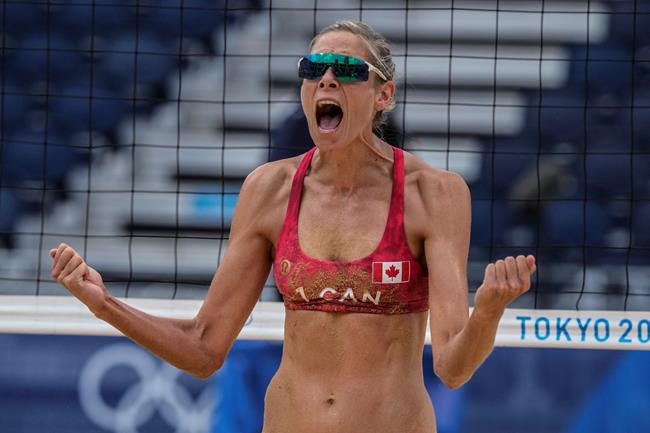
Canada's Sarah Pavan celebrates winning a beach volleyball match against Switzerland at the 2020 Summer Olympics, Thursday, July 29, 2021. Pavan has found new fans through a shared love of the anime series
Canada's Sarah Pavan celebrates winning a beach volleyball match against Switzerland at the 2020 Summer Olympics, Thursday, July 29, 2021. Pavan has found new fans through a shared love of the anime series "Haikyuu." THE CANADIAN PRESS/AP, Petros Giannakouris

As a result, she’s seen a whole new audience suddenly tune in to her career — and to volleyball as a whole.

“They’ll find my channel for ‘Haikyuu’ and then they’ll dive into the volleyball how-to’s from there. Whereas, before I started doing it, it was strictly volleyball enthusiasts, but now it’s kind of like reversed,” Pavan said in an interview from Tokyo, where she and her partner Melissa Humana-Paredes were 3-0 through the group play stage.

Her most recent video, which she posted from Tokyo though it was filmed weeks earlier, has drawn scores of comments from fans wishing her success at the Summer Games.

“I think it’s cool because I have my volleyball fans and my volleyball community that really understand the sport, but now I have my ‘Haikyuu’ community who are equally supportive of my volleyball career, but they don’t necessarily understand it in the same way,” said Pavan, a former indoor volleyball player who switched to the beach game at 26.

“But to feel that love — and I get messages from them all the time — and now they’re tuning in to real volleyball games because of my reaction (videos) … I think that’s amazing.”

The show, based on a comic or manga of the same title, follows a high school student determined to excel at volleyball despite his short stature, as his underdog team sets its sights on the national championship.

Its impact on Japan’s popular and sports culture was on display at the delayed Tokyo Olympics, where several of the show’s theme songs have rung out over the loudspeakers during the Japanese men’s team’s volleyball matches — including this week’s game against Canada.

Pavan isn’t the only Olympic volleyballer who’s become a fan.

Erik Shoji, the libero for the U.S. volleyball team, first discovered “Haikyuu” two years ago in Japan, when he and a few others walked into a store that had some of the show’s merchandise for sale. They took a photo with the items and posted it on social media “and it kind of went viral within the volleyball world,” Shoji said.

Since then, he’s posted a few videos on YouTube where he reacts to some of the anime’s show-stopping plays — particularly the digs by the main team’s libero. One of those videos has more than a million views.

“I think ‘Haikyuu’ does a really great job of teaching the sport, and also showing some really good technique in volleyball. So I think it’s great that maybe some non-volleyball fans are getting a really good glimpse into our sport,” Shoji said in a recent interview.

“They’re now just volleyball fans after watching the anime or watching my channel and watching the reaction, so I love that. I’m kind of reaching a different audience and it’s been a really cool experience,” he said.

Mark Lowes, a communications professor at the University of Ottawa who specializes in pop culture and sport, said social media has helped popular culture transcend geographic boundaries and provided a platform where different communities can cross over and take new forms.

While sports and anime are very different on the surface, “underneath it, there’s that kind of unifying theme of seeking meaning through identification with these things,” which can be a powerful motivator, he said.

“In a way, a series of athletes who have joined or created a community of fans around the program are now propagating their interests through their media networks by drawing in their own individual followers … that has effectively created a new community of fans,” he said.

It was at the urging of YouTube commenters that Pavan started watching ‘Haikyuu’ — though it took her about eight months to actually do it.

“But I started watching it, and like, became obsessed,” she said with a laugh.

“I’ve been playing this sport for so long that when the characters are going through a tough moment on the court, or the team dynamics or somebody on the bench wanting to fight for their starting position — I played indoor for the majority of my career, and I can relate to every single aspect of the show, and it brings up some like really great memories and some really hard ones,” she said.

Pavan has been trying to buy “Haikyuu” merch while in Japan, but COVID-19 restrictions — and the language barrier — have made it difficult, she said.

It’s not the first volleyball anime Pavan, 34, has enjoyed.

A self-described nerd who loved Sailor Moon growing up, Pavan remembers watching an anime called “Mila e Shiro” — the Italian title for the 1980s series “Attacker You!” — when she played professionally in Italy years ago.

Overall, though, “there isn’t a lot of volleyball pop culture,” she said.

“It’s not like your mainstream sport. So to have found something like this is so cool.”

This report by The Canadian Press was first published July 31, 2021.

Report Error Submit a Tip

More Stories

Pavan finds new fans through anime videos

Paola Loriggio, The Canadian Press 6 minute read Preview

Pavan finds new fans through anime videos

Paola Loriggio, The Canadian Press 6 minute read Saturday, Jul. 31, 2021

As Sarah Pavan faces the world on the beach volleyball court in Tokyo, she's garnering support from an unexpected demographic: fans of Japanese animation.

Over the course of the pandemic, the 34-year-old from Kitchener, Ont., has tapped into a community of anime enthusiasts through her YouTube channel. Alongside tutorials like "How To Do A Beach Volleyball Pokey" and "Volleyball Rotations Explained," Pavan has posted more than a dozen clips of herself watching the popular series "Haikyuu."

In between gasps, laughter and occasional tears, she breaks down the techniques and strategies demonstrated in the volleyball-themed show, and weighs in on the decisions made by coaches and players alike.

As a result, she's seen a whole new audience suddenly tune in to her career — and to volleyball as a whole.

Read
Saturday, Jul. 31, 2021

Imperialist crusades: 21st-century style

John R. Wiens 5 minute read Preview

Imperialist crusades: 21st-century style

John R. Wiens 5 minute read Wednesday, Jul. 8, 2026

In the 11th century and lasting into the 13th, the papacy launched a series of at least eight military campaigns we now refer to as the Crusades, or Holy Wars. They were an imperialistic call to arms for Christians to retake Jerusalem, which was at the time under Muslim rule.

Spiritual rewards for participation were implied, and other incentives offered, to dull the extra taxation demanded to fund the campaigns. Over time, the “crusades” morphed to become massacres of not only Muslims but also Jews and Christian dissidents — in other words, any enemies of the papacy. If today’s news sounds like déjà vu all over again, it probably should.

The stories keep repeating themselves in many forms. We now know that two 20th century world wars, global in scope, were caused by imperialistic ambitions, changes in the balance of international powers and corresponding arms races. The first was attributed to the assassination of the heir to the Austro-Hungarian throne by a Bosnian Serb, a kind of “regime change” initiative. The second resulted from rising tensions between Allied and Axis powers, triggered by the rise of European fascism and Japanese militarism. The human toll of both was unimaginable.

In the First World War, 15 to 22 million people, including soldiers and civilians, were killed and another 23 million were wounded. These numbers do not account for those otherwise affected — victims of chemical warfare whose compromised health shortened their lives; of the subsequent Spanish flu epidemic amplified by the displacement of peoples; others who died from other diseases caused by war conditions; and those who were malnourished or starved. Nor do they account for the ongoing trauma and resentments passed on intergenerationally to this day.

Read
Wednesday, Jul. 8, 2026

Court ruling concludes Canadian Wheat Board saga

Laura Rance-Unger 4 minute read Preview

Court ruling concludes Canadian Wheat Board saga

Laura Rance-Unger 4 minute read Yesterday at 2:01 AM CDT

It remains to be seen whether the recent court ruling in a lawsuit filed after Canadian Wheat Board’s dissolution in 2012 puts the whole debate to rest, as some no doubt hope.

But either way, the dust has settled on the post-CWB world. The sun still rises and a new generation of farmers on the land only knows by name an institution that for generations influenced every aspect of Prairie grain farming.

The first Rural Revival column I wrote for this newspaper more than 30 years ago was about a thousand farmers from Western Canada demonstrating in support of the Wheat Board. It was in the aftermath of the Western Grain Marketing Panel report, one of several efforts that eventually included a plebiscite to help the federal government decide what to do about a vocal minority of farmers who wanted marketing “freedom.”

The polls at the time suggested about two-thirds of farmers were comfortable enough with the single-desk system for food wheat and barley to keep it around. It served as a counterbalance to canola, which they sold on the open market. They essentially had a dual market.

Read
Yesterday at 2:01 AM CDT

RRC Polytech program cuts take bite out of hospitality, tourism sector

Maggie Macintosh 4 minute read Preview

RRC Polytech program cuts take bite out of hospitality, tourism sector

Maggie Macintosh 4 minute read Saturday, May. 2, 2026

Manitoba’s tourism industry is bracing for the disappearance of hospitality training programs — once-popular courses among international students.

Citing budgetary challenges related to a shift in federal immigration policy, Red River College Polytechnic is scrapping 11 programs and scaling back three others in 2026-27. Its hospitality business management diploma is one of seven permanent casualties.

The announcement, while unsurprising, is but the latest blow to a sector trying to “build back the workforce” in the wake of the COVID-19 pandemic, said Michael Juce, president of the Manitoba Hotel Association.

“Are people going to go outside of Manitoba for training? And if they leave, are they going to come back?” Juce said, adding that rural hotels in particular are already grappling with staffing shortages.

Read
Saturday, May. 2, 2026

Province changes Thompson ‘Vaxport’ plan

Carol Sanders 5 minute read Preview

Province changes Thompson ‘Vaxport’ plan

Carol Sanders 5 minute read Thursday, Jan. 14, 2021

The Manitoba government has changed its plans for a vaccination "super site" for the North — just days after it was announced — after local officials argued the original proposal was unworkable.

Some northern residents will still get their COVID-19 shots at Thompson's airport, but "Vaxport" will be less super than originally planned, providing injections only to residents of fly-in communities.

Most northern residents will get their shots at the Thompson Community Recreation Centre, which is centrally located in the city of about 13,000.

"This makes much more sense logistically, and for the citizens of Thompson," Mayor Colleen Smook said Thursday after touring the airport site, which is located 10 kilometres from the city and isn't serviced by public transportation.

Read
Thursday, Jan. 14, 2021

SNC planned U.S. move if no deal: documents

Jordan Press and Christopher Reynolds, The Canadian Press 5 minute read Preview

SNC planned U.S. move if no deal: documents

Jordan Press and Christopher Reynolds, The Canadian Press 5 minute read Thursday, Mar. 28, 2019

OTTAWA - SNC-Lavalin warned federal prosecutors last fall about a possible plan to split the company in two, move its offices to the United States and eliminate its Canadian workforce if it didn't get a deal to avoid criminal prosecution, newly obtained documents show.

The documents, part of a PowerPoint presentation obtained by The Canadian Press, describe something called "Plan B" — what Montreal-based SNC might have to do if it can't convince the government to grant a so-called remediation agreement to avoid criminal proceedings in a fraud and corruption case related to projects in Libya.

Under that plan, SNC would move its Montreal headquarters and corporate offices in Ontario and Quebec to the U.S. within a year, cutting its workforce to just 3,500 from 8,717, before eventually winding up its Canadian operations.

“The government of Canada needs to weigh the public interest impact of the prosecution of SNC-Lavalin," the presentation reads.

Read
Thursday, Mar. 28, 2019