Major Japan newspaper Asahi calls for Olympic cancellation

Advertisement

Advertise with us

TOKYO (AP) — Japan’s Asahi Shimbun newspaper on Wednesday called for the Tokyo Olympics to be canceled with the games set to open in less than two months.

Read this article for free:


By clicking the button above, an account will be created and you will begin to receive some of our recommended newsletters. You may opt out of any newsletter by visiting your Email and Communication Preferences page or by clicking "unsubscribe" at the bottom of any email.

or

Already have an account? Log in here »

To continue reading, please subscribe:

Digital Subscription

One year of digital access for only $1.44 a week*

  • Enjoy unlimited reading on winnipegfreepress.com
  • Read the E-Edition, our digital replica newspaper
  • Access News Break, our award-winning app
  • Play interactive puzzles

*Billed as $5.77 plus GST every four weeks. After 52 weeks, price increases to the regular rate of $19.95 plus GST every four weeks. Offer available to new and qualified returning subscribers only. Cancel any time.

To continue reading, please subscribe:

Add Free Press access to your Brandon Sun subscription for only an additional

$1 for the first 4 weeks*

  • Enjoy unlimited reading on winnipegfreepress.com
  • Read the E-Edition, our digital replica newspaper
  • Access News Break, our award-winning app
  • Play interactive puzzles
Start now

*Your next Brandon Sun subscription payment will increase by $1.00 and you will be charged $17.95 plus GST for four weeks. After four weeks, your payment will increase to $24.95 plus GST every four weeks.

Hey there, time traveller!
This article was published 25/05/2021 (1984 days ago), so information in it may no longer be current.

TOKYO (AP) — Japan’s Asahi Shimbun newspaper on Wednesday called for the Tokyo Olympics to be canceled with the games set to open in less than two months.

It is the first of Japan’s major newspapers to make the move and joins some regional newspapers that have recently added to the growing opposition to holding the Olympics.

Coming out against the Olympics could be significant since the newspaper, like many in Japan, is a sponsor of the postponed Tokyo Games that are scheduled to open on July 23. Asahi is typically liberal-leaning and often opposes the ruling party led by Prime Minister Yoshihide Suga.

Eugene Hoshiko / The Associated Press

“We cannot think it’s rational to host the Olympics in the city this summer,” the newspaper said in its editorial under a headline that read: “We Demand PM Suga Decide Cancellation.”

“Distrust and backlash against the reckless national government, Tokyo government and stakeholders in the Olympics are nothing but escalating,” the editorial added. “We demand Prime Minister Suga to calmly evaluate the circumstances and decide the cancellation of the summer event.”

Asahi has a morning circulation reported at 5.16 million, and 1.55 million for its evening edition. It is second in circulation behind Yomiuri Shimbun, and subsequently is the second largest circulating newspaper in the world behind Yomiuri.

Despite the editorial, there is no indication the International Olympic Committee or local organizers have any plans to pull the plug on the games. But opposition is mounting with only a tiny percentage of Japanese people now vaccinated.

Tokyo organizing committee CEO Toshiro Muto said Wednesday he was aware of the editorial, but offered little response.

Asahi is one of about 70 local Olympic sponsors that have chipped in almost $3.5 billion to the organizing committee budget. It is also one of a half dozen newspapers that are sponsors.

“Of course, different press organizations have different views. And that’s very natural,” Muto said, adding local partners, or sponsors, continued to offer “support.”

Senior IOC member Richard Pound said in an interview with Japan’s JiJi Press last week that the final deadline to call off the Olympics was still a month away.

“Before the end of June, you really need to know, yes or no,” JiJi quoted Pound as saying.

The British Medical Journal called last month for a hard look at going forward with the Olympics. Local medical officials have also been skeptical, and billionaire businessman Masayoshi Son suggested over the weekend that the IOC was forcing the Olympics on Japan.

“Right now, more than 80% of the nation’s people want the Olympics postponed or canceled,” said Son, the founder and CEO of SoftBank Group Corp. who also owns the SoftBank Hawks baseball team.

“Who is forcing this to go ahead, and under what rights?” Son added.

Asahi also criticized the IOC, calling it “self-righteous” and also lambasted IOC vice president John Coates. Last week, Coates was asked if the Olympics would be held if a state of emergency were in force.

“Absolutely, yes,” he replied.

The newspaper said there was a “huge gap” between Coates’ words and the sentiments “of the people.”

“Despite its overgrown size and excessive commercialism and many other problems, the Olympics have been supported because of empathy for its ideals. … But what is the reality now?” Asahi asked.

On Tuesday, the Japanese government said a warning by the United States to avoid travel to Japan would have no impact on holding the Olympics.

Japan has officially spent $15.4 billion to organize the Olympics, and government audits suggest it might be much larger. The IOC gets billions from selling broadcast rights, which amounts to about 75% of its income.

Public opinion polls in Japan show between 60-80% want the Olympics canceled because of the COVID-19 pandemic, and an online petition asking the games be canceled has gained 400,000 signatures in a few weeks.

Tokyo, Osaka and other regions of the country are under a state of emergency that is likely to be extended past its May 31 expiration.

Organizers and the IOC, often citing the authority of the World Health Organization, say the games can be held safely with 15,000 Olympic and Paralympic athletes entering Japan, joined by tens of thousands of judges, officials, sponsors, broadcasters and media.

Fans from abroad have already been banned, and organizers are to announce next month if any fans at all will be allowed into Olympic venues.

___

Associated Press writer Mari Yamaguchi contributed to this report.

___

More AP Olympics: https://apnews.com/hub/olympic-games and https://twitter.com/AP_Sports

Report Error Submit a Tip

More Stories

Submit a news tip

1 minute read Monday, Mar. 16, 2026

Submit a news tip

Meteorologist behind Rob’s Obs is moving weather station to Ontario

Ben Waldman 7 minute read Preview

Meteorologist behind Rob’s Obs is moving weather station to Ontario

Ben Waldman 7 minute read Monday, Jun. 13, 2022

In a Winnipeg winter, there are always at least two certainties: it will be cold, and it will snow. A third certainty: the people will talk endlessly about how frigid the temperature is, and argue about how much snow is cloaking their driveways. Is it colder than it ever has been? Is there more snow today than the same time last year?

Rob Paola likely knows the answers to those questions.

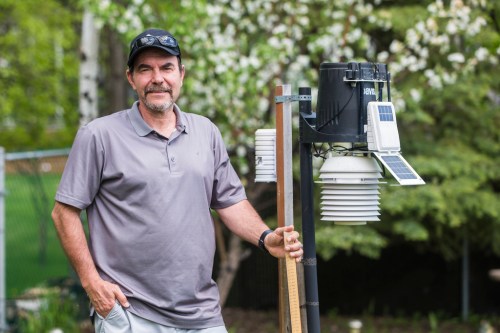
Paola possesses no super powers. He is but a man with a metre stick and 40 years of professional meteorological experience, in the midst of a lifelong love affair with Mother Nature, a most turbulent mistress who rarely, if ever, reciprocates.

Each year when snow begins to fall, Paola heads outside his Charleswood home to figure out how much. He sticks his ruler in the ground, grabs his clipboard, and clicks his pen. In neat script, he records the temperature, what time precipitation began, how deep the powder is stacked. Then, he shares his data and insights online with thousands of followers who want a clear answer to the eternal questions: Why is this happening? When will it stop? How much snow has fallen in the city of Winnipeg?

Read
Monday, Jun. 13, 2022

Security tightens at downtown library

Aldo Santin 5 minute read Preview

Security tightens at downtown library

Aldo Santin 5 minute read Saturday, Feb. 16, 2019

Users of the downtown Millennium Library will be subject to several new security screening measures, more commonly seen at airports and sporting facilities.

City hall announced Friday that effective Feb. 25, all visitors to the Donald Street library will undergo bag checks and be subjected to a hand-held metal detector sweep for alcohol and prohibited weapons. Visitors who refuse to participate will be barred from entering the library.

“The number of incidents (has) increased in the past four to five years, incidences involving violence, threats, alcohol, substance abuse and it was concerning. We met with police and our security contractor. After discussing, we came up with this course of action,” Ed Cuddy, manager of library services, told reporters. “We feel it’s a big change, but we feel it’s justified based on the kind of incidents we’ve been experiencing recently.”

Cuddy wouldn’t elaborate on the nature of the incidents, but did say library workers have not been the victims.

Read
Saturday, Feb. 16, 2019

Manitoba family adopts Ukrainian children just before Russian invasion

Chris Kitching 7 minute read Preview

Manitoba family adopts Ukrainian children just before Russian invasion

Chris Kitching 7 minute read Wednesday, Mar. 30, 2022

When Trish Braun sees horrific images of Russia’s attack on Ukraine, the Manitoba mother is thankful she had enough time to flee from the country with her three adopted children.

Other Canadian families weren’t as fortunate, as Ukraine halted intercountry adoptions due to the Kremlin’s unprovoked invasion and war.

“I’m so thankful we were able to get out, but lots (of Ukrainians) don’t have the option of getting to leave,” said Braun, who lives in Grunthal, about 50 kilometres southeast of Winnipeg. “It’s hard to adjust to life here while our hearts are over there.”

Just days before Russia began its assault, Braun was staying in the Odesa region with the three Ukrainian children — siblings Daniel, 16, Lewis, 10, and Paige, 6 — that she and her husband, Mike, 43, had adopted from an orphanage.

Read
Wednesday, Mar. 30, 2022

Science-art collaboration injects dose of emotion into cold, hard truths

Sarah Lawrynuik 5 minute read Preview

Science-art collaboration injects dose of emotion into cold, hard truths

Sarah Lawrynuik 5 minute read Wednesday, Apr. 28, 2021

Looking at spreadsheets and map plots of trees is far beyond Rhian Brynjolson’s typical day as a visual artist, but she became entranced and inspired by data collected by Canadian scientists for a new art project.

Her hope is to try and bring the numbers, map dots and statistics to life in a new way to help the public better connect to climate science.

Falcon Lake’s Brynjolson is one of 12 Canadian artists who participated in an art-science collaboration exhibit, co-ordinated by the Global Water Futures program out of the University of Saskatchewan. The project saw the artists paired with researchers and scientists across the country who then engaged in conversations to try to inspire a new angle to their art.

“The whole idea behind it is: water is life,” says Louise Arnal, the project lead, and a post-doctoral fellow at the Centre for Hydrology and Coldwater Laboratory.

Read
Wednesday, Apr. 28, 2021

Is Canada headed for time chaos this weekend?

Michelle Bastian 5 minute read 2:00 AM CDT

When Manitoba Premier Wab Kinew declared Sept. 17 that the province would remain on permanent daylight time, he suggested it was a historical moment people would share with their “great-great-grandkids.” But, while Sunday, Nov. 1 has been heralded as the date many Canadians will stop changing their clocks, there are rumblings behind the scenes suggesting this will actually cause more trouble than ever before.

There are, of course, the warnings from chrono-biologists and sleep scientists about the damage permanent daylight time will do. The lighter evenings will mean many more dark mornings. But there is another set of problems in the offing in the critical infrastructure that underpins our digital lives.

While it used to be common to spend the Sunday morning after a time change going around our homes updating the clocks, we now wake up to devices that have already adjusted to the new time. These automatic updates occur regularly for daylight time, as well as when we travel to new time zones.

Our clocks are able to change by themselves owing to the hard work of a group of volunteers who were recently named in a list of the people who hold up the internet. This group, led by Paul Eggert, a computer scientist at UCLA, maintains a little-known tool called the Time Zone Database. Since the 1980s, it has kept track of regional, national and international debates about clock time and provided an up-to-date table of what time it should be on our walls.