French film has no clue about what kind of mystery it is

Advertisement
Read this article for free:
or
Already have an account? Log in here »
To continue reading, please subscribe:
Digital Subscription
One year of digital access for only $1.44 a week*
- Enjoy unlimited reading on winnipegfreepress.com
- Read the E-Edition, our digital replica newspaper
- Access News Break, our award-winning app
- Play interactive puzzles
*Billed as $5.77 plus GST every four weeks. After 52 weeks, price increases to the regular rate of $19.95 plus GST every four weeks. Offer available to new and qualified returning subscribers only. Cancel any time.
To continue reading, please subscribe:
Add Free Press access to your Brandon Sun subscription for only an additional
$1 for the first 4 weeks*
- Enjoy unlimited reading on winnipegfreepress.com
- Read the E-Edition, our digital replica newspaper
- Access News Break, our award-winning app
- Play interactive puzzles
*Your next Brandon Sun subscription payment will increase by $1.00 and you will be charged $17.95 plus GST for four weeks. After four weeks, your payment will increase to $24.95 plus GST every four weeks.
Read unlimited articles for free today:
or
Already have an account? Log in here »
Hey there, time traveller!
This article was published 30/01/2026 (275 days ago), so information in it may no longer be current.
There are a “lot of loose ends,” worries one amateur sleuth midway through this elegant, intelligent but ultimately unsatisfying French film.
That’s a frustrating problem with A Private Life (in French with English subtitles). Filmmaker Rebecca Zlotowski (Other People’s Children) throws out intriguing ideas and sly cinematic riffs, but the narrative lines keep flying off in all directions.
By its anticlimactic conclusion, this would-be psychological thriller is held together only by the astonishing centrifugal force of star Jodie Foster.
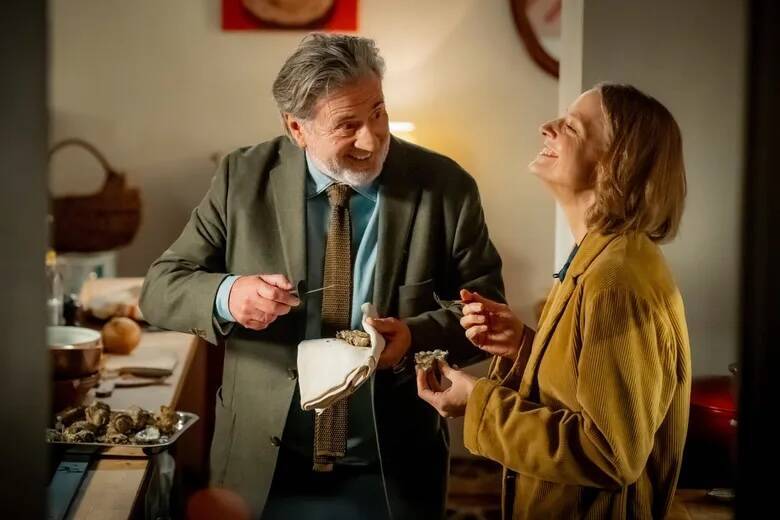
Netflix
Jodie Foster’s French is a highlight of A Private Life.
Foster plays Lilian Steiner, an American expatriate living in Paris and working as a psychoanalyst. (Foster speaks very good French, though her character falls back on English whenever she needs to swear.)
Lilian’s world is ordered, controlled and cool. In professional terms, she seems to have become bored with her patients and their issues. She records her sessions because she doesn’t trust herself to listen when the patients are actually in the room.
In her personal life, she has been divorced for many years from Gabriel (Caché’s Daniel Auteuil) and has a somewhat aloof relationship with their adult son Julien (Vincent Lacoste from HBO’s The Seduction). She’s even uninterested in her baby grandson. “He’s always sleeping,” she explains defensively to Julien.
Lilian is shaken out of this self-enclosed existence when she learns one of her patients, Paula (Elle’s Virginie Efira), has died by suicide.
After an ugly confrontation with Paula’s widower (Mathieu Amalric of The Diving Bell and the Butterfly), who blames Lilian for his wife’s death, Lilian begins to suspect that Paula was murdered. She starts her own investigation, dragging in the semi-reluctant Gabriel.
Watching Foster and Auteuil, two practiced actors, as their characters navigate an affectionate, abiding but clearly complicated relationship, is pure pleasure.
Lilian and Gabriel’s sleuthing, however, is hit-and-miss.
Zlotowski, who co-scripted with Anne Berest and Gaëlle Macé, can’t decide on an approach to their murder mystery. Sometimes the film is reaching for dark Hitchcockian suspense, and sometimes it feels like a light comic caper. And sometimes Lilian and Gabriel are just out-and-out Scooby-Dooing around.
The detective hijinkery leads to plot points that seem silly and preposterous in what is otherwise a talky, adult, very French film.
A Private Life works best as a character study of Lilian, who remains consistently compelling amidst the film’s narrative jumpiness and tonal confusion.
Lilian is so detached from her emotions that when she starts spontaneously weeping on the metro, she is convinced her tears are the result of an eye disorder rather than grief at Paula’s death.

At one point, Lilian meets up with her own former analyst (a wonderfully sly cameo by the noted 96-year-old American documentarian Frederick Wiseman), who suggests Lilian has thrown herself into a murder investigation because of her own unresolved guilt and suppressed emotions.
While the trope of the psychiatrist who has little insight into her own life and her own feelings might seem tired, the “physician, heal thyself” plotline is the best part of the film, thanks to Foster’s precise, underplayed and intensely watchable performance.
With her sharp, angular presence and her ability to convey layers of meaning with just a subtle vocal inflection or a small gesture, her work here reminds us that Foster is a star.
If only she had a better star vehicle.
winnipegfreepress.com/alisongillmor
Studying at the University of Winnipeg and later Toronto’s York University, Alison Gillmor planned to become an art historian. She ended up catching the journalism bug when she started as visual arts reviewer at the Winnipeg Free Press in 1992.
Our newsroom depends on a growing audience of readers to power our journalism. If you are not a paid reader, please consider becoming a subscriber.
Our newsroom depends on its audience of readers to power our journalism. Thank you for your support.
Movie review
A Private Life
Starring: Jodie Foster and Daniel Auteuil
● McGillivray
● 107 minutes, PG
★★★ out of five
Other voices
In America, it might be called a mess, and at times this movie sags, but overall, there’s something about it that holds interest. A Private Life is an odd ramble that eventually arrives somewhere.
— Mick LaSalle, San Francisco Chronicle
Foster and the rest of the cast are so good, I almost want to recommend that you go just for their performances. After all, it’s the journey, not the destination, that counts. That is, unless you’re making a murder mystery.
— Odie Henderson, Boston Globe
A Private Life pokes fun at the idea that the subconscious can be concretely interpreted, and intervened upon, for a fee that adds up to a middle-class life.
— Naveen Kumar, Washington Post
Studying at the University of Winnipeg and later Toronto’s York University, Alison Gillmor planned to become an art historian. She ended up catching the journalism bug when she started as visual arts reviewer at the Winnipeg Free Press in 1992.
Our newsroom depends on a growing audience of readers to power our journalism. If you are not a paid reader, please consider becoming a subscriber.
Our newsroom depends on its audience of readers to power our journalism. Thank you for your support.
Advertisement Advertise With Us
Advertisement Advertise With Us