Spielberg delivers his own origin story in personal film
Director looks back at the forces that shaped him in fictionalized biopic

Advertisement
Read this article for free:
or
Already have an account? Log in here »
To continue reading, please subscribe:
Digital Subscription
One year of digital access for only $1.44 a week*
- Enjoy unlimited reading on winnipegfreepress.com
- Read the E-Edition, our digital replica newspaper
- Access News Break, our award-winning app
- Play interactive puzzles
*Billed as $5.77 plus GST every four weeks. After 52 weeks, price increases to the regular rate of $19.95 plus GST every four weeks. Offer available to new and qualified returning subscribers only. Cancel any time.
To continue reading, please subscribe:
Add Free Press access to your Brandon Sun subscription for only an additional
$1 for the first 4 weeks*
- Enjoy unlimited reading on winnipegfreepress.com
- Read the E-Edition, our digital replica newspaper
- Access News Break, our award-winning app
- Play interactive puzzles
*Your next Brandon Sun subscription payment will increase by $1.00 and you will be charged $17.95 plus GST for four weeks. After four weeks, your payment will increase to $24.95 plus GST every four weeks.
Read unlimited articles for free today:
or
Already have an account? Log in here »
Hey there, time traveller!
This article was published 25/11/2022 (1436 days ago), so information in it may no longer be current.
Steven Spielberg is sometimes criticized for being too sentimental, too sappy. But as this “portrait of the filmmaker as a young man” suggests, his need for feel-good endings is rooted not in optimism but anxiety.
Spielberg’s filmography is full of distant fathers and abandoned children. In genres ranging from fairy tales to crime capers to adventure stories to sci-fi, he has been playing out his parents’ difficult marriage and traumatic divorce, which occurred when he was in his teens.
In this tender but surprisingly tough film, we finally see Spielberg’s family directly, through the eyes of Spielberg’s stand-in character, the young Sammy Fabelman (played as a child by Mateo Zoryan Francis-DeFord and as an adolescent by Gabriel LaBelle).
This is not a biopic, though. As the title hints, it’s a family fable.
Spielberg’s approach to the relationship between strict factuality and the stretchier truth of art is suggested by one crucial scene. When slightly disreputable Great-Uncle Boris shows up (memorably played by Judd Hirsch, with lots of Yiddish) and starts relating a tall tale about joining the circus, one of Sammy’s sisters accuses him of lying. He’s not lying, their father explains: “He’s telling you a story.”
As a director, Spielberg has always been a supreme visual storyteller. Here he works on the script as well, with frequent collaborator Tony Kushner. The writing is occasionally too neat, too obvious about the connections between the nascent filmmaker’s art and life. But it takes on a clear-eyed but compassionate complexity when looking at the Fabelman family’s emotional dynamics.
Sammy’s life as a filmmaker starts in 1952, when his parents take the five-year-old to see his first movie, Cecil B. DeMille’s The Greatest Show on Earth. Father Burt (Paul Dano), a brilliant engineer, explains to the boy about “24 frames per second” and “persistence of vision,” which allow a series of images to transform into moving pictures. His mother, Mitzi (Michelle Williams), a gifted musician who gave up performing to raise a family, tells him that “movies are dreams.”
Universal Pictures and Amblin Entertainment Sammy Fabelman (Mateo Zoryan Francis-DeFord) is inspired to make films in part to give him control over his anxiety.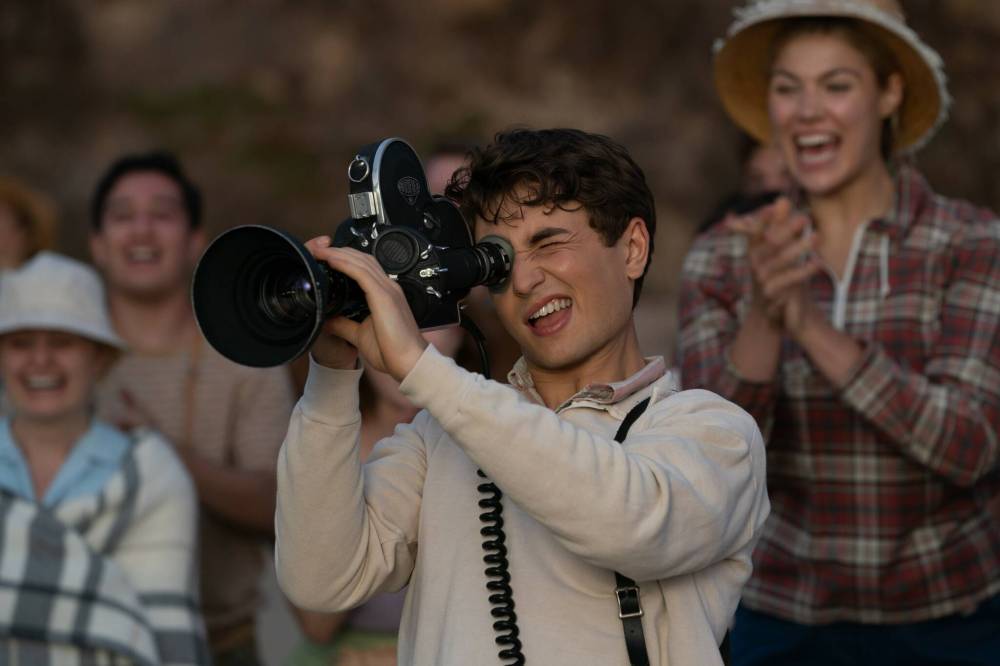
This sets up a science-vs.-art showdown that resounds through Burt and Mitzi’s marriage. Burt, whom Dano plays with quiet poignance, is devoted and dependable but a little preoccupied and stiff. Mitzi, played by Williams at her most radiant and vulnerable, is fun and imaginative but unpredictable, sometimes recklessly so.
Watching The Greatest Show on Earth, little Sammy is mesmerized but also traumatized by the movie’s spectacular train crash. Back at home, his fears cause him to repeatedly crash his model train set — at least until Mitzi has the idea of letting Sammy film the toy train disaster, which allows the boy to re-enact and thus control his anxieties.
We soon see how Sammy keeps his camera between himself and his emotions, observing but not participating, managing his world by managing its image. As he heads into adolescence and the family moves from Cleveland to Phoenix and then northern California, it’s not train crashes that worry him but his parents’ troubled relationship, and in particular the way it’s affected by ever-present family friend Benny (Seth Rogen).
When everyone goes on a family camping trip, Sammy finds his camera is picking up difficult truths about Burt and Mitzi’s marriage.
Universal Pictures and Amblin Entertainment Great-Uncle Boris (Judd Hirsch, right) spins a yarn to teenage Sammy Fabelman (Gabriel LaBelle).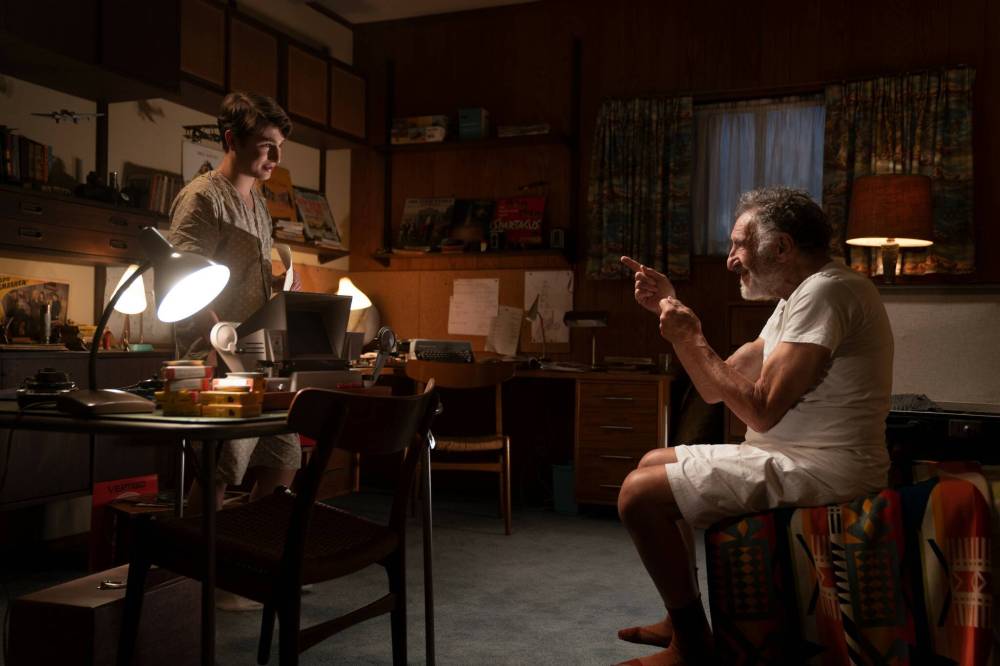
There’s an exuberant, gee-whiz joyfulness to other movie scenes, in which Sammy collaborates with his scout troop to create westerns and war movies, rigging up fake explosions and spectacular falls from cliffs. Later, when he’s seemingly the only Jewish kid in his new neighbourhood, Sammy uses film to get revenge on antisemitic high school bullies, shooting a particularly thuggish blond giant like he’s in Leni Riefenstahl’s Olympia.
Spielberg’s technical craft is predictably assured — it looks like he was already pretty good as a middle-schooler — and the performances pulse with emotion. The writing sometimes falters, punching thematic points too hard or fumbling the overall tone. But there are brilliant standalone scenes, from astonishing moments with Williams and Dano to a wonderfully eccentric cameo by David Lynch as film legend John Ford.
The Fablemans works as a moving coming-of-age drama, as a detailed picture of America at mid-century, and as an expression of Spielberg’s pure love of cinema. It’s about art’s possibilities and its price, and ultimately, it’s about forgiveness, for the filmmaker’s parents and for himself.
alison.gillmor@freepress.mb.ca
Related Articles
Berlin film fest gives Spielberg lifetime achievement award


Studying at the University of Winnipeg and later Toronto’s York University, Alison Gillmor planned to become an art historian. She ended up catching the journalism bug when she started as visual arts reviewer at the Winnipeg Free Press in 1992.
Our newsroom depends on a growing audience of readers to power our journalism. If you are not a paid reader, please consider becoming a subscriber.
Our newsroom depends on its audience of readers to power our journalism. Thank you for your support.
Movie Review
The Fabelmans
Starring Michelle Williams, Paul Dano and Gabriel LaBelle
● Polo Park
● 151 minutes, PG
★★★★ out of five
Other voices
This filmmaker has earned the right to make a movie about why he makes movies the way he does. And with Williams and Dano, especially, he gets performances that can match the technique.
— Michael Phillips, Chicago Tribune
Still operating at the top of his game, Fabelmans all but guarantees there’s more great work to come from him.
— Chris Hewitt, Minneapolis Star Tribune
The Fabelmans is entertaining enough, but perhaps what’s best about it is that Spielberg got it out of his system. After this, he won’t ever need to make a film about himself or his parents again.
— Mick LaSalle, San Francisco Chronicle
The Fabelmans does it all, with an expansive spirit and that quintessential Spielbergian combination of honesty and sentiment.
— Ann Hornaday, Washington Post
If it all feels a little sanitized and idealized, it’s also consistently lovely — and after 75 years and 34 films, who more than Spielberg has earned the right to revisit his stardust memories?
— Leah Greenblatt, Entertainment Weekly
A uniquely confessional work, in which a great artist freely and happily acknowledges the manipulation inherent in the art form he was born to master.
— Justin Chang, Los Angeles Times
Bring out the Oscars for the year’s best movie, a personal best from Steven Spielberg about his own coming of age as a teen torn between his love for movies and family (Michelle Williams is incandescent as his troubled mom). You won’t forget this classic.
—Peter Travers, ABC News
The Fabelmans may look nice ’n’ easy as it swings along, with a pile of laughs to cushion the ride, and a nifty visual gag in the closing seconds, but take care. Here is a film that is touched with the madness of love.
— Anthony Lane, New Yorker
A love letter from director Steven Spielberg to the people and the art form that made him who he is.
— Rafer Guzman, Newsday
Studying at the University of Winnipeg and later Toronto’s York University, Alison Gillmor planned to become an art historian. She ended up catching the journalism bug when she started as visual arts reviewer at the Winnipeg Free Press in 1992.
Our newsroom depends on a growing audience of readers to power our journalism. If you are not a paid reader, please consider becoming a subscriber.
Our newsroom depends on its audience of readers to power our journalism. Thank you for your support.
Advertisement Advertise With Us
Advertisement Advertise With Us