The quiet power — and necessity — of Oseredok
Advertisement
Read this article for free:
or
Already have an account? Log in here »
To continue reading, please subscribe:

Digital Subscription
One year of digital access for only $205*
- Enjoy unlimited reading on winnipegfreepress.com
- Read the E-Edition, our digital replica newspaper
- Access News Break, our award-winning app
- Play interactive puzzles
*First annual payment billed as $205.00 + GST for one year. This annual subscription will automatically renew at $233.00 + GST every 52 weeks (10% off the regular annual price of $259.35). Offer available to new and qualified returning subscribers only. Cancel any time.
To continue reading, please subscribe:
Add Free Press access to your Brandon Sun subscription for only an additional
$1 for the first 4 weeks*
- Enjoy unlimited reading on winnipegfreepress.com
- Read the E-Edition, our digital replica newspaper
- Access News Break, our award-winning app
- Play interactive puzzles
*Your next Brandon Sun subscription payment will increase by $1.00 and you will be charged $17.95 plus GST for four weeks. After four weeks, your payment will increase to $24.95 plus GST every four weeks.
Read unlimited articles for free today:
or
Already have an account? Log in here »
At a moment when Ukraine sits at the centre of global political attention, one of North America’s most important Ukrainian cultural institutions continues to operate quietly in Winnipeg’s Exchange District.
For many Winnipeggers, Oseredok remains one of the city’s hidden treasures — preserving an extraordinary collection of Ukrainian and Ukrainian-Canadian art, artifacts and archives within its five-storey building on Alexander Avenue.
Originally constructed in 1912 as the British and Foreign Bible Society Building and designed by Winnipeg architect William Bruce, the structure itself reflects layers of immigration, faith and history embedded within the city.
James Verscheure / Submitted
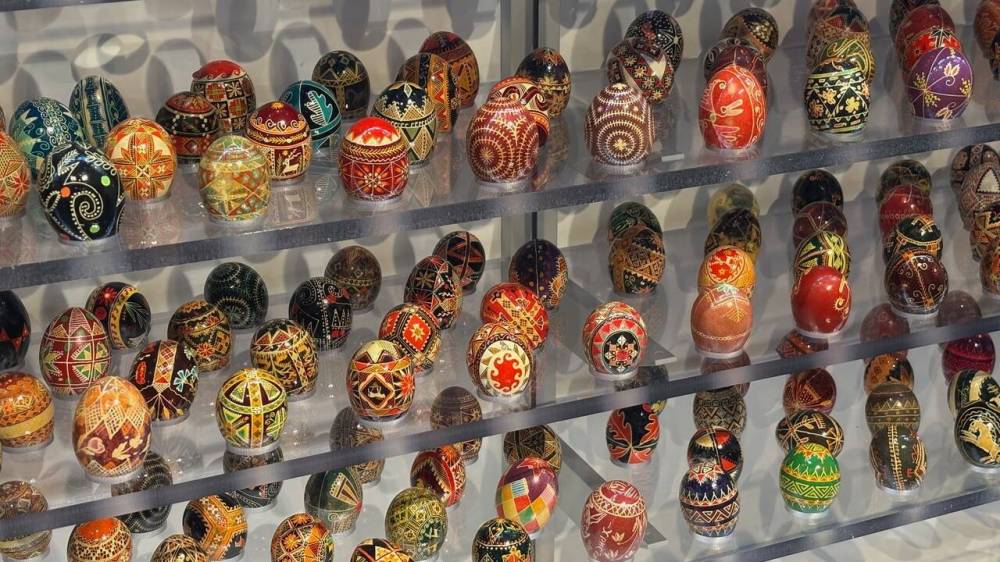
The pysanky (decorated egg) collection at Oseredok is the largest of its kind outside of Ukraine.
Yet few people fully understand its scale and significance.
Founded in 1944 by the Ukrainian Canadian community, the Ukrainian Cultural and Educational Centre, known as Oseredok, is not simply a museum. It is a museum, art gallery, archive and research library — four institutions operating together under one roof.
Its collections include more than 30,000 artifacts, nearly 1,000 works of art, thousands of rare books and research materials and one of the richest repositories of Ukrainian archival material anywhere on the continent. It also houses the largest pysanky (decorated eggs) collection outside Ukraine.
As someone who has spent much of my professional life working in museums and galleries across Canada and the United States, I can say confidently that organizations of this breadth and complexity are rare — particularly those sustained through volunteer effort and collective commitment.
For decades, volunteers alongside a small professional staff have sustained the organization through exhibitions, archives, fundraising, education and public engagement.
But Oseredok’s story is also the story of a much broader network that shaped Ukrainian Canadian life across the Prairies.
Churches, schools, businesses, credit unions, foundations and cultural associations all helped build the infrastructure that allowed a language, history and identity to flourish in Canada.
The centre itself emerged from a larger history of migration, displacement and cultural preservation.
Founded during the Second World War by members of Winnipeg’s Ukrainian community, Oseredok became both a cultural home and a safeguard for Ukrainian memory in the diaspora.
Closely tied to its early history was the celebrated conductor Olexander Koshetz, whose internationally renowned choir introduced Ukrainian music to audiences around the world. After his death in Winnipeg in 1944, his wife Tetiana Koshetz helped shape Oseredok’s early archival and cultural mission. Nearly 80 years later, the O. Koshetz Choir remains part of that living legacy in Winnipeg.
Too often, organizations like Oseredok are treated as cultural extras rather than civic necessities. In reality, they are part of the civic infrastructure of a democratic society, helping preserve memory and foster belonging.
The centre’s location within Winnipeg’s historic East Exchange District is also significant.
For generations, this neighbourhood has been shaped by immigration, commerce, architecture and public life. Within that urban landscape, Oseredok remains an enduring anchor contributing to the identity and vitality of downtown Winnipeg.
Winnipeg frequently speaks about economic growth, while too often overlooking the cultural organizations that make urban life meaningful in the first place.
In an era when “community engagement” is often reduced to abstract, institutional language, Oseredok offers something much more tangible.
It demonstrates what people can build collectively when they believe history, language and memory are worth protecting. At a time of growing polarization and historical disconnection, places like Oseredok matter more than ever.
The war in Ukraine has reshaped how many people understand Ukrainian history and identity. Here in Winnipeg — home to one of the largest Ukrainian-Canadian populations in the country — Oseredok has become increasingly important not only as a repository of history, but as a place helping newcomers, families, students and the broader public better understand Ukrainian experience and culture.
Today, the organization offers classes, lectures, research access and public programs.
At Oseredok, those encounters can happen through something as monumental as a centuries-old archive or as intimate as a pysanka, a handwritten letter, an embroidered shirt or a family photograph.
These objects tell stories of migration and continuity. They remind us that the history of Ukrainians in Canada is not peripheral to the Canadian story — it is woven directly into it.
The collections encompass fine art, archives, literature, music and material culture. Oseredok is historical and contemporary, scholarly yet accessible, deeply local while connected to an international story.
And like many grassroots heritage organizations across Canada, it operates quietly — sustained through determination, volunteerism, modest resources and an enduring belief that cultural stewardship matters.
Archives, museums and libraries safeguard evidence, language and identity during periods of conflict and instability. In modern warfare, the destruction of culture is rarely accidental. Monuments are destroyed because identity itself becomes part of the battlefield.
Recently, through Civic Muse, I began serving as interim executive leader for Oseredok. I have increasingly sought opportunities to work with organizations that are not only culturally significant, but civically important.
Leading Oseredok at this moment feels especially meaningful.
For me, this work is also deeply personal. My paternal great-grandparents arrived in Canada from Galicia — then part of the Austro-Hungarian Empire — in 1903 as part of the first major wave of Ukrainian immigration to the Prairies.
They settled in Winnipeg and helped build the foundations that allowed Ukrainian traditions and identity to flourish in Canada. Organizations like Oseredok exist because generations of immigrant families believed culture required stewardship, organization, sacrifice and collective effort.
At a time shaped by war, political polarization, migration and renewed global struggles over identity and democracy, places like this matter profoundly.
They preserve more than artifacts and archives. They preserve empathy, continuity and our capacity to recognize ourselves in one another.

Art helps us encounter histories and experiences we may never otherwise fully understand.
In increasingly fragmented societies, places that preserve shared memory and foster genuine human encounter are no longer marginal. They are essential.
At their very best, organizations like Oseredok remind us that culture is not static or inherited automatically. It survives because people choose — generation after generation — to protect it and carry it forward.
And for Winnipeg, Canada and the Ukrainian community, that work may be more important now than at any point in recent memory.
Stephen Borys is president and CEO of Civic Muse, and former director and CEO of the Winnipeg Art Gallery–Qaumajuq.