

Qualified success
The second time around, merely setting foot on a World Cup pitch won’t be enough for this Canadian men’s national team
Advertisement
Read this article for free:
or
Already have an account? Log in here »
To continue reading, please subscribe:

Digital Subscription
One year of digital access for only $205*
- Enjoy unlimited reading on winnipegfreepress.com
- Read the E-Edition, our digital replica newspaper
- Access News Break, our award-winning app
- Play interactive puzzles
*First annual payment billed as $205.00 + GST for one year. This annual subscription will automatically renew at $233.00 + GST every 52 weeks (10% off the regular annual price of $259.35). Offer available to new and qualified returning subscribers only. Cancel any time.
To continue reading, please subscribe:
Add Free Press access to your Brandon Sun subscription for only an additional
$1 for the first 4 weeks*
- Enjoy unlimited reading on winnipegfreepress.com
- Read the E-Edition, our digital replica newspaper
- Access News Break, our award-winning app
- Play interactive puzzles
*Your next Brandon Sun subscription payment will increase by $1.00 and you will be charged $17.95 plus GST for four weeks. After four weeks, your payment will increase to $24.95 plus GST every four weeks.
Read unlimited articles for free today:
or
Already have an account? Log in here »
Hey there, time traveller!
This article was published 17/11/2022 (1363 days ago), so information in it may no longer be current.
In the summer of 1986, I was a Canadian women’s national soccer team player and I had a gig running a rickshaw with passengers through the streets of Toronto. The FIFA World Cup in Mexico was barely a headline at home in those days, but I knew our men’s team was playing.
I decorated the rickshaw with a Maple Leaf-adorned beach ball bouncing off the back, trotted up and down Yonge Street making some cash, and then hunted for a bar willing to show the game on television.
It was a difficult task.
Darryl Dyck / THE CANADIAN PRESS FILES
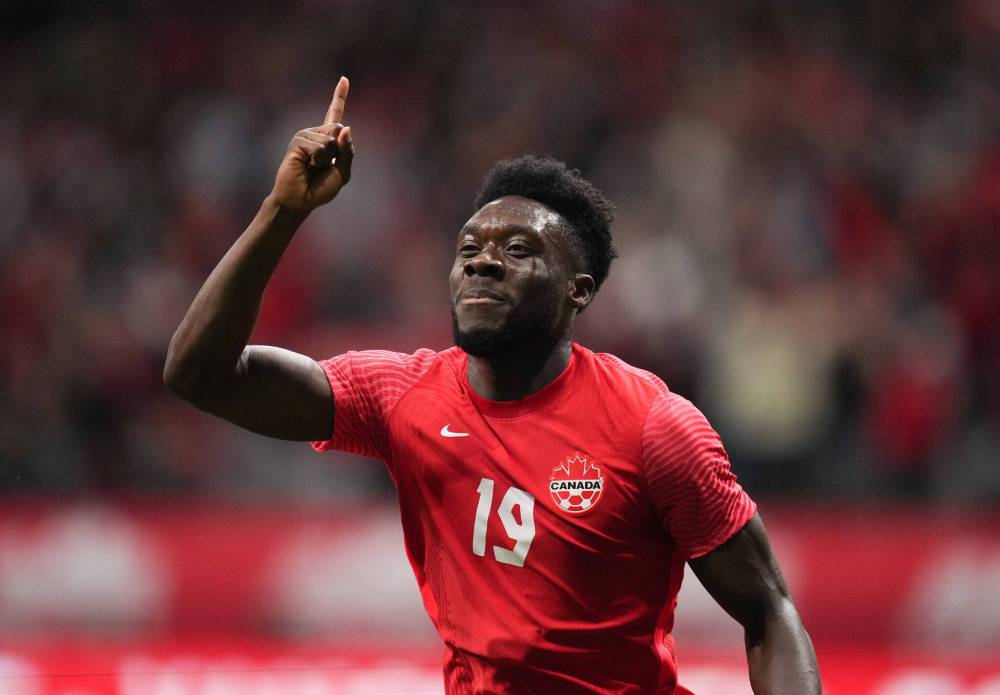
Unlike the Canadian men’s national team’s only previous appearance at the World Cup in 1986, the squad can now boast a global superstar in Alphonso Davies.
Barely a soul knew about the World Cup and Canada’s participation. I found an empty, dark pub on Queen Street, parked my rickshaw outside, and cheered for a team that had 1,000-to-one odds against them scoring a goal in the tournament. Vegas was correct. Canada lost all of their matches with zeros on the game sheet.
Thirty-six long, torturous years later for anyone who dared to care about the Canadian national men’s team has finally qualified again for the most prestigious sporting event on the planet. But boy is it a different world.
A perfect storm of success has been brewing for decades in our backyards: mass numbers of youth players, three Canadian teams now competing in Major League Soccer, a large influx of immigrants who already live and breathe the beautiful game, and a FIFA marketing machine that blasts our screens every four years.
We are a very different Canada. We have hosted a U19 FIFA men’s tournament and a Women’s World Cup. We have won Olympic gold. We will share the big dance as co-hosts with the U.S. and Mexico in 2026. We are now a knowledgeable people when it comes to the sport, with generations of folks who follow the English Premier League or play FIFA EA video games and wear uniforms with Ronaldo, Messi and Sinclair on their backs. Now it is Alphonso Davies.
A talented squad has burst onto the scene, shocking opponents with the attacking prowess, flair and biting grit that dominated CONCACAF qualifications. (CONCACAF is Canada’s World Cup qualifying confederation, which includes North American, Central American and Caribbean nations.) Led by magnetic and inspiring manager John Herdman, the Canadian men’s team is the story of the year. The improbable became possible.
It still seems hard to believe, but the FIFA World Cup in Qatar has Canada on the ticket and their odds are much superior than they were in ’86. Games against Belgium, Croatia and Morocco are on the horizon. We will soon see how far heart and soul will take the team.
As a former player, I fell in love with the FIFA World Cup in 1990. I was playing in Paris and I scored a ticket from my friend at the French Football Federation to the quarterfinal match in Rome between Italy and Ireland. Walking into the Stadio Olimpico with 73,000 electric fans who loved soccer as much as, or more, than I did completely blew my mind. So, I kept going back: to the U.S. in ’94, France in ’98, Japan in 2002, Germany in 2006, South Africa in 2010, Brazil in 2014 and Russia four years ago. I went to all of these World Cups, but not once could I ever cheer for my own country: Canada. We are a growing soccer nation, but many of us have never been able to root for our men at the World Cup.
We performed genetic forensics, searching for connections to faraway countries, maybe Italian, Swedish or Brazilian blood, or a great aunt living in Britain. But it has always felt a bit hollow to sport an Argentina jersey when you don’t even understand a sentence in Spanish.
When streets throughout France were stormed with gleeful fans waving the “tricolore” after a World Cup victory, we knew that could never be us. We couldn’t even qualify.
I know I gave up. I stopped watching the men’s team a long time ago. It felt bitter.
But now to my own surprise, I am packing my luggage and heading to Qatar with a Canada scarf and team uniform in the mix. Maybe I should get face paint — I have never done that before.
In fact, for the past three months, I have been in daily online conversations with Canadian fans who’ll be travelling to Doha. We have been sharing information on accommodation, stadiums, ticket exchanges, jerseys, flags, flights, airport strikes and COVID requirements. Someone knows a bit about the dress codes, weather and entertainment; others have expertise with bank cards, SIM cards and the Hayya pass that gets you access into the country and free transportation.
We are figuring out cheers, potential camel rides, dune-bashing safaris, parties and where to buy alcohol. There has been a lot of research on booze. Beers are apparently $19. Some supporters will be living on a cruise ship, while others will be in cargo containers, $1,500-a-night hotels in elite Doha districts, or barrack-type quarters with thousands of fans on their doorstep. Canada House is hosting a party for $250 a pop prior to matches and plans to parade to stadiums are in the works.
FIFA Fan Festival zones, one as long as six kilometres at the Al Bidda Park along the Doha Corniche coastline, will feature mega-sized viewing screens and stages and will play host to over 100 global entertainment stars. Tens of thousands of fans will have access to football pitches, fun activities, beer tents, and local culinary and cultural experiences.
Michael Creagan / THE CANADIAN PRESS FILES
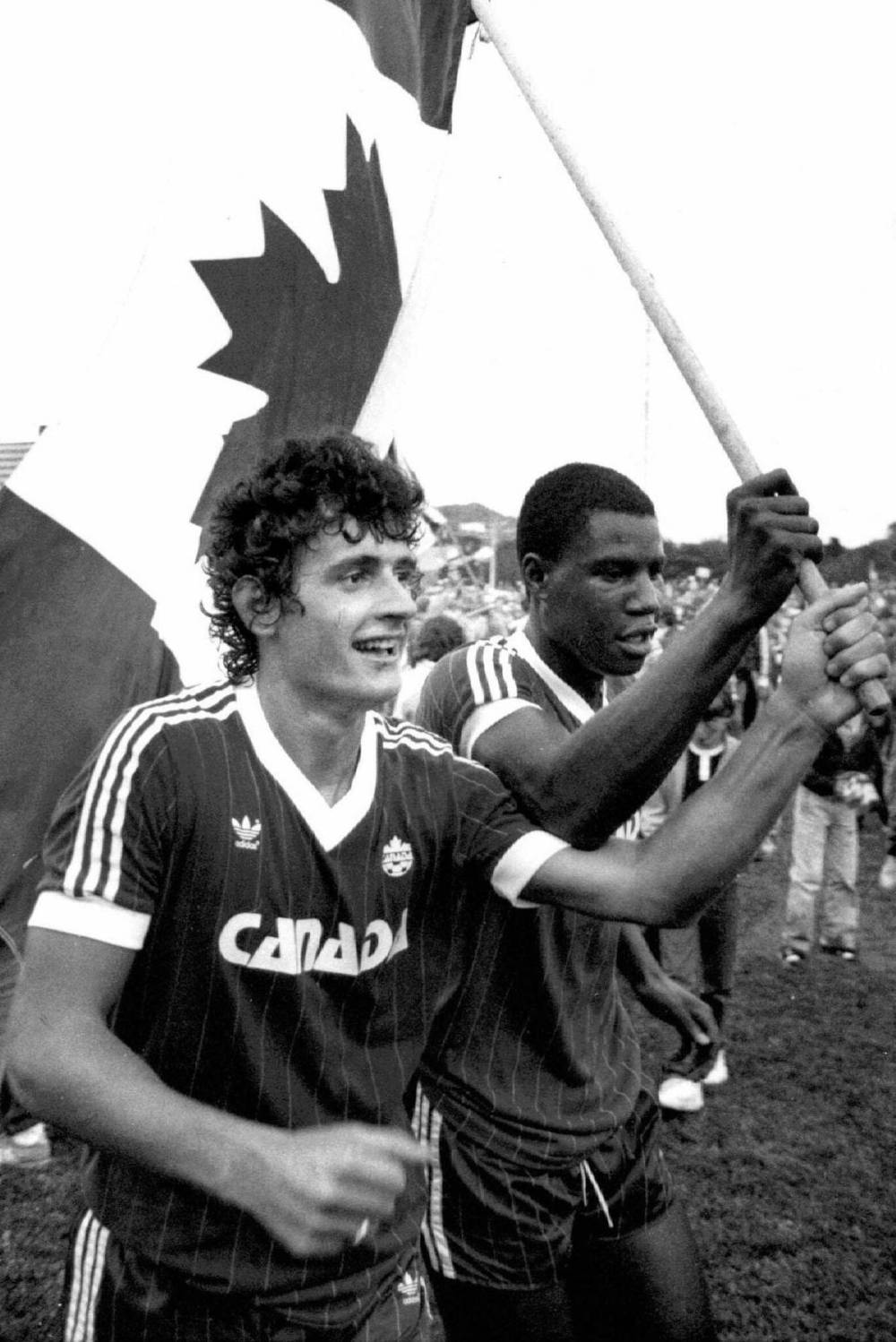
Canadian national soccer team players Paul James (left) and Randy Samuel celebrate after a World Cup qualifying victory in 1985. When the team played in the 1986 World Cup in Mexico, few Canadians knew (or even cared) that their nation had qualified.
FIFA just announced that police plan to be tolerant to foreigners, so tipsy revellers chanting and jumping on public benches and statues won’t be thrown in the slammer. Rainbow flags, queer kisses and sex outside of marriage, a taboo that might cost you your life during normal times, will be ignored, at least so far.
It’s a weird place to host a World Cup, but the Middle East deserves to have the opportunity, too. Millions and millions of fans across the region absolutely adore the sport, but where else could it be: Syria, Iran, Iraq, Egypt, Israel, Turkey, Saudi Arabia? Qatar is the wealthiest country in the vicinity, rich from natural gas. Apparently, it is safe.
We all know it was bought. We all know it is corrupt. We know there was senseless harm done building eight stadiums within a 55-km radius of Doha. Celebrations will be done on the backs of others.
When fans travel from all over the globe to Canada, the U.S. and Mexico in 2026, we will be exposed, too.
But the World Cup is also one of the greatest peace movements of our lifetime. Countries from around the globe compete against one another in their regions for two years, just to qualify. It brings people together. It inspires a game that requires fitness, intense skill, teamwork and sportsmanship — a far cry from the war machines and conflict that also dominate many of our nations. We will be reminded of this joy again when the whistle blows and Qatar kicks off the tournament against Ecuador this weekend.

My online Canada fans have met a few times in person in Vancouver to gleefully discuss details. Everyone is excited and nervous. Others have gathered in pubs in Toronto and Edmonton. It has been wonderful. Even though I could get a free media ticket, I am much happier to pay $300 or 810 Qatari Rial to sit in Category 1 seats with alumni and families behind the Canadian team’s bench. There is a shared feeling of elation.
It is much better than the lonely bar on Queen Street back in ’86, when no one even knew we were playing.
This is the start of a new generation of soccer in Canada. It is a chance to feel proud, hopeful and excited for the future. It is a chance to wear our Maple Leaf.
For many it has taken a lifetime.
Carrie Serwetnyk is a former Canadian national team member and first woman inducted in the Canadian Soccer Hall of Fame. She will be in Qatar sharing the World Cup experience.
Related Articles
Next-level opposition awaits Canada's World Cup team in Qatar

Advertisement Advertise With Us
Advertisement Advertise With Us