End of vaccine mandates poised to widen travel floodgates, despite doubts for some

Advertisement

Advertise with us

Starting next week, passengers no longer need to be fully vaccinated to board a plane or train in Canada, leading to forecasts of further travel surges — and congested airports.

Read this article for free:


By clicking the button above, an account will be created and you will begin to receive some of our recommended newsletters. You may opt out of any newsletter by visiting your Email and Communication Preferences page or by clicking "unsubscribe" at the bottom of any email.

or

Already have an account? Log in here »

To continue reading, please subscribe:

Digital Subscription

One year of digital access for only $1.44 a week*

  • Enjoy unlimited reading on winnipegfreepress.com
  • Read the E-Edition, our digital replica newspaper
  • Access News Break, our award-winning app
  • Play interactive puzzles

*Billed as $5.77 plus GST every four weeks. After 52 weeks, price increases to the regular rate of $19.95 plus GST every four weeks. Offer available to new and qualified returning subscribers only. Cancel any time.

To continue reading, please subscribe:

Add Free Press access to your Brandon Sun subscription for only an additional

$1 for the first 4 weeks*

  • Enjoy unlimited reading on winnipegfreepress.com
  • Read the E-Edition, our digital replica newspaper
  • Access News Break, our award-winning app
  • Play interactive puzzles
Start now

*Your next Brandon Sun subscription payment will increase by $1.00 and you will be charged $17.95 plus GST for four weeks. After four weeks, your payment will increase to $24.95 plus GST every four weeks.

Hey there, time traveller!
This article was published 14/06/2022 (1600 days ago), so information in it may no longer be current.

Starting next week, passengers no longer need to be fully vaccinated to board a plane or train in Canada, leading to forecasts of further travel surges — and congested airports.

The federal government announced Tuesday it will scrap vaccine mandates for domestic and outbound passengers, effective Monday. The move will also lift vaccination requirements for federally regulated workers, allowing airline and airport employees on unpaid leave to go back on the job and ease the labour crunch behind long security and customs queues.

Richard Vanderlubbe, CEO of travel agency Tripcentral.ca, said he expects demand for vacation packages to rise by 10 per cent due to the move, which could vault his business close to 2019 customer levels.
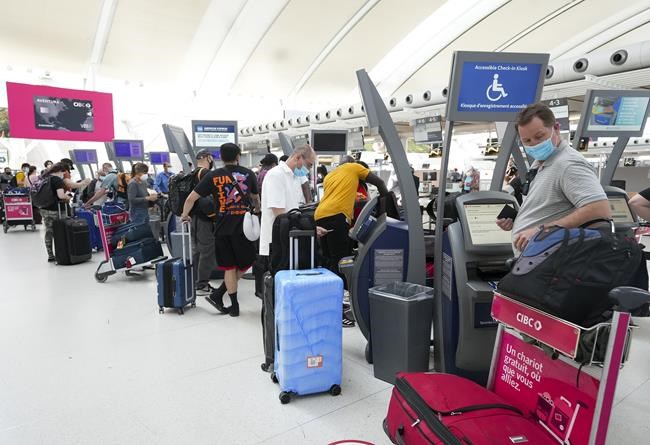
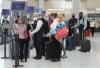
People wait in line to check in at Pearson International Airport in Toronto on Thursday, May 12, 2022. THE CANADIAN PRESS/Nathan Denette

“Canada’s one of the last places if not the only place that has this rule,” he said in an interview, arguing that “fear of the unvaccinated” is fading.

Nonetheless, a small segment of Canadians may be more reluctant than ever to get on a plane or train, given their neighbouring passengers or nearby workers may never have been jabbed, Vanderlubbe said.

“There still are some people sitting on the sidelines … the ones that are really cautious,” he said. “But as things improve in restaurants and gyms and workplaces, perhaps people get more confidence.”

Masks will still be required on board, and full vaccination remains mandatory for foreigners entering Canada, federal ministers said at an Ottawa news conference.

Dr. Zain Chagla, an infectious diseases physician at St. Joseph’s hospital in Hamilton, Ont., says vaccine mandates have outworn their purpose and fallen out of step with provincial guidelines that allow mass gatherings at sports and entertainment events.

Chief public health officer Dr. Theresa Tam has said cabinet should re-evaluate vaccination measures given that vaccines now provide less protection against transmission. And public health officials have said repeatedly since the Omicron variant hit in late 2021 that the virus was more adept at transmitting between vaccinated people than its predecessors.

Tuesday’s announcement came after Ottawa paused randomized COVID-19 testing of vaccinated passengers, starting last Saturday through at least June 30, following industry demands to process travellers more quickly. It also comes after the U.S. nixed its rule that all travellers entering the country present a negative test.

Kelly McDonagh, a 52-year-old Toronto-area resident, said the end of travel vaccine mandates would not discourage her from hopping on a plane.

“I think you have to live life. You still have to take precautions but continue to enjoy yourself,” she said.

The only deterrent might be her “unacceptable” travel experience Monday, when her flight from Chicago to Toronto’s Pearson airport was delayed nearly three hours before being cancelled.

McDonaugh managed to book herself on an evening flight, paying a second fare. Had she waited for Air Canada to rebook her like most of her fellow travellers, she would have returned on a 9 a.m. flight the next day with a four-hour layover in Connecticut, she said.

“Other people were in much more dire situations. They had connecting flights, they had to get home for work, they had to pick up kids. So people were really upset,” she said. “It’s getting out of hand.”

The government’s decision to cut steps that confirm vaccination status at the departures area will speed up the flow of passengers headed out of the country, said Marty Firestone, president of insurer Travel Secure. But the surge in domestic travel could be hard to for security screeners to handle.

“A huge uptick should happen immediately,” he said.

The millions of Canadians who remain unvaccinated may be less eager to travel abroad, since some countries — like Canada — require that foreigners be jabbed to enter, and they would have to self-isolate upon return.

“That 14-day quarantine is just not feasible for them,” said Wendy Paradis, president of the Association of Canadian Travel Agencies.

Canadians’ biggest travel destination remains Canada itself.

“With the summer season in front of us, the ability to travel across Canada is actually very significant for unvaccinated Canadians,” Paradis said.

“We always find that there is a certain amount of the Canadian public who are more safety-conscious, that it does take them longer to be comfortable travelling. But for the vast majority of Canadians, the easing of these mandates is only good news for them,” she said.

The National Airlines Council of Canada called Ottawa’s latest announcement an “important milestone,” but pushed for more rollbacks.

The trade group is demanding the government end the vaccine mandate for inbound travellers — in step with more than 100 countries — streamline the ArriveCan app to expedite customs processing and make the pause on randomized COVID-19 testing at airports permanent.

Treasury Board President Mona Fortier told reporters Tuesday reverting to vaccine mandates in the fall remains a possibility.

This report by The Canadian Press was first published June 14, 2022.
Report Error Submit a Tip

More Stories

The new normal in Canadian politics

David McLaughlin 5 minute read Preview

The new normal in Canadian politics

David McLaughlin 5 minute read 2:01 AM CDT

“Nothing happening, all at once.”

Welcome to the new normal of Canadian politics, where normality is the new normal. Routine and stable are in; disruptive and excessive are out. Exhibits A and B are the Alberta referendum and the British Columbia election. Voters opted for stability over volatility.

The opposite of being normal is being different from the norm. In politics that means different from where we’ve been and what we’ve come to expect. Two competing trends have dominated our politics for the past decade and a half — progressivism and populism. Think Justin Trudeau and liberal, progressive identity politics in Canada, and Donald Trump and conservative, populist MAGA politics in America. We are now experiencing a swing away from both those trends.

Representing this “new normal” are Prime Minister Mark Carney, for one, and newly elected British Columbia premier, Lorne Doerksen, for another. Both are considered normal because they talk and act like adults in a childish political world. Their political flair is to not have any political flair. They stand out for not standing out.

Read
2:01 AM CDT

Walkout creates chaos at St. James Smitty’s

Morgan Modjeski 3 minute read Preview

Walkout creates chaos at St. James Smitty’s

Morgan Modjeski 3 minute read 2:01 AM CDT

Gordon Sharpe wanted to eat a meal at the St. James Smitty’s Wednesday, but he got a helping of bad news instead.

He saw several workers walk out of the restaurant, at 1017 St. James St.

“(The waiter) came back about 10 minutes later and stood over the table, looking a little distraught and said, ‘I’m quitting right now and so is everybody else,’” Sharpe said. “He said, ‘This is my last time serving you,’ and he was quite choked up.”

“I’ve never seen anything like it,” he said, adding that the managers scrambled to serve patrons.

Read
2:01 AM CDT

Teemu Selanne living the good life in southern California

Mike McIntyre 19 minute read Preview

Teemu Selanne living the good life in southern California

Mike McIntyre 19 minute read Friday, Oct. 15, 2021

LAGUNA BEACH — He likes his coffee black. His steak “medium rare plus.” And he’s an extremely generous pour, especially when it comes to a Moscow mule.

His left knee is giving him all sorts of trouble these days, he’s admittedly almost always running behind schedule and his biggest pride and joy are his four children, who keep him and his wife Sirpa hopping with their numerous athletic pursuits.

He is Teemu Selanne, the beloved Winnipeg Jets legend who, you’ll be happy to know, is still living the good life just a stone’s throw from the Pacific Ocean in this little piece of southern California paradise.

Despite being nearly eight years removed from the end of a Hall of Fame hockey career, the Finnish Flash remains a big deal around here. That was clear as we sat down earlier this week for an exclusive chat inside “Selanne’s Steak Tavern” — a high-end eatery he owns that sits along the stunning Pacific Coast Highway.

Read
Friday, Oct. 15, 2021

Industry minister to meet Rogers CEO after outage

Tyler Griffin, The Canadian Press 4 minute read Preview

Industry minister to meet Rogers CEO after outage

Tyler Griffin, The Canadian Press 4 minute read Sunday, Jul. 10, 2022

TORONTO - Canada's industry minister will convene a meeting with the leader of Rogers Communications in the wake of a massive outage that paralyzed the company's network and hampered several crucial services, his office announced on Sunday, even as some customers continued to report service disruptions.

A statement released from the office of François-Philippe Champagne said he plans to meet with Tony Staffieri and other telecom leaders to discuss the importance of improving "the reliability of networks across Canada."

The statement said Champagne found last week's widespread service disruption — which lasted at least 15 hours and knocked out access to numerous law enforcement, health care and banking services — "unacceptable," adding he has expressed that view directly to Staffieri.

"These services are vitally important for Canadians in their day to day life and we expect our telecom industry to meet the highest standards that Canadians rightly deserve," the statement read.

Read
Sunday, Jul. 10, 2022

The long and winding road

Editorial 4 minute read Preview

The long and winding road

Editorial 4 minute read 2:01 AM CDT

As theatre goes, it sent a strong message.

Manitoba Premier Wab Kinew, standing in front of microphones and television cameras, holding up his Indigenous status card and saying that he didn’t feel Canada should have “a race-based form of identification in this country, but that is a reality,” adding that it was time to abolish the Indian Act.

“I think it’s time to abolish the Indian Act, get rid of the Indian Act, move past the Indian Act, and it needs to be done with First Nations people and First Nations governments, of course. I think it’s long overdue that we have a relationship with Indigenous Peoples in Canada that reflects who we are as Canadians today,” he said.

The Indian Act — the name alone suggests how out-dated and out of place the law has become. Originally dating from 1876, the law was put in place to “amend and consolidate the laws respecting Indians” and gave the Minister of the Interior the responsibility to “control and management of the reserves, lands, moneys and property of Indians in Canada.”

Read
2:01 AM CDT

Actor-director Cooper takes new approach to familiar tale

Randall King 4 minute read Preview

Actor-director Cooper takes new approach to familiar tale

Randall King 4 minute read Thursday, Oct. 4, 2018

TORONTO — In his self-directed version of A Star Is Born, Bradley Cooper plays a rock star named Jackson Maine.

Note the name: it marks the character as a member of a cinematic lineage that descends all the way to 1937.

That year, the first A Star Is Born was made, with Frederick March in the role of alcoholic actor Norman Maine. The name stayed in 1954, when James Mason took over the role of an actor who first nurtures the career of Judy Garland’s up-and-coming star Vicki Lester before his drunken shenanigans threaten to derail it. By 1976, Kris Kristofferson played the role of musician John Norman Howard, a rock singer with a musical stake in the ascent of Barbra Streisand’s Esther Hoffman.

Cooper, 43, remembered the Maine name, but also brought his own vision as a first-time feature filmmaker to the new version, which opens Thursday, Oct. 4, opposite Lady Gaga after the originally designated director, Clint Eastwood, dropped out. While actors might not want to see different interpretations of a role, Cooper embraced the opportunity to see all the past iterations.

Read
Thursday, Oct. 4, 2018