Bid bon voyage to ArriveCan travel requirement, mayors of border cities urge Ottawa
Advertisement
Read this article for free:
or
Already have an account? Log in here »
To continue reading, please subscribe:
Digital Subscription
One year of digital access for only $1.44 a week*
- Enjoy unlimited reading on winnipegfreepress.com
- Read the E-Edition, our digital replica newspaper
- Access News Break, our award-winning app
- Play interactive puzzles
*Billed as $5.77 plus GST every four weeks. After 52 weeks, price increases to the regular rate of $19.95 plus GST every four weeks. Offer available to new and qualified returning subscribers only. Cancel any time.
To continue reading, please subscribe:
Add Free Press access to your Brandon Sun subscription for only an additional
$1 for the first 4 weeks*
- Enjoy unlimited reading on winnipegfreepress.com
- Read the E-Edition, our digital replica newspaper
- Access News Break, our award-winning app
- Play interactive puzzles
*Your next Brandon Sun subscription payment will increase by $1.00 and you will be charged $17.95 plus GST for four weeks. After four weeks, your payment will increase to $24.95 plus GST every four weeks.
Read unlimited articles for free today:
or
Already have an account? Log in here »
Hey there, time traveller!
This article was published 15/06/2022 (1601 days ago), so information in it may no longer be current.
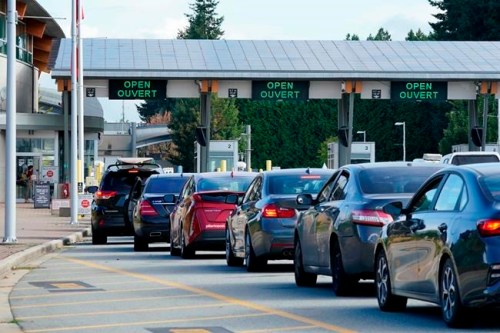
WASHINGTON – It’s time to bid farewell to the ArriveCan app, say border-city mayors, tourism industry leaders and others who complain Canada’s stringent COVID-19 rules for international travellers are encouraging would-be U.S. visitors to spend their tourist dollars at home.
Two Ontario mayors whose cities depend on cross-border tourism — Sarnia’s Mike Bradley and Jim Diodati of Niagara Falls — urged the federal government Wednesday to stop requiring travellers to navigate a preclearance process many find frustrating and confusing.
“I learned a long time ago — I’ve been in politics a long time: when you’re riding a dead horse, dismount,” Bradley told a news conference in Ottawa.

“That’s what the federal government needs to do.”
Bradley, Diodati and Estelle Muzzi, mayor of the Quebec border community of Saint-Bernard-de-Lacolle south of Montreal, as well as advocates for duty-free store operators, say the rules are a drag on incidental cross-border visits, which they say are vital for their local economies.
Adding insult to injury, they say, is the fact that similar rules don’t exist for travellers entering the U.S., especially now that Ottawa is lifting the COVID-19 vaccination requirement for domestic and outbound international travel.
Canadian and foreign visitors aiming to enter Canada must continue to use the app or an online portal to submit their vaccination information to the Canada Border Services Agency ahead of time, a rule Diodati said has outlived its usefulness.
“We all supported the federal government with all the restrictions at the border; we stood shoulder-to-shoulder with them to make sure that we are safe,” he said.
“But the science is now telling us that having these restrictions at the border (is) no longer serving us. In the beginning, it was to keep the virus out — well, it’s clearly here. It’s not doing what it was originally intended to do.”
Richard Cannings, a New Democrat MP whose southern B.C. riding encompasses six separate Canada-U.S. border crossing points, said duty-free stores in those communities continue to see business that’s 95 per cent lower than it was before the pandemic.
“The NDP caucus especially has been very much in favour of restrictions to keep Canadians safe in travel and in their line of work,” Cannings said.
“But we have been calling for many months for a safe border task force, a safe border strategy that would bring together stakeholders to build a system that makes sense for all Canadians to keep us safe, but also keep businesses going.”
There was an absence of American voices from Wednesday’s news conference, a striking distinction from the bilateral appeals for eased restrictions that became a fixture of the pandemic last year.
That’s because U.S. communities and tourism operators are benefiting from the imbalance, because it encourages American travellers to stay put and spend their money closer to home, Bradley said.
“The Americans, and I give them credit, are great at their own self-interest,” he said.
Some U.S. lawmakers took full political advantage of the vaccine-mandate protests that snarled southbound cross-border traffic and trade earlier this year, arguing in favour of ramping up domestic manufacturing and supply chains, Bradley added.
“They were using it as an economic development tool to keep industries in their own country instead of coming here.”
Rep. Brian Higgins, the New York congressman who over the course of the pandemic became one of the most vocal proponents of eased travel restrictions, did surface later Wednesday to express solidarity with his Canadian cousins.
“I stand with municipal leaders and tourism agencies in calling for an end to the ArriveCan mandate,” Higgins said in a statement. Constituents frequently call his office, “frustrated and confused” by the constant changes in the requirements for crossing the border, he said.
“Consequently, to bypass the uncertainty and hassle it creates, many are avoiding making the trip across the border entirely. We have to get back to pre-pandemic U.S.-Canada border management.”
Martin Firestone, a travel insurance broker in Toronto who specializes in helping retirees spend the winter months in warmer climes like Florida, said the ArriveCan requirements are especially onerous for his older, less tech-savvy clients.
Many of them “don’t have a phone to do it on — and even if they can do it on a computer, nothing is simple about it; it serves no purpose,” Firestone said.
“You are asking too much from people to the point where they’re going to say, ‘You know what, it’s just not worth it.'”
The government will “suspend” COVID-19 vaccine mandates for domestic and outbound international travellers, as well as federally regulated workers, effective Monday. Visiting foreign nationals must be vaccinated to avoid a 14-day quarantine and extensive testing requirements.
Transport Minister Omar Alghabra has acknowledged the ongoing complaints, saying Tuesday the government is working on “efficiencies” to make it less onerous. But it remains a valuable and necessary public health tool, Alghabra said.

Mark Agnew, senior vice-president of policy for the Canadian Chamber of Commerce, was scheduled to urge the House of Commons international trade committee later Wednesday to recommend retooling the app to focus on streamlining border procedures more broadly.
Among its current problems, Agnew says in prepared remarks, are the fact that it requires a Canadian address — something U.S. visitors are unlikely to have — and requires travellers to input information they may already have had to submit to an airline.
“There are also issues for travellers whose first language is neither English nor French,” Agnew says, noting that the app is likely proving a drag on border-agency resources as well.
“The system in its current form is not efficient and simply not working,” he says. “With summer travel season here, and the last two seasons being missed, we don’t have the luxury of time to get this right.”
This report by The Canadian Press was first published June 15, 2022.
Related Articles
United in disdain for outdated ArriveCAN app



Advertisement Advertise With Us
Advertisement Advertise With Us