As gas prices spike, Montreal’s bike culture seen as model for rest of the country

Advertisement

Advertise with us

Montrealer Olivia Collette sold her car in 2016 and hasn't looked back.

Read this article for free:


By clicking the button above, an account will be created and you will begin to receive some of our recommended newsletters. You may opt out of any newsletter by visiting your Email and Communication Preferences page or by clicking "unsubscribe" at the bottom of any email.

or

Already have an account? Log in here »

To continue reading, please subscribe:

Digital Subscription

One year of digital access for only $1.44 a week*

  • Enjoy unlimited reading on winnipegfreepress.com
  • Read the E-Edition, our digital replica newspaper
  • Access News Break, our award-winning app
  • Play interactive puzzles

*Billed as $5.77 plus GST every four weeks. After 52 weeks, price increases to the regular rate of $19.95 plus GST every four weeks. Offer available to new and qualified returning subscribers only. Cancel any time.

To continue reading, please subscribe:

Add Free Press access to your Brandon Sun subscription for only an additional

$1 for the first 4 weeks*

  • Enjoy unlimited reading on winnipegfreepress.com
  • Read the E-Edition, our digital replica newspaper
  • Access News Break, our award-winning app
  • Play interactive puzzles
Start now

*Your next Brandon Sun subscription payment will increase by $1.00 and you will be charged $17.95 plus GST for four weeks. After four weeks, your payment will increase to $24.95 plus GST every four weeks.

Hey there, time traveller!
This article was published 04/06/2022 (1611 days ago), so information in it may no longer be current.

Montrealer Olivia Collette sold her car in 2016 and hasn’t looked back.

Collette, a communications consultant living in central Montreal, said getting around using a bicycle, a car-sharing service or a transit pass has not only saved her money, it’s often more enjoyable.

“When it’s sunny and warm, it’s really pleasant,” Collette said of her bicycle commutes. “It’s a really pleasant way of going from A to B.”

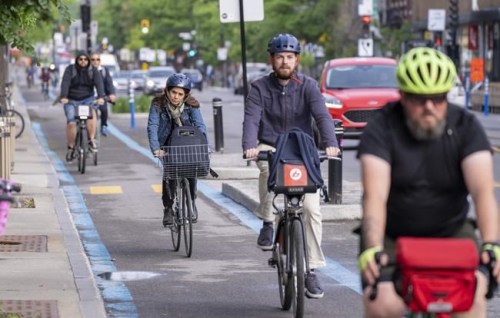
Cyclists make their way down the REV -- Reseau Express Velo -- on St-Denis Street during the morning commute in Montreal on Thursday, June 2, 2022. THE CANADIAN PRESS/Paul Chiasson

Collette said that while getting around Montreal isn’t difficult without a personal vehicle, she’s not sure doing so would be as easy in many other Canadian cities. And with the soaring cost of gasoline and new vehicles, urban transit experts say the rest of Canada should look to Montreal for lessons on how to boost cycling culture.

Stein van Oosteren, spokesperson for a Paris-based cycling association, says the time is right for Canadian cities to make big gains in changing the way people move around.

Van Oosteren, who grew up in the Netherlands before moving to France, said the rise of cycling in both countries was partially driven by high gas prices.

At the beginning of the 1970s, “the Netherlands was like Canada today: a car-centric country, where the car was the foundation of transport, and it was very unpleasant and dangerous to travel by bicycle,” said van Oosteren, who was in Montreal this week to speak at the Go vélo bicycle festival.

That began to change due to a campaign for safer streets, launched in response to the death of a six-year-old girl who was struck by a car and to gas shortages triggered by the 1973 oil crisis.

“The government, under pressure from both citizens who wanted livable cities and the real problem of gas shortages that we had in the Netherlands, decided to promote bikes,” he said.

In France, bicycles began to gain popularity in 2018, when a tax increase pushed the price of gas to nearly $3 a litre, he said. In Paris, meanwhile, that growth continued as the local government rapidly created temporary bike paths in 2020 to encourage people to enjoy the outdoors at the start of the COVID-19 pandemic, he said. Many of those paths have become permanent.

“This created a whole generation of cyclists who today travel by bike, and once this critical mass exists, it will attract others,” van Oosteren said.

Montreal, he said, is a cycling leader in North America — particularly due to the city’s focus on building a contiguous network of bike lanes that are protected from the rest of the street. The protected lanes attract a wide range of users because the infrastructure increases cyclists’ sense of safety.

In North America, the majority of bike trips are taken by men who are experienced cyclists, said Owen Waygood, a professor of transportation engineering at Polytechnique Montréal. Safer infrastructure, he said, will attract more women, older people and children.

“Montreal does have some great leadership in that respect,” he said.

Bike counters — automated sensors that detect and count passing cyclists — indicate an increase in users on new routes that are part of the city’s “express” bike lane network, the Réseau express vélo, Waygood said. The city began building the REV in 2020.

Around 2,000 cyclists a day, he said, use a recently constructed bike lane on St-Denis Street, a major artery in Montreal’s urban core. “There’s some days when it’s 8,000, which is impressive.”

But hard data can be difficult to come by. The provincial government conducts a travel survey every five years, but Waygood said that survey captures a limited snapshot and is usually done in the fall season — when there are fewer cyclists compared with the spring and summer.There’s no Canada-wide survey that would allow comparisons between different cities, he added.

Statistics Canada collects data about Canadians’ daily commutes, but the most recent public data from the federal statistics agency is from 2016. It indicates that Vancouver and Victoria have higher rates of cycling than Montreal does, which Waygood said makes sense given the milder year-round weather.

Ry Shissler, the communications manager for Cycle Toronto, a charity that promotes cycling culture, said the organization ranks Victoria, Vancouver and Montreal higher than Toronto at encouraging cycling. While Toronto is flatter than Montreal and has somewhat warmer weather, Shissler said Montreal has built better biking infrastructure.

“We just don’t have the same sort of network that makes people feel comfortable riding a bike,” Shissler said.

Toronto, however, keeps its bike-sharing system operational year-round, while Montreal packs up its bike system — called BIXI — for the winter.

Stephen Miller, spokesman with Transit, a trip-planning mobile application for public transit, said people are able to get around Montreal without a car in large part because of the city’s high-quality public transit network.

Transportation projects that have launched in Montreal have been exported internationally, he said, like car-sharing service Communauto, which can be found across Canada and in France. The technology used in the BIXI system, originally developed by a company owned by the City of Montreal, has since has been exported to cities around the world, including Toronto, New York City and London.

“Montreal benefits from having a culture that is focused on innovation in transit and public transportation,” Miller said.

Collette, who said she sometimes goes months without driving a car, said there’s now a rush hour on Montreal’s bike lanes, but she said it’s much less stressful than being stuck in traffic.

“If I had a car, I would have to pay for parking; I would have to move it all the time; I would still be paying to have the car even if I wasn’t using it,” she said.

This report by The Canadian Press was first published June 4, 2022.

Note to readers: This is a corrected story. A previous version misgendered Ry Shissler, whose pronouns are they/them.

Report Error Submit a Tip

More Stories

The new normal in Canadian politics

David McLaughlin 5 minute read Preview

The new normal in Canadian politics

David McLaughlin 5 minute read Yesterday at 2:01 AM CDT

“Nothing happening, all at once.”

Welcome to the new normal of Canadian politics, where normality is the new normal. Routine and stable are in; disruptive and excessive are out. Exhibits A and B are the Alberta referendum and the British Columbia election. Voters opted for stability over volatility.

The opposite of being normal is being different from the norm. In politics that means different from where we’ve been and what we’ve come to expect. Two competing trends have dominated our politics for the past decade and a half — progressivism and populism. Think Justin Trudeau and liberal, progressive identity politics in Canada, and Donald Trump and conservative, populist MAGA politics in America. We are now experiencing a swing away from both those trends.

Representing this “new normal” are Prime Minister Mark Carney, for one, and newly elected British Columbia premier, Lorne Doerksen, for another. Both are considered normal because they talk and act like adults in a childish political world. Their political flair is to not have any political flair. They stand out for not standing out.

Read
Yesterday at 2:01 AM CDT

Province changes Thompson ‘Vaxport’ plan

Carol Sanders 5 minute read Preview

Province changes Thompson ‘Vaxport’ plan

Carol Sanders 5 minute read Thursday, Jan. 14, 2021

The Manitoba government has changed its plans for a vaccination "super site" for the North — just days after it was announced — after local officials argued the original proposal was unworkable.

Some northern residents will still get their COVID-19 shots at Thompson's airport, but "Vaxport" will be less super than originally planned, providing injections only to residents of fly-in communities.

Most northern residents will get their shots at the Thompson Community Recreation Centre, which is centrally located in the city of about 13,000.

"This makes much more sense logistically, and for the citizens of Thompson," Mayor Colleen Smook said Thursday after touring the airport site, which is located 10 kilometres from the city and isn't serviced by public transportation.

Read
Thursday, Jan. 14, 2021

Montreal bike culture a model for rest of Canada

Jacob Serebrin, The Canadian Press 6 minute read Preview

Montreal bike culture a model for rest of Canada

Jacob Serebrin, The Canadian Press 6 minute read Monday, Jun. 6, 2022

Montrealer Olivia Collette sold her car in 2016 and hasn't looked back.

Collette, a communications consultant living in central Montreal, said getting around using a bicycle, a car-sharing service or a transit pass has not only saved her money, it's often more enjoyable.

“When it’s sunny and warm, it’s really pleasant,” Collette said of her bicycle commutes. “It's a really pleasant way of going from A to B.”

Collette said that while getting around Montreal isn't difficult without a personal vehicle, she's not sure doing so would be as easy in many other Canadian cities. And with the soaring cost of gasoline and new vehicles, urban transit experts say the rest of Canada should look to Montreal for lessons on how to boost cycling culture.

Read
Monday, Jun. 6, 2022

Imperialist crusades: 21st-century style

John R. Wiens 5 minute read Preview

Imperialist crusades: 21st-century style

John R. Wiens 5 minute read Wednesday, Jul. 8, 2026

In the 11th century and lasting into the 13th, the papacy launched a series of at least eight military campaigns we now refer to as the Crusades, or Holy Wars. They were an imperialistic call to arms for Christians to retake Jerusalem, which was at the time under Muslim rule.

Spiritual rewards for participation were implied, and other incentives offered, to dull the extra taxation demanded to fund the campaigns. Over time, the “crusades” morphed to become massacres of not only Muslims but also Jews and Christian dissidents — in other words, any enemies of the papacy. If today’s news sounds like déjà vu all over again, it probably should.

The stories keep repeating themselves in many forms. We now know that two 20th century world wars, global in scope, were caused by imperialistic ambitions, changes in the balance of international powers and corresponding arms races. The first was attributed to the assassination of the heir to the Austro-Hungarian throne by a Bosnian Serb, a kind of “regime change” initiative. The second resulted from rising tensions between Allied and Axis powers, triggered by the rise of European fascism and Japanese militarism. The human toll of both was unimaginable.

In the First World War, 15 to 22 million people, including soldiers and civilians, were killed and another 23 million were wounded. These numbers do not account for those otherwise affected — victims of chemical warfare whose compromised health shortened their lives; of the subsequent Spanish flu epidemic amplified by the displacement of peoples; others who died from other diseases caused by war conditions; and those who were malnourished or starved. Nor do they account for the ongoing trauma and resentments passed on intergenerationally to this day.

Read
Wednesday, Jul. 8, 2026

Canada tops Dominican Republic in pre-qualifier

Jason Hills, The Canadian Press 4 minute read Preview

Canada tops Dominican Republic in pre-qualifier

Jason Hills, The Canadian Press 4 minute read Sunday, Nov. 17, 2019

EDMONTON - Canada's women's basketball team put its depth on display Sunday in a dominant 110-60 victory over the Dominican Republic in the final game of the FIBA Olympic pre-qualifying tournament.

All 12 players hit the scoresheet, including six in double digits, to help the Canadians finish 3-0 at the tournament and advance to the next Olympic qualifier in February.

Sami Hill led the way with 16 points, three rebounds, two assists and three steals, while 20-year-old Shaina Pellington recorded 14 points. Bridget Carleton and Jamie Scott had 13 points each and Ruth Hamblin had 11 points and five rebounds.

"We got to roll our whole lineups through, and it was fun when we got going," said Canada's coach Lisa Thomaidis. "It was nice to see different lineup contributing and building chemistry.

Read
Sunday, Nov. 17, 2019

Has the political wind changed?

Gwynne Dyer 5 minute read Yesterday at 2:01 AM CDT

It has been quite a week. First we had “Lula” – Luiz Inácio da Silva (as nobody but his mother ever called him) – defying everybody’s expectations. After winding up two million votes behind his challenger, Flávio Bolsonaro, in the first round of the Brazilian presidential election, he made a “miraculous” comeback in the second.

It was like a man going into a revolving door behind you and coming out in front. At the end of the first round, Lula was two million votes behind; at the end of the second round on Oct. 25 he was four million votes ahead. So how did he win a fourth term without cheating?

That’s what Bolsonaro claims he did, having fled to the United States; Trump, Flávio’s mentor, hints at the same. But Lula’s victory was not miraculous. He only learned to read when he was 10, and at 80 he still refused to have a mobile phone. His team finally made him get one and use it.

He wouldn’t do social media videos, so they created a WhatsApp channel called Lula’s Army, and made him appear on it at least daily. The channel went from zero to 10.8 million viewers in two weeks, and Lula won.