‘He took ownership’: Manitoba Métis meet with Pope Francis at the Vatican

Advertisement

Advertise with us

ROME - A Métis group from Manitoba says Pope Francis took ownership of the harms done by the Roman Catholic Church during the first meeting with an Indigenous group at the Vatican since the pontiff's historic apology.

Read this article for free:


or

Already have an account? Log in here »

To continue reading, please subscribe:

Subscribe and receive a limited-edition Free Press branded hat or tote.

Digital Subscription

One year of digital access for only $205*

  • Enjoy unlimited reading on winnipegfreepress.com
  • Read the E-Edition, our digital replica newspaper
  • Access News Break, our award-winning app
  • Play interactive puzzles

*First annual payment billed as $205.00 + GST for one year. This annual subscription will automatically renew at $233.00 + GST every 52 weeks (10% off the regular annual price of $259.35). Offer available to new and qualified returning subscribers only. Cancel any time.

To continue reading, please subscribe:

Add Free Press access to your Brandon Sun subscription for only an additional

$1 for the first 4 weeks*

  • Enjoy unlimited reading on winnipegfreepress.com
  • Read the E-Edition, our digital replica newspaper
  • Access News Break, our award-winning app
  • Play interactive puzzles
Start now

*Your next Brandon Sun subscription payment will increase by $1.00 and you will be charged $17.95 plus GST for four weeks. After four weeks, your payment will increase to $24.95 plus GST every four weeks.

Hey there, time traveller!
This article was published 21/04/2022 (1627 days ago), so information in it may no longer be current.

ROME – A Métis group from Manitoba says Pope Francis took ownership of the harms done by the Roman Catholic Church during the first meeting with an Indigenous group at the Vatican since the pontiff’s historic apology.

“He understands the damage that was done and he asked that we in that room and the Red River Métis forgive him and the church,” Manitoba Métis Federation president David Chartrand said after the meeting Thursday.

“That’s a very powerful way to start the healing process.”
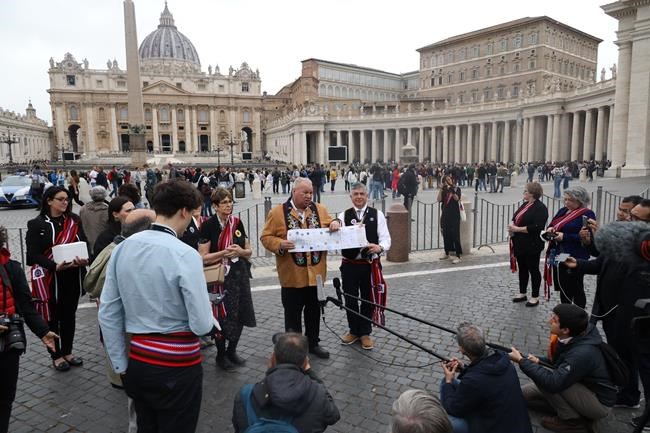
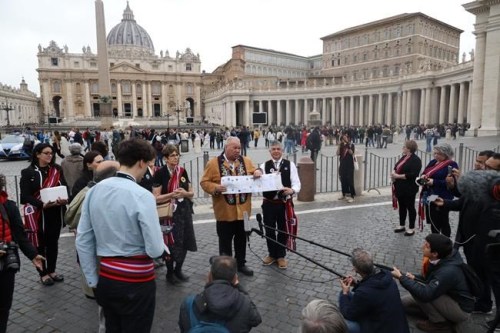
Manitoba Métis Federation President David Chartrand stands in St. Peter's Square as Métis met with Pope Francis at the Vatican on April 21, 2022, in this handout photo. THE CANADIAN PRESS/HO-Jordan Meixner - Manitoba Métis Federation  **MANDATORY CREDIT**
Manitoba Métis Federation President David Chartrand stands in St. Peter's Square as Métis met with Pope Francis at the Vatican on April 21, 2022, in this handout photo. THE CANADIAN PRESS/HO-Jordan Meixner - Manitoba Métis Federation **MANDATORY CREDIT**

Andrew Carrier said he spoke about his experiences as an abuse survivor at a Catholic day school. The Pope was sincere and listened, Carrier said.

“We need to overcome this pain and move forward,” he said.

On April 1, after meetings with First Nations, Inuit and Métis groups, Francis apologized for the deplorable conduct of church members involved in residential schools. He stood before a room of nearly 200 Indigenous delegates and asked for God’s forgiveness for the actions of the Catholic Church.

“I want to say to you with all my heart: I am very sorry,” Francis said in Italian. “And I join my brothers, the Canadian bishops, in asking your pardon.”

An estimated 150,000 Indigenous children were forced to attend residential schools, more than 60 per cent of which were run by the Catholic Church.

The Manitoba Métis Federation organized the separate meeting with the Pope because the group last year withdrew from the Métis National Council following years of internal conflict.

The national council was part of the larger Indigenous delegation.

Chartrand said the Manitoba Métis understood there “were individuals that were predators, evil and did such harm to so many. It wasn’t the church.”

After the apology, there was pushback from some Indigenous people in Canada who said it focused on the actions of a few members of the church. They said the apology did not recognize the lasting damage that was done in residential schools.

Chartrand said Métis people experienced significant harm to their culture, language and identity through actions of the churches.

But, he said, the ties between Métis and the Roman Catholic Church remain deep and strong.

A Catholic priest played a significant role in Métis leader Louis Riel’s founding of what would become Manitoba. Rev. Noël-Joseph Ritchot led the delegation Riel sent to Ottawa to negotiate the provisional government’s entry into Confederation.

Riel himself was Catholic but also wrote about his issues with the church.

In 1817, the Métis petitioned to have churches built in Western Canada, Chartrand noted.

Francis told the group that it’s important to learn to walk in other people’s shoes, said Archbishop Richard Joseph Gagnon, who accompanied the latest delegation. That means learning to appreciate the importance of culture and the spirituality of others, he said.

“If all of us, if we can learn to appreciate other people’s journeys more, then the future does have a lot of hope,” Gagnon said.

The group gave the Pope a scroll that explained the Métis history with the church, beaded moccasins, a Louis Riel coin and beaded crosses. They received a brass olive branch in return.

Chartrand said he invited the pontiff to come to Manitoba to visit Riel’s grave at Saint-Boniface Cathedral cemetery in Winnipeg as part of an expected trip to Canada.

The Manitoba Métis delegation came with a message of hope and revitalization, Chartrand said.

“We can’t change history but we definitely can change the future.”

This report by The Canadian Press was first published April 21, 2022.

— By Kelly Geraldine Malone in Winnipeg

History

Updated on Thursday, April 21, 2022 10:24 AM CDT: Removes file photo

Report Error Submit a Tip

The Free Press acknowledges the financial support it receives from members of the city’s faith community, which makes our coverage of religion possible.
More Stories

Letters, Oct. 3

7 minute read Yesterday at 2:01 AM CDT

A morning in the life …

My very first lesson does not start when I walk into that lecture hall, oh no — it starts long before. It begins when I walk to my car, check the estimated arrival time to the University of Manitoba and hope that Winnipeg traffic agrees with it.

A drive that appears completely manageable changes almost immediately when I’m greeted by a tsunami of orange pylons and a line of cars that appears to go on forever. Traffic moves by the inch, lanes magically disappear and the detour I took yesterday now has a detour of its own. These factors make me do a calculation that I have become all too familiar with. How late can I arrive and still find parking, run to my class across campus and get to class with enough time left to make it worth it?

I have grown used to people saying, “Why not just leave earlier?” I do. But when I’m already leaving for my 8:30 a.m. class at 7 a.m., there’s only so much I can do. This drive that some would think is relaxing is one that feels like an assignment that I didn’t know I had to complete and is due at 8:30 a.m.

Manitoba Métis meet with Pope Francis

The Canadian Press 4 minute read Preview

Manitoba Métis meet with Pope Francis

The Canadian Press 4 minute read Thursday, Apr. 21, 2022

ROME - A Métis group from Manitoba says Pope Francis took ownership of the harms done by the Roman Catholic Church during the first meeting with an Indigenous group at the Vatican since the pontiff's historic apology.

“He understands the damage that was done and he asked that we in that room and the Red River Métis forgive him and the church," Manitoba Métis Federation president David Chartrand said after the meeting Thursday.

"That’s a very powerful way to start the healing process."

Andrew Carrier said he spoke about his experiences as an abuse survivor at a Catholic day school. The Pope was sincere and listened, Carrier said.

Read
Thursday, Apr. 21, 2022

‘Detrimental to the growth of female hockey in Manitoba’

Joshua Frey-Sam 7 minute read Preview

‘Detrimental to the growth of female hockey in Manitoba’

Joshua Frey-Sam 7 minute read Friday, Oct. 2, 2026

She lived the best of both worlds.

For the last three years, the 17-year-old wore a sweater for two different hockey programs — her high school team and AAA club in the Manitoba Female Hockey League — and was preparing to flourish in both colours again this winter.

Recently, however, the blue-liner was disappointed to learn she is no longer eligible to play her Grade 12 season with her school owing to a new policy imposed by Hockey Manitoba that bans players from participating in the Manitoba Women’s High School Hockey League if they are rostered on a U18 AAA team.

The rule applies to all athletes who play for both Winnipeg-based and rural AAA teams.

Read
Friday, Oct. 2, 2026

The idea of Alberta separation viewed through a faith lens shows further fracture lines

Josiah Neufeld 10 minute read Preview

The idea of Alberta separation viewed through a faith lens shows further fracture lines

Josiah Neufeld 10 minute read Yesterday at 2:01 AM CDT

CALGARY — One morning in May, John Pentland, a minister at Hillhurst United Church in Calgary, opened his newspaper and read about a group of Albertans who were trying to divide his country.

Something inside of him felt like it cracked open. He started to weep.

“I couldn’t stop, I couldn’t breathe,” he said. He called a friend and told him: “I think I’m losing my mind.”

Pentland has always believed in Canada — flawed as it might be — as a nation gifted with diversity and welcoming of asylum seekers, refugees and immigrants. But recently that belief has been shaken as he’s witnessed right-wing ideologies charged with anti-immigrant sentiment take root in his province. It makes him angry and embarrassed for the country he loves.

Read
Yesterday at 2:01 AM CDT

May be whiff of truth to ex’s odour ardour

Maureen Scurfield 5 minute read Yesterday at 2:01 AM CDT

DEAR MISS LONELYHEARTS: I ran into an old boyfriend I used to curl on a team with, and we went for drinks. We’ve been almost eight years apart, and I couldn’t remember why we broke up, as we always had such a great time together.

It wasn’t until the second date — this time on a weekend — that it came back to me, with a jolt. Pee-yew! I remembered he doesn’t use deodorant on weekends. Why? He enjoys his own body odour. I recalled that a bit too late, and it was just as awful as ever! I went home early.

Tonight, he called and I refused him another date. I said, “Think back. You remember why we broke up?” Then he said, “Oh yeah, you hated my no-deodorant weekend policy. Well, guess what? Some women don’t mind!” I said I really doubted that, and that ended the conversation. Miss L., wouldn’t any women find stinky underarms offensive?

— Sensitive Nose, Fort Richmond

Poster protocol

Sheldon Birnie 7 minute read Preview

Poster protocol

Sheldon Birnie 7 minute read Tuesday, Sep. 15, 2026

Although the days when telephone poles and notice boards across the city were thick with gig posters, either slopped up with wheat paste or wrapped tight with packing tape, are behind us, the art of making an appealing visual ad for live music events is still a vital part of the local creative scene.

However, a widespread backlash against a new kind of slop — the use of generative AI images — has been building, especially among creatives when it comes to promoting live music.

“Live music is and always has been a DIY type of scene, especially locally,” says Evan Simpson, who has been working as a graphic designer for nearly a decade.

“For years people have been making their own flyers, or if they have the budget, hiring a designer or artist to come up with some artwork for their flyers. It’s a whole ecosystem, a scene supporting itself. If you take away the visual side of it, the spark, individuality and uniqueness of each gig poster is lost. What a sad world it would be if all art were made by AI.”

Read
Tuesday, Sep. 15, 2026