Tow-truck companies refuse to haul away large trucks gridlocking Ottawa

Advertisement

Advertise with us

OTTAWA - All tow-truck companies on contract with the city have refused to haul away the big rigs that have gridlocked Ottawa's downtown for the second week in a row, the city's manager says.

Read this article for free:


By clicking the button above, an account will be created and you will begin to receive some of our recommended newsletters. You may opt out of any newsletter by visiting your Email and Communication Preferences page or by clicking "unsubscribe" at the bottom of any email.

or

Already have an account? Log in here »

To continue reading, please subscribe:

Digital Subscription

One year of digital access for only $1.44 a week*

  • Enjoy unlimited reading on winnipegfreepress.com
  • Read the E-Edition, our digital replica newspaper
  • Access News Break, our award-winning app
  • Play interactive puzzles

*Billed as $5.77 plus GST every four weeks. After 52 weeks, price increases to the regular rate of $19.95 plus GST every four weeks. Offer available to new and qualified returning subscribers only. Cancel any time.

To continue reading, please subscribe:

Add Free Press access to your Brandon Sun subscription for only an additional

$1 for the first 4 weeks*

  • Enjoy unlimited reading on winnipegfreepress.com
  • Read the E-Edition, our digital replica newspaper
  • Access News Break, our award-winning app
  • Play interactive puzzles
Start now

*Your next Brandon Sun subscription payment will increase by $1.00 and you will be charged $17.95 plus GST for four weeks. After four weeks, your payment will increase to $24.95 plus GST every four weeks.

Hey there, time traveller!
This article was published 08/02/2022 (1726 days ago), so information in it may no longer be current.

OTTAWA – All tow-truck companies on contract with the city have refused to haul away the big rigs that have gridlocked Ottawa’s downtown for the second week in a row, the city’s manager says.

Steve Kanellakos said the consensus among many of the companies seems to be that they don’t want to do the work because the heavy truck industry is such a large part of their livelihoods and they don’t want to damage that part of their businesses.

The city has contracts with 10 companies, which are typically used to tow vehicles during parking bans so city plows can remove snow. Some of the contracts cover towing services for city vehicles, and others help recover lost and stolen vehicles for police.
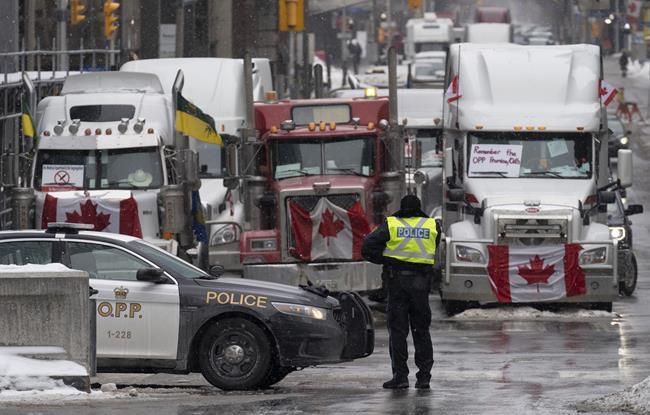
Police man a barricade in front of vehicles parked as part of the trucker protest, Tuesday, Feb. 8, 2022 in Ottawa’s downtown core. Ottawa's city manager says all tow-companies on contract with the city have refused to haul away the large trucks that have gridlocked Ottawa's downtown for the second week in a row.  THE CANADIAN PRESS/Adrian Wyld

“We’ve contacted them all and every one, they’re all refusing as of today to provide heavy tow truck work,” Kanellakos said Monday evening after a briefing to city council on the demonstration downtown.

Pascal Loyer, CEO of one of the tow-truck companies contracted by the city, said his concern is for the safety of his employees and the future of his business.

If he were to start towing trucks away from downtown, he said “nobody is going to have my back.”

The big rigs have been blocking city streets and honking horns day and night in Ottawa since Jan. 28 in protest of vaccine mandates.

Towing away a big rig without the co-operation of a driver is dangerous, difficult,andtime-consumingwork, he said, and the crowds downtown pose a degree of uncertainty.

If one of his employees got hurt, he could be charged under the labour code because of the unsafe work conditions, he said.

Loyer said he wants to remain neutral in the conflict between the city and the protesters and would like to see a political solution that avoids putting private businesses like his and public servants at risk.

The city is reviewing the contracts to see what recourse it has in this unprecedented situation but the problem, he said, goes beyond Ottawa.

Ottawa’s mayor has reached out to other large Ontario cities to see if they can help, and the city is calling companies across Eastern Ontario.

The city has raised the issue with the provincial and federal governments but has found tow truck operators have been reticent to get involved with the protests across Canada.

The lack of tow companies willing to get involved has also hampered the efforts of the RCMP to remove trucks and other vehicles from a protest blockade in southern Alberta.

The operators they’ve contacted worry about long-term damage to their businesses should they help police haul away protester vehicles, said Alberta RCMP Deputy Commissioner Curtis Zablocki.

Sonya Savage, Alberta’s acting justice minister, says the province has other tools it could use if necessary, including filing for a civil injunction and seizing vehicles and forfeiting them to the Crown.

Kanellakos says the tow companies are still doing other work for the City of Ottawa, including towing regularly sized vehicles.

Steve Bell, Ottawa’s deputy police chief, said Monday the issue has cropped up in all jurisdictions and has forced cities and police services to come up with some “creative solutions.”

He opted not to share those solutions, citing “operation concerns” about showing their hand to the protesters they’re attempting to shoo from the city’s core.

“We’re not going to let the tow truck operators and the ability to tow those vehicles out of there be an obstacle to ending what’s occurring,” he said Monday.

By Tuesday, Bell said that some vehicles have been seized and towed but the situation has become even more difficult: some trucks have removed their tires or split their brakes to make them completely immobile.

“The immobilizing of the vehicles in the occupation area is extremely concerning to us,” he said at a briefing Tuesday.

This report by The Canadian Press was first published Feb. 8, 2022.

Report Error Submit a Tip

More Stories

Court ruling concludes Canadian Wheat Board saga

Laura Rance-Unger 4 minute read Preview

Court ruling concludes Canadian Wheat Board saga

Laura Rance-Unger 4 minute read 2:01 AM CDT

It remains to be seen whether the recent court ruling in a lawsuit filed after Canadian Wheat Board’s dissolution in 2012 puts the whole debate to rest, as some no doubt hope.

But either way, the dust has settled on the post-CWB world. The sun still rises and a new generation of farmers on the land only knows by name an institution that for generations influenced every aspect of Prairie grain farming.

The first Rural Revival column I wrote for this newspaper more than 30 years ago was about a thousand farmers from Western Canada demonstrating in support of the Wheat Board. It was in the aftermath of the Western Grain Marketing Panel report, one of several efforts that eventually included a plebiscite to help the federal government decide what to do about a vocal minority of farmers who wanted marketing “freedom.”

The polls at the time suggested about two-thirds of farmers were comfortable enough with the single-desk system for food wheat and barley to keep it around. It served as a counterbalance to canola, which they sold on the open market. They essentially had a dual market.

Read
2:01 AM CDT

Defunding police ‘illogical step’: Pallister

Carol Sanders 5 minute read Preview

Defunding police ‘illogical step’: Pallister

Carol Sanders 5 minute read Tuesday, Jun. 9, 2020

Manitoba Premier Brian Pallister says he’s open to channelling justice funding to preventive programs, but questions whether defunding police is the best approach — warning there will always be criminals taking advantage of vulnerable people.

“I think the motivation that lies in frustrations of the actions of some police services — not necessarily here in Winnipeg exclusively, but elsewhere — is justifiable and understandable, and I get it,” Pallister said Tuesday, when asked to comment on the 30,000 signatures collected for a Justice 4 Black Lives Winnipeg petition calling for the abolition of the city police.

“But then moving to defunding police is, to me, an illogical step from that one. Don’t let your frustration lose your common sense... There’s a lot of people out there in vulnerable communities who depend on the police to protect them and make sure they’re safe from the action of criminals.”

There has been a widespread call to restructure police funding in the wake of George Floyd’s death May 25 in Minneapolis.

Read
Tuesday, Jun. 9, 2020

Provincial budget fails to chart new course

Editorial 4 minute read Preview

Provincial budget fails to chart new course

Editorial 4 minute read Wednesday, Apr. 13, 2022

If the 2022 Manitoba budget was intended to provide a lifeline for the Progressive Conservative government, it must surely be considered a failure.

Prior to the budget’s release, Premier Heather Stefanson and her government were teetering on the edge of the political abyss. Manitobans are profoundly unhappy with the government’s performance on most issues, including pandemic management. National polls show Ms. Stefanson is Canada’s least popular premier.

That political context made this budget a high-priority project for the Tories. It was, simply put, their best chance to shed the lingering burden left by former premier Brian Pallister, and rebuild the party brand under a new leader.

Unfortunately, Ms. Stefanson’s first budget remains shackled to the deeply flawed fiscal and political logic that defined the Pallister years. And no single budgetary measure embodies that failure more than the premier’s decision to continue cutting education property taxes.

Read
Wednesday, Apr. 13, 2022

The new normal in Canadian politics

David McLaughlin 5 minute read Preview

The new normal in Canadian politics

David McLaughlin 5 minute read 2:01 AM CDT

“Nothing happening, all at once.”

Welcome to the new normal of Canadian politics, where normality is the new normal. Routine and stable are in; disruptive and excessive are out. Exhibits A and B are the Alberta referendum and the British Columbia election. Voters opted for stability over volatility.

The opposite of being normal is being different from the norm. In politics that means different from where we’ve been and what we’ve come to expect. Two competing trends have dominated our politics for the past decade and a half — progressivism and populism. Think Justin Trudeau and liberal, progressive identity politics in Canada, and Donald Trump and conservative, populist MAGA politics in America. We are now experiencing a swing away from both those trends.

Representing this “new normal” are Prime Minister Mark Carney, for one, and newly elected British Columbia premier, Lorne Doerksen, for another. Both are considered normal because they talk and act like adults in a childish political world. Their political flair is to not have any political flair. They stand out for not standing out.

Read
2:01 AM CDT

Has the political wind changed?

Gwynne Dyer 5 minute read 2:01 AM CDT

It has been quite a week. First we had “Lula” – Luiz Inácio da Silva (as nobody but his mother ever called him) – defying everybody’s expectations. After winding up two million votes behind his challenger, Flávio Bolsonaro, in the first round of the Brazilian presidential election, he made a “miraculous” comeback in the second.

It was like a man going into a revolving door behind you and coming out in front. At the end of the first round, Lula was two million votes behind; at the end of the second round on Oct. 25 he was four million votes ahead. So how did he win a fourth term without cheating?

That’s what Bolsonaro claims he did, having fled to the United States; Trump, Flávio’s mentor, hints at the same. But Lula’s victory was not miraculous. He only learned to read when he was 10, and at 80 he still refused to have a mobile phone. His team finally made him get one and use it.

He wouldn’t do social media videos, so they created a WhatsApp channel called Lula’s Army, and made him appear on it at least daily. The channel went from zero to 10.8 million viewers in two weeks, and Lula won.

The long and winding road

Editorial 4 minute read Preview

The long and winding road

Editorial 4 minute read 2:01 AM CDT

As theatre goes, it sent a strong message.

Manitoba Premier Wab Kinew, standing in front of microphones and television cameras, holding up his Indigenous status card and saying that he didn’t feel Canada should have “a race-based form of identification in this country, but that is a reality,” adding that it was time to abolish the Indian Act.

“I think it’s time to abolish the Indian Act, get rid of the Indian Act, move past the Indian Act, and it needs to be done with First Nations people and First Nations governments, of course. I think it’s long overdue that we have a relationship with Indigenous Peoples in Canada that reflects who we are as Canadians today,” he said.

The Indian Act — the name alone suggests how out-dated and out of place the law has become. Originally dating from 1876, the law was put in place to “amend and consolidate the laws respecting Indians” and gave the Minister of the Interior the responsibility to “control and management of the reserves, lands, moneys and property of Indians in Canada.”

Read
2:01 AM CDT