Alberta starts lifting COVID-19 restrictions, vaccine passport program
Advertisement
Read this article for free:
or
Already have an account? Log in here »
To continue reading, please subscribe:
Digital Subscription
One year of digital access for only $1.44 a week*
- Enjoy unlimited reading on winnipegfreepress.com
- Read the E-Edition, our digital replica newspaper
- Access News Break, our award-winning app
- Play interactive puzzles
*Billed as $5.77 plus GST every four weeks. After 52 weeks, price increases to the regular rate of $19.95 plus GST every four weeks. Offer available to new and qualified returning subscribers only. Cancel any time.
To continue reading, please subscribe:
Add Free Press access to your Brandon Sun subscription for only an additional
$1 for the first 4 weeks*
- Enjoy unlimited reading on winnipegfreepress.com
- Read the E-Edition, our digital replica newspaper
- Access News Break, our award-winning app
- Play interactive puzzles
*Your next Brandon Sun subscription payment will increase by $1.00 and you will be charged $17.95 plus GST for four weeks. After four weeks, your payment will increase to $24.95 plus GST every four weeks.
Read unlimited articles for free today:
or
Already have an account? Log in here »
Hey there, time traveller!
This article was published 08/02/2022 (1718 days ago), so information in it may no longer be current.
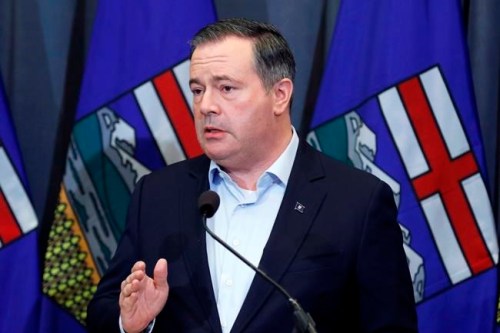
EDMONTON – Premier Jason Kenney says Alberta’s vaccine passport will end almost immediately, with most other big COVID-19 health rules gone three weeks later.
Kenney told a news conference Tuesday that the vaccine passport, known in Alberta as the restriction exemption program, would end within hours — at midnight.
He said strong vaccination rates, declining hospital cases and a continued drop in the spread of the Omicron variant make it possible to end the passport.

“Our approach to COVID must change as the disease changes,” Kenney told a news conference.
“The restriction exemption program has served its useful purpose. It has done its job.”
Kenney also announced that capacity limits at venues will end at midnight Tuesday, except for those that host 500 people or more.
Also, as of Monday, mandatory mask rules will be cancelled for children under 12 in all settings and for all children in schools.
“Given the very low threat that COVID-19 poses to the health of children, it is no longer justifiable after two long years to continue to disrupt and restrict the normal lives of kids,” said Kenney.
As he was speaking, Education Minister Adriana LaGrange issued a public letter informing school boards they don’t have the power to override the directive and order students to wear masks in school or on school buses.
Adults, including teachers and bus drivers, will continue to wear masks for the time being, said LaGrange.
Kenney said more health restrictions will fall in the coming weeks, as long as COVID-19 does not place renewed intolerable pressure on the health system.
The plan is to remove all indoor masking rules by March 1, along with capacity limits on large venues, mandatory work from home requirements and social gathering limits.
Alberta joins other provinces in announcing plans to end some or all of their health rules, citing virus protection and waning Omicron numbers as justification to ease up.
Earlier Tuesday, Saskatchewan Premier Scott Moe said his government will begin lifting all of its pandemic public health orders in a phased approach, starting Monday with the removal of its vaccine passport policy.
Saskatchewan’s mask mandate and requirement for people to self-isolate if they test positive for the virus will be gone by month’s end.
Quebec also said Tuesday it would see most restrictions lifted by March 14. And Prince Edward Island announced a phased plan to end most measures by early April.
Alberta’s vaccine passport mandated anyone using non-essential services, such as bars and restaurants, show proof of vaccination. The program was voluntary, but businesses that did not participate were subject to restrictions, including reduced customer capacity.
Since being introduced last September, the passport had come to symbolize a clash within Alberta — and within Kenney’s own United Conservative caucus and party — on balancing public health orders with individual rights and freedoms.
A week ago, Kenney said the passport could be eliminated by the end of March.
Critics, including the Opposition NDP, have said Kenney’s rapid about-face is motivated by political survival, given that some of his caucus members have spoken out against vaccine mandates. Kenney, dealing with low poll numbers, faces a party leadership review in two months.
In a tweet, Opposition Leader Rachel Notley said that remains the case.
“No evidence. No data,” she wrote on social media late Tuesday. “These are the actions of a Premier focused on protecting himself.
“These are not the actions of a Premier focused on protecting you.”
Throughout Canada, smouldering discontent with COVID-19 rules has flared up. Truckers protesting mandatory vaccinations for cross-border trips have led to protest convoys and encampments, particularly in Ottawa.
In Alberta, vaccine mandate protesters have tied up and at times halted cross-border transport at the Coutts border crossing for the past 11 days.
There have also been vehicle-driven protests in Calgary and Edmonton that led to traffic tie-ups and honking horns while some businesses were forced to close early.
Earlier Tuesday, RCMP Deputy Commissioner Curtis Zablocki said efforts to tow away massive rigs and tractors at Coutts, Alta., have been hampered because tow companies don’t want to get involved.
Zablocki said the goal is to end the standoff peacefully, but he said investigations and charges will be pursued even after the protest ends and the roads cleared.
The mayor of Coutts said he was hoping for more from Kenney’s announcement and said it likely won’t help resolve the impasse at the border.
“The premier’s an excellent negotiator in that nobody’s going to be happy with what he just announced. It’s either going to be too much or not enough and it’s happening too soon or it’s not soon enough,” Mayor Jim Willett said in an interview.
Willett said he doesn’t know what the reaction is going to be among the people who are protesting, but he doesn’t expect any immediate disbanding of those at the border or those protesting at a checkpoint north of the village.
“I don’t anticipate that, no, not for the time being. And leaving masking in place until March 1 is not going to make anybody happy either,” he said.
“Anybody in the protest group or in rural Alberta is probably not going to be happy about that.”
In removing the health rules, Kenney risks a showdown with municipal leaders — including Edmonton Mayor Amarjeet Sohi, who has said health rules must be based on scientific evidence and not put at risk vulnerable people and young kids who can’t be vaccinated.
Sohi has said Edmonton may keep its own restrictions in place, prompting Kenney to respond last week that he may have the legislature rewrite municipal government legislation to override it.
Kenney has said there needs to be continuity on health rules.
Alberta has 1,623 people in hospital with COVID-19, including 129 in intensive care.

The last time Kenney cancelled almost all health restrictions was last summer — despite warnings of the rising Delta variant. By the fall, hospitals were pushed to the edge of collapse and the military was called in to help keep the health system running.
That near-collapse prompted Kenney to bring in the vaccine passport, something he had publicly promised he would never do.
The passport led to a sharp rise in vaccination rates, helping pull the health system back from the brink.
— with files from Bill Graveland in Coutts, Alta.
This report by The Canadian Press was first published Feb. 8, 2022.
Related Articles
Conservative leader Erin O’Toole got the boot. Is Jason Kenney next?
Advertisement Advertise With Us
Advertisement Advertise With Us