Pay the same, get less: How ‘shrinkflation’ masks price increases

Advertisement

Advertise with us

As increasing commodity prices, higher shipping fees and labour shortages drive up costs for food manufacturers, experts say reducing the amount of food in a package is a subtle way to adjust for inflation without raising prices.

Read this article for free:


or

Already have an account? Log in here »

To continue reading, please subscribe:

Subscribe and receive a limited-edition Free Press branded hat or tote.

Digital Subscription

One year of digital access for only $205*

  • Enjoy unlimited reading on winnipegfreepress.com
  • Read the E-Edition, our digital replica newspaper
  • Access News Break, our award-winning app
  • Play interactive puzzles

*First annual payment billed as $205.00 + GST for one year. This annual subscription will automatically renew at $233.00 + GST every 52 weeks (10% off the regular annual price of $259.35). Offer available to new and qualified returning subscribers only. Cancel any time.

To continue reading, please subscribe:

Add Free Press access to your Brandon Sun subscription for only an additional

$1 for the first 4 weeks*

  • Enjoy unlimited reading on winnipegfreepress.com
  • Read the E-Edition, our digital replica newspaper
  • Access News Break, our award-winning app
  • Play interactive puzzles
Start now

*Your next Brandon Sun subscription payment will increase by $1.00 and you will be charged $17.95 plus GST for four weeks. After four weeks, your payment will increase to $24.95 plus GST every four weeks.

Hey there, time traveller!
This article was published 02/09/2021 (1806 days ago), so information in it may no longer be current.

As increasing commodity prices, higher shipping fees and labour shortages drive up costs for food manufacturers, experts say reducing the amount of food in a package is a subtle way to adjust for inflation without raising prices.

Food makers are steadily shrinking package sizes to offset rising input costs while keeping prices stable, a retail strategy known as “shrinkflation.”

“Food processors tend to be hit hard by higher input costs,” said Sylvain Charlebois, director of the Agri-Food Analytics Lab at Dalhousie University.
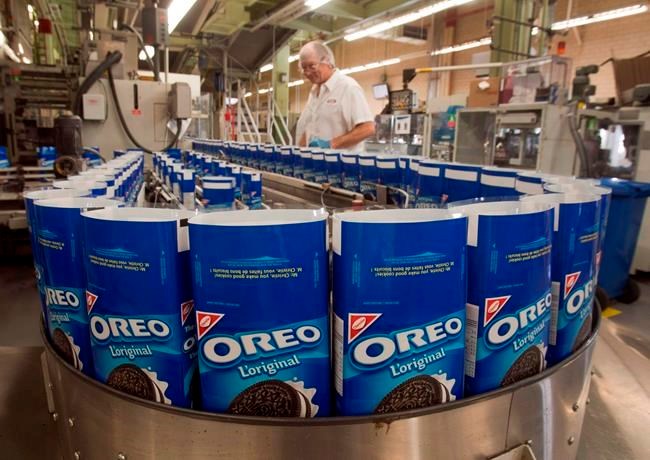
A worker keeps an eye on the Oreo cookie production line at the plant that makes all the Oreos for Canada, Wednesday, February 29, 2012 in Montreal. THE CANADIAN PRESS/Ryan Remiorz

“They want to remain competitive in an inflationary market, and in order to do that they play around with quantities instead of charging more for products.”

The shrinking-package strategy ultimately leaves consumers with less for their money for everything from cookies and chips to cheese and orange juice.

An original package of Oreo cookies, for example, has shrunk by about three cookies to 270 grams from 303 grams, a roughly 10 per cent reduction by weight.

A spokesman for Mondelēz Canada Inc., which makes the iconic cookie brand, said the company reduced the size of some Oreo packages earlier this year.

“It’s important to note that this change was a result of several factors, most significantly higher commodity costs which have been a challenge across the industry for some time,” Noah Farber said in an email.

“We work hard to ensure we offer value for money for our consumers, but we will never compromise on the taste or quality of Oreo which is loved by millions of consumers around the world.”

Consumers may also notice fewer chips in a bag, crackers in a box or granola bars in a package. A bag of Lay’s potato chips now weighs 165 grams, down from 180 grams, Quaker Chewy granola bars come with five bars rather than six or 120 grams instead of 156 grams, and Armstrong cheese is 600 grams rather than 700 grams, according to data compiled by Charlebois.

Food producers have also redesigned orange juice bottles to create a larger hollow bubble of space on the bottom, giving consumers the impression that the bottle is the same size while in fact reducing the amount of juice, he said.

Oasis orange juice containers, for example, now fit 1.5 litres rather than 1.65 litres, while Tropicana juice containers have 1.54 litres of juice rather than 1.75 litres, Charlebois said.

“It is subtle because they do alter the packages,” he said. “It gives you the illusion that you’re actually buying the same amount for the same price but you’re not.”

The “shrinkflation” retail tactic irks consumers, with recent social media posts calling out the stealth price hike strategy as sneaky.

But Charlebois said the price per 100 grams or 100 millilitres is disclosed to consumers in grocery stores, and that shrinking package sizes might have a positive impact on food waste.

“My biggest concern with shrinkflation is how we track food inflation rates in Canada,” he said, noting that we might be underestimating food inflation if shrinking package sizes aren’t accounted for.

Statistics Canada said its consumer price index compares the cost of a fixed basket of goods and services over time. The federal agency said its commodity specialists are able to do a quantity adjustment that accounts for changes in package size to ensure price increases are reflected in CPI.

A spokesperson with the Food, Health & Consumer Products of Canada, an industry group representing food manufacturers in Canada, was unavailable for an interview.

This report by The Canadian Press was first published Sept. 2 , 2021.

Report Error Submit a Tip

More Stories

Inmate captured after escape from Manitoba jail

Free Press staff 1 minute read Preview

Inmate captured after escape from Manitoba jail

Free Press staff 1 minute read Updated: 1:46 PM CDT

Manitoba RCMP have arrested an inmate who escaped from Milner Ridge Correctional Centre Wednesday.

Mounties apprehended Justin Paul at about 11 a.m. Thursday near Highway 11 and Minnewawa Street W in Lac du Bonnet.

Court records show Paul was in custody charged with multiple offences, including assault, uttering threats, robbery, theft and numerous weapon offences.

Last April, Paul pleaded guilty to failing to appear in court and was sentenced to six months probation.

Read
Updated: 1:46 PM CDT

Physician watchdog under fire for ‘outrageous’ policy

Katrina Clarke 6 minute read Preview

Physician watchdog under fire for ‘outrageous’ policy

Katrina Clarke 6 minute read Tuesday, Aug. 16, 2022

The Manitoba physician watchdog’s policy of deferring its own investigations into allegations of sexual misconduct while a police probe is ongoing is “outrageous” and is further evidence an independent review is needed into the regulatory body, critics say.

Read
Tuesday, Aug. 16, 2022

Jets hold first practice since Covid-19 shutdown

Mike McIntyre 7 minute read Preview

Jets hold first practice since Covid-19 shutdown

Mike McIntyre 7 minute read Monday, Jul. 13, 2020

Walking out of Rogers Place in the wee hours of March 12, I had no idea when the Winnipeg Jets might skate again — or what it might look like when they did. After all, the world was changing due to COVID-19, and a big win over the Edmonton Oilers earlier that night was quickly rendered meaningless in the grand scheme of things.

Now, 124 days later, we finally have some answers, along with a whole host of new questions. What went down Monday morning inside Bell MTS Iceplex, as the most unique training camp in club history got underway, was like nothing anyone associated with the sport has ever experienced before.

There were mandatory nasal swabs up the noses of all Jets players, along with health questionnaires and digital temperature checks for those of us entering the facility. Masks were required at all times. The rink lobby, normally a hub of activity whenever the hometown team hits the ice, was a ghost town and closed to the public. Handshakes among colleagues I haven't seen for four months were replaced by distant waves and muffled, socially distant pleasantries, just as hugs and high-fives among players were a no-no.

A workspace was created in the Press Box Restaurant, with tables spaced out against against glass that fogged up every few minutes. It didn't take long to remember why hockey and hot summer weather don't typically work well together. Forget the wind chill, does anyone know the humidex?

Read
Monday, Jul. 13, 2020

‘Much more to do’ to meet demand for licensed child care: education minister

Maggie Macintosh 4 minute read Preview

‘Much more to do’ to meet demand for licensed child care: education minister

Maggie Macintosh 4 minute read 5:49 PM CDT

An Elmwood child-care facility with 1,000 kids on its wait list served as the backdrop for a government news conference touting recent steps taken to meet overwhelming demand for licensed spaces in Manitoba.

“Much accomplished, much more to do — but we’re on the right track,” Education Minister Tracy Schmidt told reporters during a morning event at the Munroe Early Childhood Education Centre on Thursday.

The centre, which operates two preschool sites in northeast Winnipeg, recently underwent renovations to accommodate 48 more children at its Thames Avenue location.

Those additions are among 1,075 funded spaces that have opened across Manitoba since late last year.

Read
5:49 PM CDT

Soaring fuel prices, pandemic make market untenable for TappCar

Gabrielle Piché 5 minute read Preview

Soaring fuel prices, pandemic make market untenable for TappCar

Gabrielle Piché 5 minute read Monday, Jun. 27, 2022

Rising gas prices and market instability have created a bumpy ride for ride-hailing services. TappCar, which five years ago became the first company to offer ride-hailing services in Winnipeg, has headed for the exit ramp.

The company’s local branch shuttered Sunday, CEO Noel Bernier confirmed to the Free Press.

“Between the pandemic effects, the unknown type of recovery we’re going to have from the pandemic, and then, of course, the energy prices… all of it just made it untenable to market or manage a… discount ride-share,” Bernier said.

The Edmonton-based platform launched in Winnipeg in 2018. Bernier was among a local group to acquire TappCar’s Winnipeg branch late last year.

Read
Monday, Jun. 27, 2022

Transit installing driver-activated emergency-alert system

Joyanne Pursaga 4 minute read Preview

Transit installing driver-activated emergency-alert system

Joyanne Pursaga 4 minute read Thursday, Dec. 9, 2021

All Winnipeg Transit buses will soon be equipped to warn bystanders and motorists to call 911 instead of boarding the vehicles while an emergency is taking place.

The city is now installing a system that displays “Emergency Call 911” followed by “Do Not Board Bus” on electronic message boards that are visible only from the outside. When a driver activates the system, the message will also be sent to Winnipeg Transit’s control centre.

The entire 645-bus fleet will be upgraded with the new safety feature by Dec. 15.

“This emergency-signal system ensures another layer of protection for our operators and our passengers by ensuring help arrives as quickly as possible,” said Greg Ewankiw, Transit’s director.

Read
Thursday, Dec. 9, 2021