EXPLAINER: Why Japan ‘rising sun’ flag provokes Olympic ire

Advertisement

Advertise with us

SEOUL, South Korea (AP) — Japan considers the “rising sun” flag part of its history. But some in the Koreas, China and other Asian countries say the flag is a reminder of Japan’s wartime atrocities, and is comparable to the Nazi swastika.

Read this article for free:


By clicking the button above, an account will be created and you will begin to receive some of our recommended newsletters. You may opt out of any newsletter by visiting your Email and Communication Preferences page or by clicking "unsubscribe" at the bottom of any email.

or

Already have an account? Log in here »

To continue reading, please subscribe:

Digital Subscription

One year of digital access for only $1.44 a week*

  • Enjoy unlimited reading on winnipegfreepress.com
  • Read the E-Edition, our digital replica newspaper
  • Access News Break, our award-winning app
  • Play interactive puzzles

*Billed as $5.77 plus GST every four weeks. After 52 weeks, price increases to the regular rate of $19.95 plus GST every four weeks. Offer available to new and qualified returning subscribers only. Cancel any time.

To continue reading, please subscribe:

Add Free Press access to your Brandon Sun subscription for only an additional

$1 for the first 4 weeks*

  • Enjoy unlimited reading on winnipegfreepress.com
  • Read the E-Edition, our digital replica newspaper
  • Access News Break, our award-winning app
  • Play interactive puzzles
Start now

*Your next Brandon Sun subscription payment will increase by $1.00 and you will be charged $17.95 plus GST for four weeks. After four weeks, your payment will increase to $24.95 plus GST every four weeks.

Hey there, time traveller!
This article was published 22/07/2021 (1927 days ago), so information in it may no longer be current.

SEOUL, South Korea (AP) — Japan considers the “rising sun” flag part of its history. But some in the Koreas, China and other Asian countries say the flag is a reminder of Japan’s wartime atrocities, and is comparable to the Nazi swastika.

That’s why the flag has created anger at the Olympics, with some of the host nation’s neighbors calling for it to be banned during the Tokyo Games, which start Friday.

There’s little prospect that ties between Seoul and Tokyo will improve any time soon. But the flag dispute may ease. Some experts say the COVID-19 restrictions that have banned spectators at most Olympic venues stadiums may prevent the disagreement from growing.
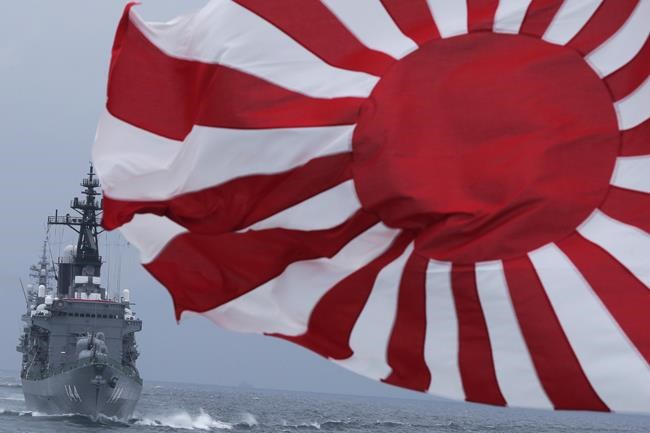
FILE - In this Oct. 14, 2012, file photo, Japan Maritime Self-Defense Force (JMSDF) escort ship
FILE - In this Oct. 14, 2012, file photo, Japan Maritime Self-Defense Force (JMSDF) escort ship "Kurama," left, navigates behind destroyer "Yudachi," with a rising sun flag, during a fleet review in water off Sagami Bay, south of Tokyo. Japan’s “rising sun” flag is raising anger at the Olympics, with some of the host nation’s neighbors calling for it to be banned during the Tokyo Games, which start Friday, July 23, 2021. (AP Photo/Itsuo Inouye, File)

Here’s a look at the “rising sun” flag and the long-running unease it has caused in Northeast Asia.

___

ORIGIN

There are two rising sun flags associated with Japan, whose very name in Japanese means “the sun’s origin.”

One is the country’s national flag, called “nisshoki,” or “hinomaru,” which has a red disc on a white background. Few have a problem with this.

The other one also has a red disc, but it is surrounded by 16 rays that extend outward. Called “kyokujitsuki,” this one has led to vehement protests from some of Japan’s neighbors.

Both flags have been used for centuries. But disputes about the “rising sun” flag date back to the early part of the 20th century. That’s when Japan’s imperial navy used it as its official flag as the nation colonized the Korean Peninsula and invaded or occupied China and other Asian countries until its World War II defeat in 1945.

It’s still Japan’s navy flag, used by the Maritime Self-Defense Force and, in a slightly modified version, by the Ground-Self Defense Force since 1954.

These days, ultra-rightists in Japan often use the flag during rallies or on social media.

___

CONFLICTING VIEWS

Japan’s government emphasizes that both rising sun flags use the sun as a motif and were used across the country even before the wartime period. Even today, the rising sun with rays flag motif is used in everyday life in Japan, such as to celebrate a big catch by fishermen, childbirth and other festivities, the government says.

“An argument that it is a political statement or a symbol of militarism is completely irrelevant. I believe there is a big misunderstanding,” now-Japanese Prime Minister Yoshihide Suga said in 2013, when he served as chief cabinet secretary.

Japan’s neighbors view it differently.

In 2019, South Korea formally requested that the International Olympic Committee ban the flag at the Tokyo Olympics. Seoul said that the flag recalls the “scars and pain” of Asian people who experienced Japan’s wartime military aggression, similar to how the swastika “reminds Europeans of the nightmare of World War II.”

North Korea’s state media, not known for understatement, have accused Japan of trying to turn “the flag of war criminals” into a symbol of peace at the Olympics, saying that is “an intolerable insult to our people and other Asian people.”

China is also highly sensitive to perceived slights from the Japanese government, individuals and companies. However, official outrage over history has diminished somewhat, while China’s political, economic and cultural rivalry with the United States and European democracies has increased in recent years. When it comes to the flag, it’s clearly less sensitive in China than in South Korea.

___
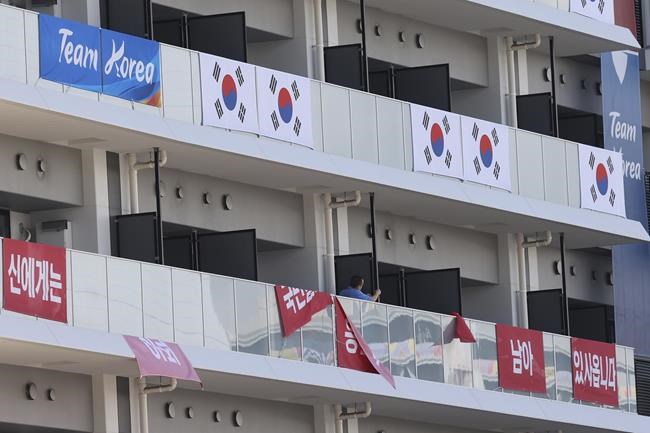
FILE - In this July 17, 2021, file photo, banners with the words
FILE - In this July 17, 2021, file photo, banners with the words "I still have the support of 50 million Korean people," are removed from balconies at the the Olympic athletes' village in Tokyo. South Korea removed the banners that the IOC ruled to be provocative, Seoul said it received an IOC promise that the displaying of the “rising sun” flag would also be banned at stadiums and other Olympic venues. (Jin Sung-chul/Yonhap via AP, File)

USE AT THE GAMES

On Saturday, when South Korea removed banners at the Olympic athletes’ village in Tokyo that the IOC ruled to be provocative, Seoul said it received an IOC promise that the displaying of the “rising sun” flag would also be banned at stadiums and other Olympic venues.

But South Korean media later reported that some activists carried the “rising sun” flag near the athletes’ village. Media reports also said Japan’s organizing committee ruled the flag isn’t banned inside Olympic stadiums.

“It would be inappropriate to ban the flag from naval exchanges because a version is used by the Japanese Maritime Self-Defense Forces,” Leif-Eric Easley, a professor at Ewha University in Seoul, said. “However, you would not expect the Tokyo Olympics hosts or Japanese athletes to use the rising sun emblem because it is not the national flag.”

Ties between Seoul and Tokyo, both U.S. allies, have suffered for years in part because of disputes over history and trade.

South Korean President Moon Jae-in’s office announced Monday that Moon had decided not to visit Japan for the Olympics because the two countries failed to find enough common ground to support a leaders’ summit.

___

WILL THIS GET WORSE?

Some experts say the flag dispute isn’t as serious as other points of contention, like Japan’s wartime mobilization of Koreans into sexual slavery or forced labor, and won’t likely worsen ties.

The flag dispute can still flare, however, if anger among anti-Japan civic groups in the South draw a backlash among the Japanese public, says Lee Myon-woo, deputy head of the private Sejong Institute near Seoul. Lee says South Korea should refrain from a “too excessive, political interpretation” of the flag because there is no sign that Japan is reviving past militarism.

But Bong Youngshik, a research fellow at Yonsei University Institute for North Korean Studies, says the flag wouldn’t have become a major issue if Japan had accepted its neighbors’ demands for making a more “sincere apology” over its wartime abuse.

The dispute may not have much kindling to fuel it, though, for one key reason: The lack of spectators at nearly all Olympics venues means no one is waving that flag — which means the dispute may die down for the time being.

___

Yamaguchi reported from Tokyo. More AP Olympics: https://apnews.com/hub/2020-tokyo-olympics and https://twitter.com/AP_Sports

Report Error Submit a Tip

More Stories

Provincial budget fails to chart new course

Editorial 4 minute read Preview

Provincial budget fails to chart new course

Editorial 4 minute read Wednesday, Apr. 13, 2022

If the 2022 Manitoba budget was intended to provide a lifeline for the Progressive Conservative government, it must surely be considered a failure.

Prior to the budget’s release, Premier Heather Stefanson and her government were teetering on the edge of the political abyss. Manitobans are profoundly unhappy with the government’s performance on most issues, including pandemic management. National polls show Ms. Stefanson is Canada’s least popular premier.

That political context made this budget a high-priority project for the Tories. It was, simply put, their best chance to shed the lingering burden left by former premier Brian Pallister, and rebuild the party brand under a new leader.

Unfortunately, Ms. Stefanson’s first budget remains shackled to the deeply flawed fiscal and political logic that defined the Pallister years. And no single budgetary measure embodies that failure more than the premier’s decision to continue cutting education property taxes.

Read
Wednesday, Apr. 13, 2022

Doctor’s departure stressful for teen

Kevin Rollason 6 minute read Preview

Doctor’s departure stressful for teen

Kevin Rollason 6 minute read Sunday, Oct. 24, 2021

Morgan Walker is a typical teen — but only because a piece of his brain the size of a deck of cards was removed four years ago.

Walker, who had seizures multiple times a day before his surgery, fears other people might not be so lucky.

That’s because his surgeon, Dr. Demitre Serletis, is leaving the province and Health Sciences Centre. Serletis will start practising at the Cleveland Clinic in the new year.

“I was kind of shocked, but I understood why,” Walker said from his home in Brandon. “The government really hasn’t been respecting doctors.”

Read
Sunday, Oct. 24, 2021

Westman to lose sole medical oncologist

Rylee Gerrard 5 minute read Preview

Westman to lose sole medical oncologist

Rylee Gerrard 5 minute read Updated: Yesterday at 9:26 AM CDT

BRANDON — Western Manitoba is about to lose its only medical oncologist, leaving just 22 in the province — all of whom are in Winnipeg.

Brandon West MLA Wayne Balcaen raised the issue during question period Thursday, saying the departure of Dr. Brady Anderson will be a “major loss” for the region.

After four years working out of the Western Manitoba Cancer Centre in Brandon, Anderson’s last day will be Nov. 13.

“He literally sees hundreds of patients within the Westman area, and now those individuals will have to travel to Winnipeg to get that personal service,” Balcaen said, calling Anderson’s impending departure “catastrophic.”

Read
Updated: Yesterday at 9:26 AM CDT

Human rights museum responds to reopening backlash

Julia-Simone Rutgers 4 minute read Preview

Human rights museum responds to reopening backlash

Julia-Simone Rutgers 4 minute read Thursday, Jul. 29, 2021

The Canadian Museum for Human Rights reopened to fully vaccinated members of the public this week, drawing cries of discrimination from those who have chosen not to get vaccinated against COVID-19.

While the some of the backlash has been “disturbing,” museum CEO Isha Khan said the conflict has opened room for a conversation about human rights during the pandemic.

“We made the decision to open in compliance with that law, really because we’re a public institution and we saw it as our responsibility to open as soon as we could to the public — within the restrictions as they currently are,” Khan said Thursday.

“But it’s really important to us, as the Canadian Museum for Human Rights we have a mandate for human rights education, that we’re trying to ground the conversation in human rights principles.”

Read
Thursday, Jul. 29, 2021

Industry minister to meet Rogers CEO after outage

Tyler Griffin, The Canadian Press 4 minute read Preview

Industry minister to meet Rogers CEO after outage

Tyler Griffin, The Canadian Press 4 minute read Sunday, Jul. 10, 2022

TORONTO - Canada's industry minister will convene a meeting with the leader of Rogers Communications in the wake of a massive outage that paralyzed the company's network and hampered several crucial services, his office announced on Sunday, even as some customers continued to report service disruptions.

A statement released from the office of François-Philippe Champagne said he plans to meet with Tony Staffieri and other telecom leaders to discuss the importance of improving "the reliability of networks across Canada."

The statement said Champagne found last week's widespread service disruption — which lasted at least 15 hours and knocked out access to numerous law enforcement, health care and banking services — "unacceptable," adding he has expressed that view directly to Staffieri.

"These services are vitally important for Canadians in their day to day life and we expect our telecom industry to meet the highest standards that Canadians rightly deserve," the statement read.

Read
Sunday, Jul. 10, 2022

Regulator urged to force MPI to lower rates, tackle claims costs

Nicole Buffie 4 minute read Preview

Regulator urged to force MPI to lower rates, tackle claims costs

Nicole Buffie 4 minute read Updated: Yesterday at 5:01 PM CDT

A citizen-led coalition has urged the Public Utilities Board to order Manitoba Public Insurance to lower its rates, which it says would force the Crown corporation to tackle rising claims costs.

The Consumers Coalition described MPI as “risk-averse,” at a hearing this week to discuss its application for a rate increase.

“The last three (general rate applications) have demonstrated that the corporation is running out of ideas and tools to mitigate rate increases and are executing a strategic plan grounded in their legacy business model,” said Katrine Dilay, a lawyer for the Public Interest Law Centre who spoke on behalf of the coalition.

Dilay said the coalition believes MPI is riding out the cost pressures and passing them on to ratepayers rather than preparing for the future.

Read
Updated: Yesterday at 5:01 PM CDT