Top medical adviser says ‘no fans’ safest for Tokyo Olympics
Advertisement
Read this article for free:
or
Already have an account? Log in here »
To continue reading, please subscribe:
Digital Subscription
One year of digital access for only $1.44 a week*
- Enjoy unlimited reading on winnipegfreepress.com
- Read the E-Edition, our digital replica newspaper
- Access News Break, our award-winning app
- Play interactive puzzles
*Billed as $5.77 plus GST every four weeks. After 52 weeks, price increases to the regular rate of $19.95 plus GST every four weeks. Offer available to new and qualified returning subscribers only. Cancel any time.
To continue reading, please subscribe:
Add Free Press access to your Brandon Sun subscription for only an additional
$1 for the first 4 weeks*
- Enjoy unlimited reading on winnipegfreepress.com
- Read the E-Edition, our digital replica newspaper
- Access News Break, our award-winning app
- Play interactive puzzles
*Your next Brandon Sun subscription payment will increase by $1.00 and you will be charged $17.95 plus GST for four weeks. After four weeks, your payment will increase to $24.95 plus GST every four weeks.
Read unlimited articles for free today:
or
Already have an account? Log in here »
Hey there, time traveller!
This article was published 18/06/2021 (1961 days ago), so information in it may no longer be current.
TOKYO (AP) — The safest way to hold the Tokyo Olympics is without any fans, the top medical adviser to the Japanese government said in a report on Friday.
Dr. Shigeru Omi’s recommendation seems to put him at odds with organizers and the International Olympic Committee with the Olympics opening in just five weeks on July 23.
Fans from abroad were banned several months ago, and organizers are to announce early next week if some local fans should be allowed.

“We believe the risks of infections inside venues would be lowest by holding the event with no fans,” said the report, which was compiled by a group of 26 experts led by Omi, a former World Health Organization official. It was submitted to the government and Olympic officials
Widely circulated reports say the government wants to allow up to 10,000 people at some sports and cultural events. This policy is expected to be applied to the Olympics with smaller ceilings at smaller venues, and differences for indoor and outdoor venues.
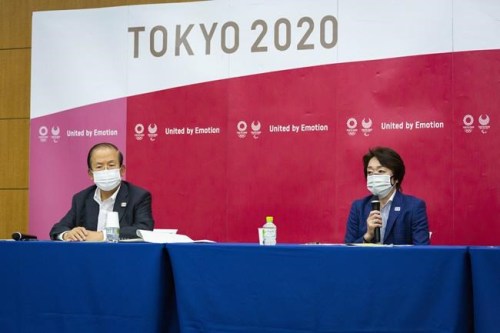
“We believe it would be most desirable not to have fans inside venues,” Omi told a news conference on Friday after submitting the written report. “Regardless of holding the Olympics or not, Japan has continuing risks of a resurgence of the infections that puts pressure on the medical systems.”
Omi said that putting fans in the venues increased the risk — and not only there but afterward as people exit. He said the Olympics easily get more attention from the public than other sporting events and are likely to trigger more movements and more partying.
Seiko Hashimoto, the president of the local organizing committee, said that the final decision on fans was likely to be made Monday in a meeting with organizers, the IOC, the Tokyo metropolitan government, the Japanese government, and the International Paralympic Committee.
Hashimoto said if Tokyo decides to allow fans, the rules will have to be much stricter than for half-filled stadiums in Japan for baseball or soccer. She also said organizers would have to be ready to suddenly ban local fans if conditions change.
“Dr. Omi has indicated that ideally the best way is to hold the games without spectators — that was his recommendation,” Hashimoto said. “But if we are to hold the games with spectators, Dr. Omi also had his recommendations.”
Hashimoto said she had consulted with baseball and soccer officials in Japan, where games with fans have been largely problem free.
“But Dr. Omi has also mentioned that the Tokyo Olympics and Paralympics are very special,” Hashimoto said. “Therefore Dr. Omi has mentioned that we need to be even more stringent than the other sports events. So we need to look at stricter rules. There is this risk of people who come to the games, and after watching they stop by bars and restaurants before going home. So it is recommended that we urge people to go straight home after watching the games.”
Ticket sales were to account for $800 million in income for the organizing committee. Much of it will be lost and government entities will have to make up the shortfall.
Organizers say about 3.6 million-3.7 million tickets are still held by residents of Japan. About 800,000 tickets were returned locally.
The total number of tickets originally announced for the Olympics was about 7.8 million.
The official cost of the Tokyo Olympics is $15.4 billion, although government audits suggest it is much higher. All but $6.7 billion is public money.
The IOC is pushing ahead with Tokyo, partly because it depends on broadcast rights sales for almost 75% of its income. Sponsors supply about 18%,

Emergency measures in Tokyo and other prefectures are being lifted on Sunday, although “quasi-emergency” restrictions will remain in place that may limit bar and restaurant hours.
Japan has attributed just over 14,000 deaths to COVID-19 and has controlled the virus better than many countries, but not as well as many in Asia. Only 15% of Japanese have at least one COVID-19 vaccination, and much of the public has been opposed to holding the Olympics.
Poll answers have shifted depending on how the question is phrased, and the country’s second-most widely circulated newspaper, the Asahi Shimbun, has said the games should be called off.
___
More AP Olympics: https://apnews.com/hub/olympic-games and https://twitter.com/AP_Sports
Related Articles
Heat remains a threat at Tokyo Olympics





Advertisement Advertise With Us
Advertisement Advertise With Us