‘Delicate, sensitive process:’ Expert talks on searching for burial sites with radar
Advertisement
Read this article for free:
or
Already have an account? Log in here »
To continue reading, please subscribe:

Digital Subscription
One year of digital access for only $205*
- Enjoy unlimited reading on winnipegfreepress.com
- Read the E-Edition, our digital replica newspaper
- Access News Break, our award-winning app
- Play interactive puzzles
*First annual payment billed as $205.00 + GST for one year. This annual subscription will automatically renew at $233.00 + GST every 52 weeks (10% off the regular annual price of $259.35). Offer available to new and qualified returning subscribers only. Cancel any time.
To continue reading, please subscribe:
Add Free Press access to your Brandon Sun subscription for only an additional
$1 for the first 4 weeks*
- Enjoy unlimited reading on winnipegfreepress.com
- Read the E-Edition, our digital replica newspaper
- Access News Break, our award-winning app
- Play interactive puzzles
*Your next Brandon Sun subscription payment will increase by $1.00 and you will be charged $17.95 plus GST for four weeks. After four weeks, your payment will increase to $24.95 plus GST every four weeks.
Read unlimited articles for free today:
or
Already have an account? Log in here »
Hey there, time traveller!
This article was published 01/06/2021 (1952 days ago), so information in it may no longer be current.
EDMONTON – Searching for unmarked burial sites is a painstaking process that not all Indigenous communities could be immediately ready for after the remains of more than 200 children were found at a former residential school in British Columbia, says an anthropologist who has done similar projects on the Prairies.
“Just a note of caution — we can’t just show up with our equipment and run surveys tomorrow,” says Kisha Supernant, an anthropology professor at the University of Alberta in Edmonton.
“This is a delicate, sensitive process that requires such care. And communities must decide what would be the right way forward.”
Supernant, who is also Métis and a descendant of the Papaschase First Nation, says residential schools often had children from many different Nations attend, so communities must also come together to ensure any search work done is in keeping with cultural practices.
Last week, the chief of the Tk’emlups te Secwepemc First Nation announced that the remains of 215 children had been found buried on the site of a former residential school in Kamloops, B.C. Chief Rosanne Casimir said the children, some as young as three, were students at the school, which was once the largest in Canada’s residential school system.
Kamloops Indian Residental School operated between 1890 and 1969. The federal government took over operation from the Catholic Church to operate it as a day school until it closed in 1978.
Casimir said technology such as ground-penetrating radar allowed for a true accounting of the missing children and will hopefully bring some peace and closure to those lives lost.
Supernant uses the same technology to help Indigenous communities survey burial grounds. She and her team have worked with the Enoch Cree and Papaschase First Nations in the Edmonton area.
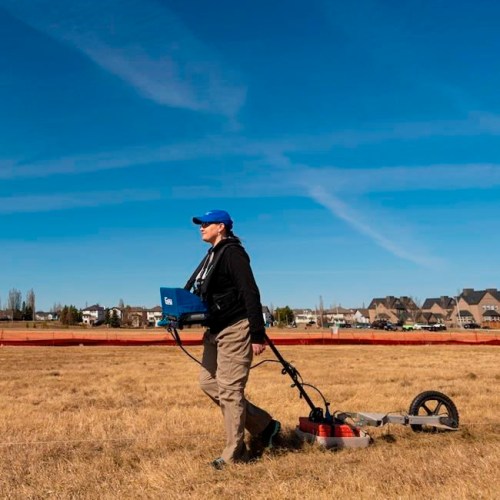
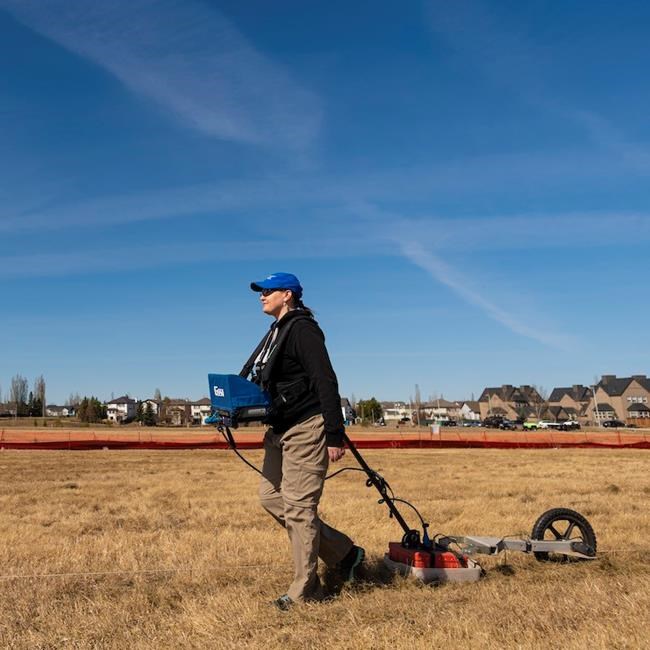
Ground-penetrating radar consists of a small antenna shaped as a box, which is dragged along the surface of the ground while sending a signal into the soil, she says. If there is a difference between the surrounding soil and a particular location, it changes the signal.
“In the case of looking for unmarked graves and burial locations, what this piece of equipment is able to show are areas that have been disturbed,” Supernant explains.
“When you dig a grave, the soil changes — the composition changes, the density can change — and the ground-penetrating radar can actually pick up that change.”
Her team pulls the equipment over the ground in a grid of 25-centimetre intervals, using frequencies best suited to detect changes two to three metres deep.
She worked on one project involving a residential school in 2018 in Saskatchewan. She and her team helped find remains of students of the Muscowequan Indian Residential School located near Lestock.
Supernant says she expected to get more requests after that project, but acknowledges that many Indigenous communities have a lot of pressing needs, such as mental health supports, housing and clean drinking water.
“Many communities don’t have access to the resources and the funding,” Supernant says. “And while, of course, this is very important, it’s also very difficult work and needs to be properly resourced.”
But Supernant says she expects to get more calls after the discovery in Kamloops, which has received attention countrywide.
In Nova Scotia, two groups that represent the province’s Mi’kmaq population issued a joint statement Monday saying ground-penetrating radar has been used at the former site of the Shubenacadie residential school, but no graves or human remains have been found.
The Mi’kmaq Rights Initiative and the Assembly of Nova Scotia Mi’kmaw Chiefs said archaeological investigations continue at the site north of Halifax
“With so many schools across the country, we are very aware that this is not an isolated incident,” the statement said.
In Saskatchewan, the Federation of Sovereign Indigenous Nations and the Saskatchewan government said they want Ottawa to help research undocumented deaths and burials at residential schools in the province.
The federation has compiled a list of initial sites where it hopes to complete radar ground searches, including Onion Lake, Beauval, Guy Hill, Lebret, Sturgeon Landing and the Lestock-Touchwood area.
Alberta’s Minister of Indigenous Affairs Rick Wilson said in a news release late Monday that the government intends to fund research into undocumented deaths and burials.
And Quebec’s Indigenous Affairs Minister said Tuesday that province was also open to searching the grounds of former residential schools for graves if survivors and their families are in favour.
Ian Lafrenière said his office has started reaching out to families, Indigenous leaders and federal counterpart to discuss the possibility.
He said he has seen no evidence that there are unmarked graves on the grounds of the six former residential schools that operated in the province, but cannot exclude the possibility.
Supernant says while the discovery in Kamloops is devastating, she is not surprised.
“I know every school had a graveyard of some kind and we can only expect to see more stories like this coming out. And communities really need to be supporting in trying to find their relatives.”

Most importantly, Supernant says, the projects have to be community-led and culturally sensitive.
“There has to be space for ceremony, because this is very sacred,” she says.
“This involved these ancestors, these children, whose spirits often haven’t been cared for in the ways their relatives need them to be cared for.”
This report by The Canadian Press was first published June 1, 2021.
— With files from Michael MacDonald in Halifax, Julia Peterson in Saskatoon, Rob Drinkwater in Edmonton and Morgan Lowrie in Montreal.
Related Articles
‘There’s another Kamloops coming’: Here are some Canadian sites believed to hold more unmarked graves of Indigenous children

Advertisement Advertise With Us
Advertisement Advertise With Us