

The election of our discontent
Winnipeg a troubled city spinning its wheels at a crumbling crossroads, grumbling residents say in poll
Advertisement
Read this article for free:
or
Already have an account? Log in here »
To continue reading, please subscribe:

Digital Subscription
One year of digital access for only $205*
- Enjoy unlimited reading on winnipegfreepress.com
- Read the E-Edition, our digital replica newspaper
- Access News Break, our award-winning app
- Play interactive puzzles
*First annual payment billed as $205.00 + GST for one year. This annual subscription will automatically renew at $233.00 + GST every 52 weeks (10% off the regular annual price of $259.35). Offer available to new and qualified returning subscribers only. Cancel any time.
To continue reading, please subscribe:
Add Free Press access to your Brandon Sun subscription for only an additional
$1 for the first 4 weeks*
- Enjoy unlimited reading on winnipegfreepress.com
- Read the E-Edition, our digital replica newspaper
- Access News Break, our award-winning app
- Play interactive puzzles
*Your next Brandon Sun subscription payment will increase by $1.00 and you will be charged $17.95 plus GST for four weeks. After four weeks, your payment will increase to $24.95 plus GST every four weeks.
Read unlimited articles for free today:
or
Already have an account? Log in here »
There’s an undercurrent of unhappiness running through the Winnipeg electorate as the municipal election day approaches.
One-half of Winnipeggers believe the city is heading in the wrong direction, according to a new Abacus Data poll, with nearly one-third unsure if Winnipeg is regressing or progressing.
Only 21 per cent of residents believe the city is on the right track, the Free Press-commissioned poll found.
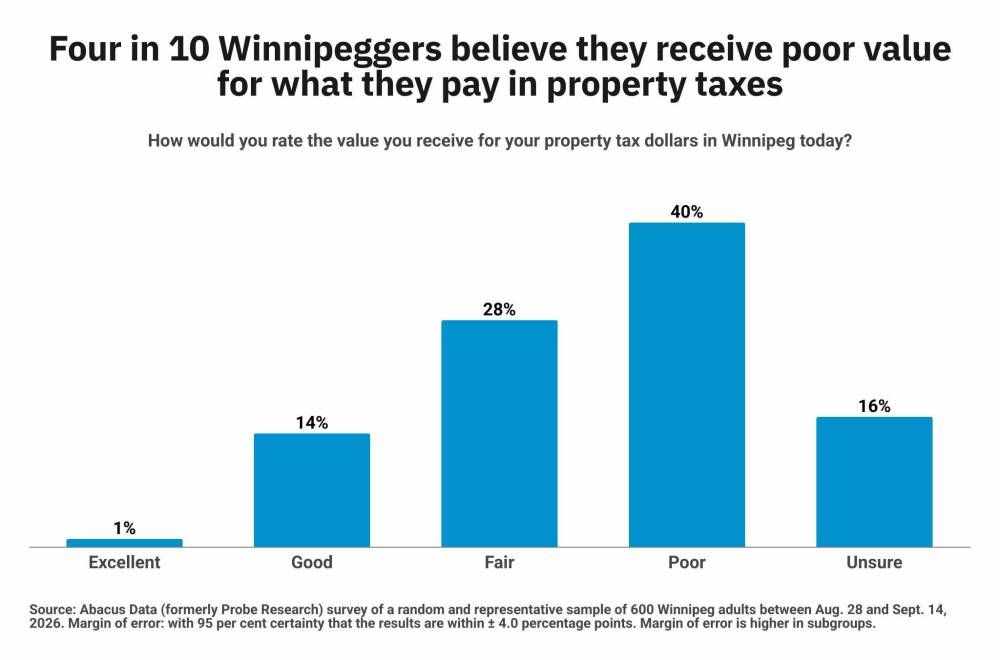
That discontentment extends to how the city spends its tax dollars, with four in 10 Winnipeggers believing they receive poor value for what they pay in property taxes.
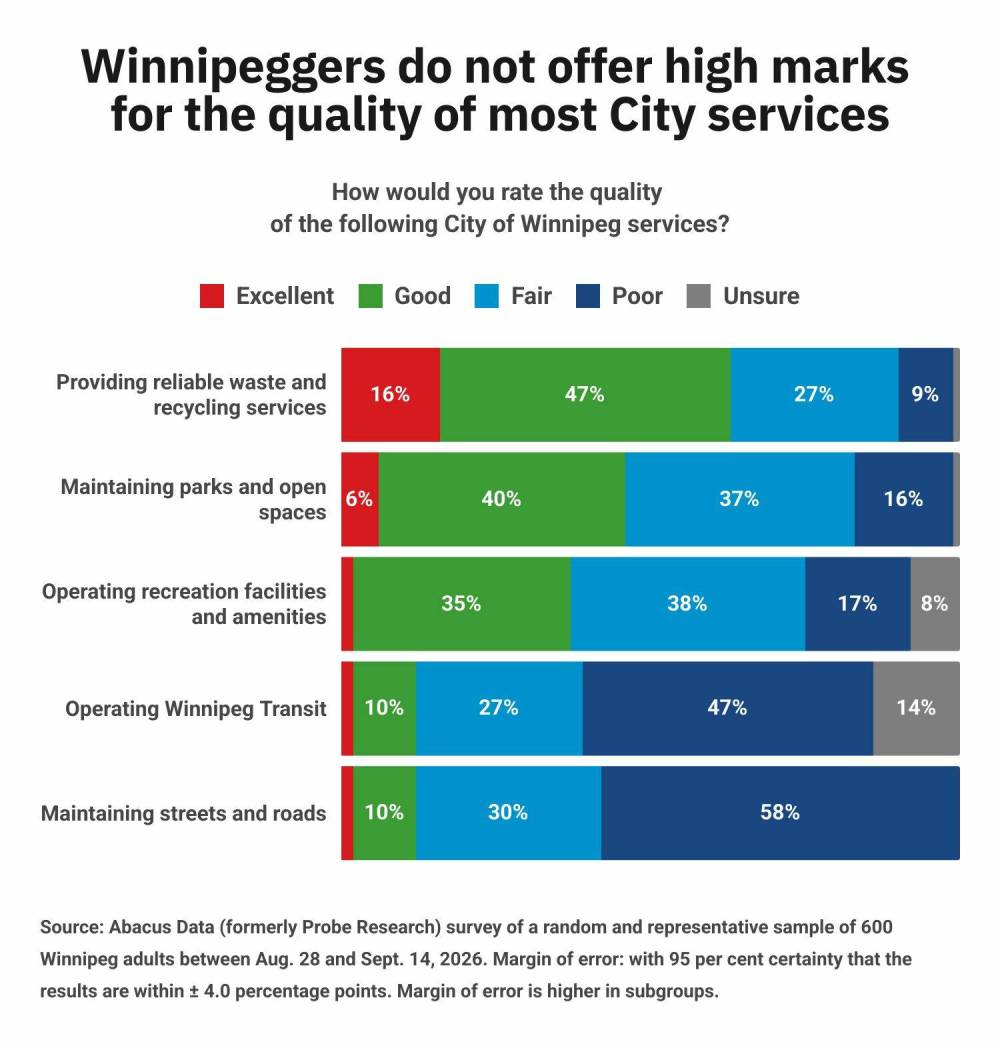
Garbage collection and recycling services received the highest mark, with 63 per cent saying it’s either excellent or good, while Winnipeg Transit operations and street maintenance are at the opposite end. Seventy-four per cent of residents say the city does a fair or poor job running Transit, while 88 per cent labelled the city’s street maintenance efforts as fair or poor.
“I think there’s a pretty acute sense that things are challenging right now, not great and not necessarily trending the right way,” Abacus Data (formerly Probe Research) vice-president Curtis Brown said.
• • •
Michael Redhead Champagne, a North End community advocate, said many Winnipeggers are becoming more cynical because they don’t see the city making progress in addressing key issues, from crime and public safety to crumbling streets and the struggling transit system.
The lack of progress fuels apathy among voters, he said, who may believe a lack of new ideas from incumbents on city council is allowing problems to linger. Additionally, the tax dollars required to extend infrastructure to new suburbs leaves other parts of the city feeling neglected, he said.
“We’re in a time where the general electorate and the voters and possible voters are not on the same planet as the elected politicians at the municipal level,” Redhead Champagne said.
Condo owner and retired social worker Margot Haig is among those troubled by the current state of the city.
Winnipeg appears to be regressing, or at best, stagnating, the 70-year-old said, describing Main Street, where homelessness and illicit drug use are prevalent, as the “saddest sight.”
“If we had visitors come to the city, we would never take them downtown because it just looks depressing,” she said.
University of Winnipeg political science professor Aaron Moore said he is not surprised people are dissatisfied about the value of city services they receive for what they pay in property taxes.
“I think people are starting to question some of the practices that we see in the city, and I think where the city is doing well, they’re giving the city credit for that, and where the city’s doing poorly, they’re holding the city to account for that, and I think that’s a good thing,” he said.
That level of dissatisfaction is the price Winnipeg is now paying for 14 years of property tax freezes under former mayors Glen Murray (1998-2004) and Sam Katz (2004-2014), Moore said.
Those fiscal decisions not only impacted the city’s coffers and long-term planning, he said, they also triggered a reduction in middle management and a loss of institutional knowledge overseeing infrastructure projects, such as road maintenance.
Scott Gillingham campaigned on raising property taxes when he was elected mayor in 2022. In 2025, city council approved a 5.95 per cent hike, the largest single-year increase since the 1990s.
Property taxes rose another 3.5 per cent this year, to fund major projects, including the $3.1-billion North End sewage treatment plant upgrade.
Last year, city council approved a $1.1-billion capital plan to fix roads over six years. An estimated $156.8 million was in the budget for local and regional road improvement this year.
Despite that, Winnipeggers judge the effectiveness of their tax dollars by what they see, Moore said, and that is often recurring repairs on the same streets while other roads continue to be neglected.
“I think even with infrastructure you don’t have to be an expert on engineering to look at a road and see that there’s a problem or, ‘OK, so this was built, like, a year ago, but now it’s heaving,’” he said.
River Heights homeowner Matthew TenBruggencate shares that view, saying he often sees construction barricades on the same roads every year, with little progress being made.
Property tax increases are necessary to catch up with operating expenses, TenBruggencate said, but cuts to city services, such as library hours, make him question if resources are being properly used.
He said he would like to see other alternative ways to generate city revenue that are more equitable and geared to income, rather than the “big club” of property tax.
West Broadway resident and longtime bus rider Mel Chepil said last year’s transit-system overhaul has made it easier to get to work, but that’s where the benefits stopped.
The 40-year-old mental-health crisis worker said it often takes three different buses to go anywhere other than work and he can understand why a significant number of Winnipeggers are unhappy with the new system.
Chepil, who doesn’t own a car and walks with a disability, said he has been spending more money on Uber and taxis to avoid the “bus confusion and hassle,” especially at night.
“Winnipeg Transit was really, really good when I first started taking the bus 22 years ago, but it has gone downhill ever since and this change didn’t help,” he said, noting a functional transit system can reduce other issues, such as poverty.
Chepil said he will vote in the Oct. 28 election, but is becoming more disillusioned when he can’t see improvements.
“I always vote, but it’s getting to the point where I’m like, ‘Why am I even doing this?’ It’s not going to do anything,” he said.
Kate Kehler, executive director for the non-profit Social Planning Council of Winnipeg, said she understands the sense of frustration shared by many residents.
“People are being asked for more money (through property tax hikes), and they don’t see things getting better,” she said.
Transit is a particular pain point for many who feel disappointed or neglected by the new system, Kehler said.

People in downtown and the North End are also cynical about the state of services because they perceive their sidewalks and roads aren’t fixed or plowed as quickly as suburban communities, she said, adding some lower-income residents, feeling their voices won’t be heard, may not bother to vote.
Both Kehler and Redhead Champagne said people have to get actively involved in the electoral process if they want to see change. That means studying what each candidate is promising and getting out to vote.
“We have to decide where we need to be,” Kehler said. “Are we going to be a city that actually looks after everybody? That’s the question right now, and right now I’m not sure we’re doing that.”
Abacus Data surveyed 600 Winnipeg adults from Aug. 28 to Sept. 14, with a margin of error of plus or minus four percentage points, 95 times out of 100.
matthew.frank@freepress.mb.ca