WEATHER ALERT

‘Delicate, sensitive process:’ Expert talks on searching for burial sites with radar

Advertisement

Advertise with us

EDMONTON - Searching for unmarked burial sites is a painstaking process that not all Indigenous communities could be immediately ready for after the remains of more than 200 children were found at a former residential school in British Columbia, says an anthropologist who has done similar projects on the Prairies.

Read this article for free:

or

Already have an account? Log in here »

To continue reading, please subscribe:

Subscribe and receive a limited-edition Free Press branded hat or tote.

Digital Subscription

One year of digital access for only $205*

  • Enjoy unlimited reading on winnipegfreepress.com
  • Read the E-Edition, our digital replica newspaper
  • Access News Break, our award-winning app
  • Play interactive puzzles

*First annual payment billed as $205.00 + GST for one year. This annual subscription will automatically renew at $233.00 + GST every 52 weeks (10% off the regular annual price of $259.35). Offer available to new and qualified returning subscribers only. Cancel any time.

To continue reading, please subscribe:

Add Free Press access to your Brandon Sun subscription for only an additional

$1 for the first 4 weeks*

  • Enjoy unlimited reading on winnipegfreepress.com
  • Read the E-Edition, our digital replica newspaper
  • Access News Break, our award-winning app
  • Play interactive puzzles
Start now

*Your next Brandon Sun subscription payment will increase by $1.00 and you will be charged $17.95 plus GST for four weeks. After four weeks, your payment will increase to $24.95 plus GST every four weeks.

Hey there, time traveller!
This article was published 01/06/2021 (1875 days ago), so information in it may no longer be current.

EDMONTON – Searching for unmarked burial sites is a painstaking process that not all Indigenous communities could be immediately ready for after the remains of more than 200 children were found at a former residential school in British Columbia, says an anthropologist who has done similar projects on the Prairies.

“Just a note of caution — we can’t just show up with our equipment and run surveys tomorrow,” says Kisha Supernant, an anthropology professor at the University of Alberta in Edmonton.

“This is a delicate, sensitive process that requires such care. And communities must decide what would be the right way forward.”
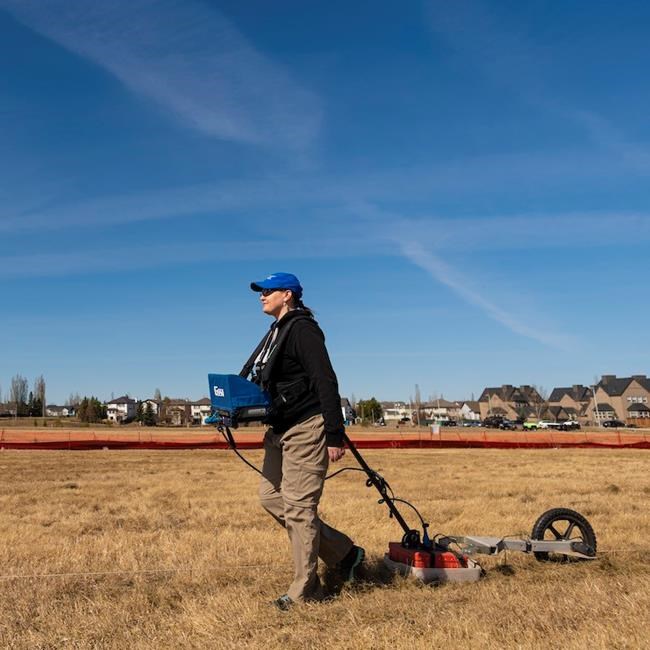
Kisha Supernant, an anthropology professor at the University of Alberta in Edmonton is shown in this handout image on Tuesday April 20, 2021. Searching for unmarked burial sites is a painstaking process that not all Indigenous communities could be immediately ready for after the remains of more than 200 children were found at a former residential school in British Columbia, says an anthropologist who has done similar projects on the Prairies. THE CANADIAN PRESS/HO-University of Alberta-John Ulan*MANDATORY CREDIT*

Supernant, who is also Métis and a descendant of the Papaschase First Nation, says residential schools often had children from many different Nations attend, so communities must also come together to ensure any search work done is in keeping with cultural practices.

Last week, the chief of the Tk’emlups te Secwepemc First Nation announced that the remains of 215 children had been found buried on the site of a former residential school in Kamloops, B.C. Chief Rosanne Casimir said the children, some as young as three, were students at the school, which was once the largest in Canada’s residential school system.

Kamloops Indian Residental School operated between 1890 and 1969. The federal government took over operation from the Catholic Church to operate it as a day school until it closed in 1978.

Casimir said technology such as ground-penetrating radar allowed for a true accounting of the missing children and will hopefully bring some peace and closure to those lives lost.

Supernant uses the same technology to help Indigenous communities survey burial grounds. She and her team have worked with the Enoch Cree and Papaschase First Nations in the Edmonton area.

Ground-penetrating radar consists of a small antenna shaped as a box, which is dragged along the surface of the ground while sending a signal into the soil, she says. If there is a difference between the surrounding soil and a particular location, it changes the signal.

“In the case of looking for unmarked graves and burial locations, what this piece of equipment is able to show are areas that have been disturbed,” Supernant explains.

“When you dig a grave, the soil changes — the composition changes, the density can change — and the ground-penetrating radar can actually pick up that change.”

Her team pulls the equipment over the ground in a grid of 25-centimetre intervals, using frequencies best suited to detect changes two to three metres deep.

She worked on one project involving a residential school in 2018 in Saskatchewan. She and her team helped find remains of students of the Muscowequan Indian Residential School located near Lestock.

Supernant says she expected to get more requests after that project, but acknowledges that many Indigenous communities have a lot of pressing needs, such as mental health supports, housing and clean drinking water.

“Many communities don’t have access to the resources and the funding,” Supernant says. “And while, of course, this is very important, it’s also very difficult work and needs to be properly resourced.”

But Supernant says she expects to get more calls after the discovery in Kamloops, which has received attention countrywide.

In Nova Scotia, two groups that represent the province’s Mi’kmaq population issued a joint statement Monday saying ground-penetrating radar has been used at the former site of the Shubenacadie residential school, but no graves or human remains have been found.

The Mi’kmaq Rights Initiative and the Assembly of Nova Scotia Mi’kmaw Chiefs said archaeological investigations continue at the site north of Halifax

“With so many schools across the country, we are very aware that this is not an isolated incident,” the statement said.

In Saskatchewan, the Federation of Sovereign Indigenous Nations and the Saskatchewan government said they want Ottawa to help research undocumented deaths and burials at residential schools in the province.

The federation has compiled a list of initial sites where it hopes to complete radar ground searches, including Onion Lake, Beauval, Guy Hill, Lebret, Sturgeon Landing and the Lestock-Touchwood area.

Alberta’s Minister of Indigenous Affairs Rick Wilson said in a news release late Monday that the government intends to fund research into undocumented deaths and burials.

And Quebec’s Indigenous Affairs Minister said Tuesday that province was also open to searching the grounds of former residential schools for graves if survivors and their families are in favour.

Ian Lafrenière said his office has started reaching out to families, Indigenous leaders and federal counterpart to discuss the possibility.

He said he has seen no evidence that there are unmarked graves on the grounds of the six former residential schools that operated in the province, but cannot exclude the possibility.

Supernant says while the discovery in Kamloops is devastating, she is not surprised.

“I know every school had a graveyard of some kind and we can only expect to see more stories like this coming out. And communities really need to be supporting in trying to find their relatives.”

Most importantly, Supernant says, the projects have to be community-led and culturally sensitive.

“There has to be space for ceremony, because this is very sacred,” she says.

“This involved these ancestors, these children, whose spirits often haven’t been cared for in the ways their relatives need them to be cared for.”

This report by The Canadian Press was first published June 1, 2021.

— With files from Michael MacDonald in Halifax, Julia Peterson in Saskatoon, Rob Drinkwater in Edmonton and Morgan Lowrie in Montreal.

Report Error Submit a Tip

More Stories

NDP infrastructure plan on shaky ground

Tom Brodbeck 5 minute read Preview

NDP infrastructure plan on shaky ground

Tom Brodbeck 5 minute read Thursday, Aug. 22, 2019

The problem with the NDP’s proposal to ramp up spending on infrastructure by hundreds of millions of dollars is the party has no legitimate plan to pay for it.

Manitoba NDP Leader Wab Kinew announced this week, if elected Sept. 10, his party would spend $690 million more on strategic infrastructure over four years compared to what the Pallister government has planned.

Strategic infrastructure includes capital spending in areas such as highways, flood mitigation, health-care facilities and public buildings.

Capital spending under the previous NDP government skyrocketed from $994 million in 2007-08 to nearly $1.7 billion in 2015-16, according to a 2018 report by Manitoba’s auditor general.

Read
Thursday, Aug. 22, 2019

Lemieux finds home on Jets’ fourth line

Mike Sawatzky 5 minute read Preview

Lemieux finds home on Jets’ fourth line

Mike Sawatzky 5 minute read Monday, Feb. 4, 2019

Brendan Lemieux's game is rough around the edges, there's no mystery about that.

But adapting that grinding style for success in the NHL may have seemed like a bit of a long shot when the 22-year-old Winnipeg Jets left-winger was suspended for two games after an illegal hit to the head of Florida's Vincent Trocheck on Nov. 2 in Helsinki. The resulting match penalty led to a power-play goal by Keith Yandle, the eventual game-winner in a 4-2 triumph by the Panthers.

Earlier in the game, a power play generated by Lemieux's high-sticking minor on Troy Brouwer resulted in a Mike Hoffman goal that tied the game 2-2.

"I think in a lot of people’s minds it was a huge deal, but it was a learning experience I think," said Lemieux following practice Monday afternoon. "There’s penalties every game… As far as the hit goes, it was unfortunate to get suspended, it cost us the game — the five-minute penalty — but it was the circumstance of the penalty and the hit, all in the same game.

Read
Monday, Feb. 4, 2019

Searching burial sites with ground radar

Daniela Germano, The Canadian Press 6 minute read Preview

Searching burial sites with ground radar

Daniela Germano, The Canadian Press 6 minute read Tuesday, Jun. 1, 2021

EDMONTON - Searching for unmarked burial sites is a painstaking process that not all Indigenous communities could be immediately ready for after the remains of more than 200 children were found at a former residential school in British Columbia, says an anthropologist who has done similar projects on the Prairies.

"Just a note of caution — we can't just show up with our equipment and run surveys tomorrow," says Kisha Supernant, an anthropology professor at the University of Alberta in Edmonton.

"This is a delicate, sensitive process that requires such care. And communities must decide what would be the right way forward."

Supernant, who is also Métis and a descendant of the Papaschase First Nation, says residential schools often had children from many different Nations attend, so communities must also come together to ensure any search work done is in keeping with cultural practices.

Read
Tuesday, Jun. 1, 2021

‘Heartbreaking loss’: Sandy Bay First Nation offers condolences after apparent dog attack.

Morgan Modjeski 3 minute read Preview

‘Heartbreaking loss’: Sandy Bay First Nation offers condolences after apparent dog attack.

Morgan Modjeski 3 minute read Yesterday at 12:52 PM CDT

Leaders with the Sandy Bay Ojibway First Nation are offering their condolences after an animal rescue worker died following an apparent dog attack in the community and say the “stray and aggressive” animals are a longstanding issue.

Amanda Nobiss, 37, was volunteering in the community on the shores of Lake Manitoba with K9 Advocacy. Her remains were discovered on Friday morning.

The Manitoba First Nations Police Service said in a news release that it had been contacted by a friend of Amanda’s who was trying to locate her, around 12:45 a.m.

Using her cellphone location, police determined she appeared to be in Sandy Bay, said the release. Resources were dispatched to the area, including a drone, but due to the large radius of the cellphone “ping,” no one was located until 6 a.m.

Read
Yesterday at 12:52 PM CDT

City denies teen received ‘life-altering injuries’ from police dog bite in lawsuit defence

Erik Pindera 3 minute read Preview

City denies teen received ‘life-altering injuries’ from police dog bite in lawsuit defence

Erik Pindera 3 minute read Saturday, Jul. 18, 2026

City officials have denied a 17-year-old girl’s claim she received life-altering injuries when a Winnipeg police dog bit her, arguing her lawsuit over last year’s incident should be rejected.

The teen, whom the Free Press is not naming because she is a minor involved with a police matter, seeks unspecified damages from the City of Winnipeg, in a statement of claim filed in the Court of King’s Bench in March.

The teen, described as “a small, slightly built girl,” claims she was “attacked, arrested and detained” by several Winnipeg Police Service officers around 1 a.m. on June 4, 2025.

The girl’s court papers say that in order to detain the teen, officers first deployed “a large, vicious and dangerous, non-human, canine animal,” which the lawsuit calls the “beast” in subsequent references.

Read
Saturday, Jul. 18, 2026

Mary Tyler Moore’s passing feels more personal than the rest

Brad Oswald 4 minute read Preview

Mary Tyler Moore’s passing feels more personal than the rest

Brad Oswald 4 minute read Wednesday, Jan. 25, 2017

This one feels oddly personal.

The past year has been a sombre parade of celebrity deaths, beginning with last January's passing of musicians David Bowie and Glenn Frey and continuing through the late winter and early spring with the deaths of comedian/actor Garry Shandling, record producer Sir George Martin, actress Patty Duke and pop-music icon Prince; summer brought sad farewells to legendary sportsmen Muhammad Ali and Gordie Howe, writer/producer Garry Marshall and actor Gene Wilder, and before 2016 could come to its woeful end we also lost golf pioneer Arnold Palmer, poet/musician Leonard Cohen, actor Alan Thicke, singer George Michael and the mother/daughter tandem of Debbie Reynolds and Carrie Fisher.

All of them were, in their own way, beloved, and the passing of each was followed by tributes and, for some, a few tears. But for several reasons, Wednesday's passing of TV icon Mary Tyler Moore feels like it hits a little bit closer to home.

Moore, who died at age 80, was one of television's most adored, enduring and important figures. She rose to stardom, as co-star of The Dick Van Dyke Show, in 1961, which is right around the time I started watching TV. So as someone who loved television as a kid and somehow grew up to spend most of my adult life watching it for a living, it's fair to say Moore has been a pop-culture presence throughout my entire lifetime.

Read
Wednesday, Jan. 25, 2017