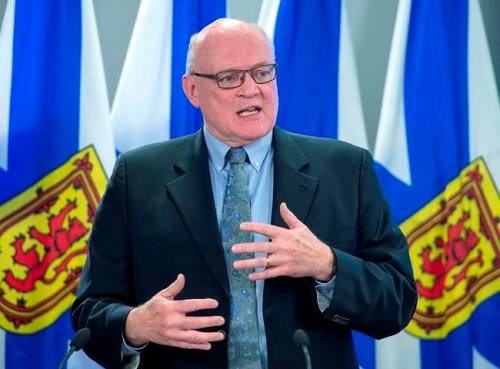
Nova Scotia re-examining conservative approach to vaccinations as supply increases

Advertisement

Advertise with us

HALIFAX - Nova Scotia will re-examine its methodical approach to COVID-19 vaccinations as supply increases and medical advice changes, chief medical officer of health Dr. Robert Strang said Tuesday.

Read this article for free:


or

Already have an account? Log in here »

To continue reading, please subscribe:

Subscribe and receive a limited-edition Free Press branded hat or tote.

Digital Subscription

One year of digital access for only $205*

  • Enjoy unlimited reading on winnipegfreepress.com
  • Read the E-Edition, our digital replica newspaper
  • Access News Break, our award-winning app
  • Play interactive puzzles

*First annual payment billed as $205.00 + GST for one year. This annual subscription will automatically renew at $233.00 + GST every 52 weeks (10% off the regular annual price of $259.35). Offer available to new and qualified returning subscribers only. Cancel any time.

To continue reading, please subscribe:

Add Free Press access to your Brandon Sun subscription for only an additional

$1 for the first 4 weeks*

  • Enjoy unlimited reading on winnipegfreepress.com
  • Read the E-Edition, our digital replica newspaper
  • Access News Break, our award-winning app
  • Play interactive puzzles
Start now

*Your next Brandon Sun subscription payment will increase by $1.00 and you will be charged $17.95 plus GST for four weeks. After four weeks, your payment will increase to $24.95 plus GST every four weeks.

Hey there, time traveller!
This article was published 02/03/2021 (2042 days ago), so information in it may no longer be current.

HALIFAX – Nova Scotia will re-examine its methodical approach to COVID-19 vaccinations as supply increases and medical advice changes, chief medical officer of health Dr. Robert Strang said Tuesday.

The province has so far received 61,980 doses of vaccine and as of Monday, had administered 33,471 doses — 20,580 first doses and 12,891 booster shots.

Health officials have been holding back roughly half the shipments to be used as booster shots — a policy that follows recommendations by vaccine makers but also in large part made possible by Nova Scotia’s low case numbers. Quebec, by contrast, has decided to vaccinate as many people as possible with one shot because it reports hundreds of new infections every day.
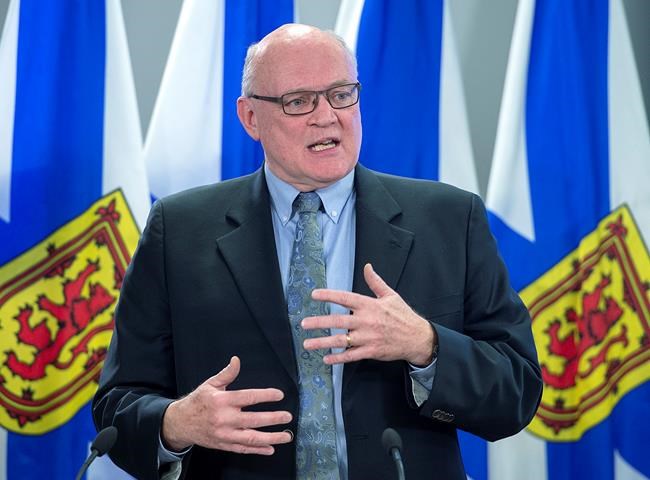
Dr. Robert Strang, chief medical officer of health, provides an update on health system preparations in Nova Scotia for the coronavirus that causes COVID-19, in Halifax on March 6, 2020. THE CANADIAN PRESS/Andrew Vaughan

But Strang told reporters the province’s approach could change pending new national recommendations on the interval between shots, which is expected Wednesday. Pfizer has said the second dose of its vaccine should be given within 21 days, while Moderna has set the date for the second shot at 28 days. Ottawa’s National Advisory Committee on Immunization, however, has said the second dose of both vaccines can wait up to 42 days.

“What we are expecting is a significant increase in the time frame between first dose and second dose,” Strang said. “What that means is that we can move away from our current process … and we will be able to focus all our vaccine on first doses.”

Doing so, he said, would double the number of people the province could vaccinate, something he described as “quite a game changer for us” as the government works toward its goal of vaccinating 70 per cent of the population by September.

British Columbia said Monday it would extend to four months the time between first and second doses of vaccine. Ontario has also said it was considering following suit.

Strang said his province has been offered an initial shipment of 13,000 doses of the newly approved Oxford-AstraZeneca vaccine, which has been recommended for use on people between 18 and 64 years old. “These will expire in a month’s time and therefore we would need to have a plan to use them immediately,” he said. “We are actively looking at what is the best use of this AstraZeneca vaccine for Nova Scotia.”

The province said it expected 56,160 doses of the Pfizer-BioNTech vaccine and 30,500 doses of the Moderna vaccine this month, for a total of 86,660 doses. A total of about one million doses of vaccine is expected to arrive from April through June.

Health officials also said that vaccination rollout plans for this month include the province’s first pharmacy clinics and an expansion of shots to community health-care workers.

Four prototype pharmacy clinics will launch in Halifax and Shelburne on March 9, Port Hawkesbury on March 16 and Springhill on March 23. People aged 80 years and over who were eligible to receive the vaccine through one of the first clinics will receive an invitation to get their shot from their pharmacy.

The vaccination program is also expanding to include anyone who works in a hospital and may come into contact with patients, as well as health-care providers in the community, such as doctors, nurses and continuing-care assistants.

Meanwhile, Nova Scotia reported one new case of COVID-19 on Tuesday and seven cases of virus mutations resulting from previously reported cases. The variant cases included two that are the B.1.1.7 variant, first detected in the United Kingdom, and five that are the 501.V2 mutation, originally identified in South Africa.

Nova Scotia has reported a total of eight cases of the B.1.1.7 variant and six cases of the South African mutation. “At this point, there is no indication that we have community spread from either of these clusters of variant cases,” Strang said.

Nova Scotia has a total of 29 active reported infections.

This report by The Canadian Press was first published March 2, 2021.

Report Error Submit a Tip

More Stories

Volunteer pop-up library axed from Manitoba Youth Centre

Matthew Frank 4 minute read Preview

Volunteer pop-up library axed from Manitoba Youth Centre

Matthew Frank 4 minute read Yesterday at 2:01 AM CDT

Manitoba Corrections has cancelled a pop-up library program at the Manitoba Youth Centre, leaving inmates without librarian services and fewer options to borrow certain books.

The Prison Libraries Committee, part of the non-profit Manitoba Library Association, operated and funded the volunteer program since 2024 before it was shut down by the province last month. The group previously partnered with the province to offer the service because the facility has no dedicated library of its own.

“It is concerning that community members who are incarcerated, especially youth, are losing out on meaningful programming, access to information and rehabilitation efforts, which are offered at no cost to (Manitoba) Corrections. We urge Manitoba Justice to promote more library services and programming, not less,” said a Sept. 24 letter from the non-profit addressed to the justice minister.

Ashley Huot, chair of the Prison Libraries Committee, said she was puzzled when she received an email last month from Manitoba Corrections stating that the pop-up library was no longer needed.

Read
Yesterday at 2:01 AM CDT

Letters, Oct. 3

7 minute read Yesterday at 2:01 AM CDT

A morning in the life …

My very first lesson does not start when I walk into that lecture hall, oh no — it starts long before. It begins when I walk to my car, check the estimated arrival time to the University of Manitoba and hope that Winnipeg traffic agrees with it.

A drive that appears completely manageable changes almost immediately when I’m greeted by a tsunami of orange pylons and a line of cars that appears to go on forever. Traffic moves by the inch, lanes magically disappear and the detour I took yesterday now has a detour of its own. These factors make me do a calculation that I have become all too familiar with. How late can I arrive and still find parking, run to my class across campus and get to class with enough time left to make it worth it?

I have grown used to people saying, “Why not just leave earlier?” I do. But when I’m already leaving for my 8:30 a.m. class at 7 a.m., there’s only so much I can do. This drive that some would think is relaxing is one that feels like an assignment that I didn’t know I had to complete and is due at 8:30 a.m.

International flavour: Canadian investors may want to make like Ottawa, diversify beyond U.S.

Joel Schlesinger 6 minute read Preview

International flavour: Canadian investors may want to make like Ottawa, diversify beyond U.S.

Joel Schlesinger 6 minute read Yesterday at 2:01 AM CDT

Canada is learning the hard way about the dangers of putting too many eggs in its U.S. economic basket.

Much has been made about the need to diversify our economy away from the United States.

Diversification is understandably beneficial. The more varied streams of revenue a nation has, the less affected the economy will be when one of those sources is interrupted.

The same can be said about investment portfolios.

Read
Yesterday at 2:01 AM CDT

N.S. rethinking vaccine plan as supply increases

Keith Doucette, The Canadian Press 4 minute read Preview

N.S. rethinking vaccine plan as supply increases

Keith Doucette, The Canadian Press 4 minute read Tuesday, Mar. 2, 2021

HALIFAX - Nova Scotia will re-examine its methodical approach to COVID-19 vaccinations as supply increases and medical advice changes, chief medical officer of health Dr. Robert Strang said Tuesday.

The province has so far received 61,980 doses of vaccine and as of Monday, had administered 33,471 doses — 20,580 first doses and 12,891 booster shots.

Health officials have been holding back roughly half the shipments to be used as booster shots — a policy that follows recommendations by vaccine makers but also in large part made possible by Nova Scotia's low case numbers. Quebec, by contrast, has decided to vaccinate as many people as possible with one shot because it reports hundreds of new infections every day.

But Strang told reporters the province's approach could change pending new national recommendations on the interval between shots, which is expected Wednesday. Pfizer has said the second dose of its vaccine should be given within 21 days, while Moderna has set the date for the second shot at 28 days. Ottawa's National Advisory Committee on Immunization, however, has said the second dose of both vaccines can wait up to 42 days.

Read
Tuesday, Mar. 2, 2021

What’s luck got to do with it?

Tim Kist 5 minute read Yesterday at 2:01 AM CDT

We all seek certainty in our daily lives. We expect if we make a decision, the outcome will be just as we planned: a direct correlation between the decision and result.

You, as a business leader, seek the same certainty from the decisions you make. And sometimes, the result is what was expected. Sometimes, it isn’t.

The big question is: why is it so difficult to achieve the business results you expect when you carefully craft your plans and seemingly make good decisions?

The truth is we cannot predict the future. This means we almost never know precisely how customers will respond to a sales quote, what competitors are planning, and a myriad of other external variables at play.

Wet weather heats up feed grain availability

Laura Rance-Unger 4 minute read Preview

Wet weather heats up feed grain availability

Laura Rance-Unger 4 minute read Yesterday at 2:01 AM CDT

Other than those in another rain cloud, it’s hard to find the silver linings attached to this year’s soggy harvest.

A showery September continued to cause delays and more deterioration in both quality and yield. Plus, the costs of mitigating post-harvest losses to spoilage are rising as the delays push further into fall. It takes more heat and time to artificially dry down grain as temperatures cool.

Crops harvested in August before the weather turned warm and damp came off with good quality and average yields. But farmers in some areas, such as southwest Manitoba, had only started when the rains came. Now they are plagued with standing water and sprouting swaths of grain that might not even make feed quality.

Suffice to say crop insurance adjusters are going to be busy this fall.

Read
Yesterday at 2:01 AM CDT