New vaccine brings optimism amid rising threat of variants, high case counts
Advertisement
Read this article for free:
or
Already have an account? Log in here »
To continue reading, please subscribe:

Digital Subscription
One year of digital access for only $205*
- Enjoy unlimited reading on winnipegfreepress.com
- Read the E-Edition, our digital replica newspaper
- Access News Break, our award-winning app
- Play interactive puzzles
*First annual payment billed as $205.00 + GST for one year. This annual subscription will automatically renew at $233.00 + GST every 52 weeks (10% off the regular annual price of $259.35). Offer available to new and qualified returning subscribers only. Cancel any time.
To continue reading, please subscribe:
Add Free Press access to your Brandon Sun subscription for only an additional
$1 for the first 4 weeks*
- Enjoy unlimited reading on winnipegfreepress.com
- Read the E-Edition, our digital replica newspaper
- Access News Break, our award-winning app
- Play interactive puzzles
*Your next Brandon Sun subscription payment will increase by $1.00 and you will be charged $17.95 plus GST for four weeks. After four weeks, your payment will increase to $24.95 plus GST every four weeks.
Read unlimited articles for free today:
or
Already have an account? Log in here »
Hey there, time traveller!
This article was published 26/02/2021 (2042 days ago), so information in it may no longer be current.
Canada’s vaccine rollout received a boost Friday with the approval of a third COVID-19 inoculation, giving the country another immunization option at a time when case counts remain nearly 75 per cent higher than they were at the peak of the first wave of the pandemic.
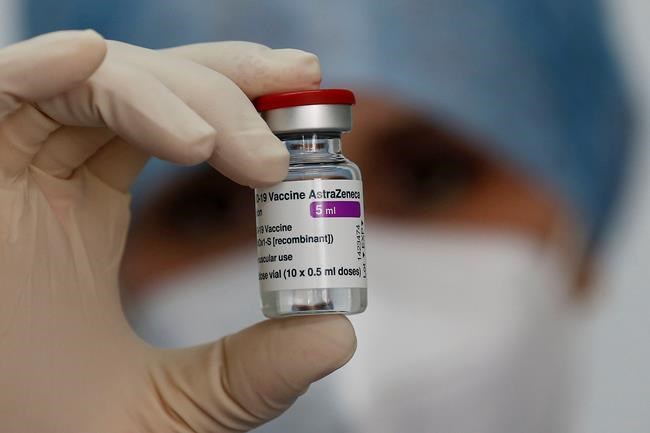
Health Canada approved a vaccine from AstraZeneca, and Prime Minister Justin Trudeau said jabs will keep arriving “faster and faster as we head into the spring.”
While numbers of cases and hospitalizations have dropped from all-time highs just weeks ago, variants of concern are rising in parts of the country.
Canada’s top doctor Theresa Tam said nationally there are 964 reported cases of the variant first detected in the U.K., up from 429 reported two weeks ago. There were also 44 cases of the variant first discovered in South Africa, and two cases of the version first found in Brazil.
“The risk of rapid re-acceleration remains,” Tam said. “At the same time new variants continue to emerge … and can become predominant.”
Tam added that average daily case counts in Ontario, Alberta and British Columbia have increased between eight and 14 per cent over the previous week.
Thunder Bay, Ont., will move into lockdown on Monday after community leaders called for government action following a recent spread of COVID in the city. Outbreaks have been declared there at correctional facilities, among the homeless population and at a number of local schools.
Ontario’s Simcoe Muskoka region will also go into lockdown next week after a spike in infections, but restrictions will loosen in seven other areas in the province.
Dr. Howard Njoo, Canada’s deputy chief public health officer, said the country’s vaccine rollout will be just one method in slowing the spread of new variants and avoiding a third wave.
He said public health measures aimed at halting transmission such as physical distancing and limiting contacts remain important, adding that jurisdictions that have recently reopened need to keep a keen eye on transmission rates.
“Certainly if there’s any indication that the case rates and … the emergence of variants are increasing, we would need to adjust as appropriate,” he said. “But the vaccinations, and certainly the introduction of more vaccines coming to Canada is very, very good news.”
Experts advising the Ontario government said this week more contagious variants of COVID-19 are expected to make up 40 per cent of cases by the second week of March.
Ontario reported 1,258 new cases of COVID-19 and 28 more deaths linked to the virus on Friday, with 362 of them in Toronto, 274 in Peel Region and 104 in York Region.
Parts of Atlantic Canada have also seen rising case counts. Newfoundland and Labrador reported four new cases of COVID-19 while Nova Scotia added 10 more to its tally.
Of the new Nova Scotia cases, the province says two are related to travel outside Atlantic Canada.
Prince Edward Island, which reported an outbreak of three cases earlier this week, had one more new case Friday that does not appear to be directly linked to the others.
Quebec, meanwhile, reported 815 new COVID-19 infections and 11 more deaths. Health officials in the province said hospitalizations have dropped by 13, to 620, while intensive care also decreased by three to 119.

Saskatchewan health officials announced 153 new cases and no new deaths, while in Manitoba there were 64 new infections and one additional death.
In Alberta, with 356 new infections and three more deaths, doctors with the Edmonton Zone Medical Staff Association’s pandemic committee urged the province to hold off on possibly easing more restrictions next week. They said they are concerned that new daily active cases have stopped decreasing and the number of new infections that result from each case is growing.
As of Thursday evening, federal data showed there have been 858,217 COVID-19 cases in Canada, including 21,865 deaths, since the beginning of the pandemic.
While Tam warned that COVID-19 variants can spread more quickly and easily become dominant, progress on the vaccine front is a source of optimism, she noted.
“To date, over 1.7 million doses of COVID-19 vaccine have been administered across Canada. And there are early indications of high vaccine efficacy.”

Trudeau also announced on Friday a partnership with Mississauga, Ont.’s Verity Pharmaceuticals and the Serum Institute of India that will deliver two million more doses of the AstraZeneca jab — in addition to the 20 million doses Canada already secured with AstraZeneca.
Trudeau said as vaccinations ramp up across the country, many provinces have expanded the number of health professions able to administer a COVID-19 vaccine, and he asked dentists, midwives, pharmacy technicians and retired nurses to lend a hand in the rollout.
“Job 1 remains beating this pandemic,” Trudeau said, adding the federal government will continue to send rapid tests to provinces in hopes of getting more Canadians tested.
“We still have to be very careful, especially with new variants out there. We all want to start the spring in the best shape possible.”
This report by The Canadian Press was first published Feb. 26, 2021.
AstraZeneca Q&A
Questions and answers about the AstraZeneca vaccine:
- Why did it take so long to approve?
- How effective was the vaccine in clinical trials?
- Does it work against the new variants?
- How does the vaccine work?
- What are the advantages to this vaccine?
- When can we expect a rollout to begin in Canada?
Here’s what we know about the AstraZeneca product:
Why did it take so long to approve?
Health Canada’s regulatory team had been reviewing AstraZeneca’s application since Oct. 1, 2020, and was undergoing its final assessment of clinical data as of late last month.
Dr. Supriya Sharma, Health Canada’s chief medical adviser, said in January the review was “a bit more complicated’’ because some volunteers in AstraZeneca’s trials only received a half dose at first.
How effective was the vaccine in clinical trials?
Data released by the company suggested the vaccine was 62 per cent effective in clinical trials when two full doses were distributed a month apart. Another dosing regimen, where a half dose was followed by a full dose 28 days later, was shown in interim data to be 90 per cent effective.
Sharma says the recommendations are to administer two shots with the same dosage amount four to 12 weeks apart. She added there was some limited data suggesting a better immune response was observed when the second dose was given closer to the 12-week range.
AstraZeneca’s efficacy compares with the 95 per cent efficacy from the clinical trials of Pfizer-BioNTech and Moderna, the other two vaccines currently approved in Canada.
Preliminary results from AstraZeneca’s trial were reviewed early on by The Lancet medical journal, which suggested the vaccine can reduce spread of the virus as well as protect against illness and death.
Health Canada says that while the vaccine was not tested on people over the age of 65, real-world data from countries already using the product suggest it is safe and effective among older age groups.
Sharma noted that while the efficacy ranged with the three approved vaccines, all of them saw zero hospitalizations and deaths in those who got COVID after getting the vaccine.
Does it work against the new variants?
A group of experts on immunization working with the World Health Organization is recommending the use of AstraZeneca’s vaccine, even in countries where variants emerged as dominant.
That guidance comes after a small study in South Africa suggested AstraZeneca’s vaccine was only minimally effective against the variant first detected there, causing the country to halt use of the product earlier this month.
South Africa said it would instead give the still-unapproved Johnson and Johnson vaccine to front-line health workers to see how it protects against the more contagious variant that’s dominant there.
Oxford University, who helped develop the AstraZeneca vaccine, has said researchers were tweaking their product by inserting a genetic sequence from that specific variant.
AstraZeneca’s vaccine has some promising early data suggesting it works against another variant first detected in the U.K. Findings based on swabs taken from around 500 volunteers in trials between October and January showed a 74.6 per cent efficacy rate against that variant.
How does the vaccine work?
Unlike Pfizer-BioNTech and Moderna, which use messenger RNA (mRNA), the Oxford-AstraZeneca vaccine is a non-replicating viral vector, using a weakened chimpanzee cold virus as a vessel.
Scientists stripped the genes from that virus, which isn’t harmful to humans, and replaced them with the spike protein gene for SARS-CoV-2.
Once injected, the vaccine shows our bodies how to produce the immune response needed to ward off future infections from the COVID-19 virus.
Non-replicating means the virus won’t actually reproduce throughout the body.
What are the advantages to this vaccine?
Oxford-AstraZeneca can be shipped and stored at regular refrigerator temperature, unlike Pfizer-BioNTech which requires ultra-low freezers to hold its product before it’s injected. Moderna’s vaccine is somewhere in the middle, needing a regular freezer to keep the injections at about minus 20 C.
From a global vaccination standpoint, the low cost of AstraZeneca’s vaccine — about US$4 per dose — gives it another advantage. AstraZeneca, which says it aims to manufacture up to three billion doses in 2021, has pledged to make their product available at cost around the world until at least July.
The AstraZeneca vaccine forms the bulk of the stockpile acquired so far by the U.N.-backed vaccine-sharing effort known as COVAX, which aims to deploy coronavirus vaccines to people globally.
When can we expect a rollout to begin in Canada?
The Canadian government has already procured 20 million doses of the Oxford-AstraZeneca vaccine and a rollout can be expected to begin shortly after the first shipments arrive in the country.
Canada will also receive up to 1.9 million doses of the AstraZeneca vaccine through COVAX by the end of June.
Prime Minister Justin Trudeau said in early February he believes most of those 20 million doses — enough to inoculate 10 million people — will be delivered before Canada Day.
The government has said it plans to vaccinate the majority of Canadians by September.
– The Canadian Press, with files from The Associated Press
Related Articles
Who can get a COVID-19 vaccine in Canada? AstraZeneca vaccine approved in Canada

Advertisement Advertise With Us
Advertisement Advertise With Us