Seven residents at Montreal care home get COVID despite receiving first vaccine dose

Advertisement

Advertise with us

MONTREAL - Quebec health authorities are examining how seven residents of a Montreal long-term care centre contracted COVID-19 despite being among the first to receive the Pfizer-BioNTech vaccine in the province.

Read this article for free:


By clicking the button above, an account will be created and you will begin to receive some of our recommended newsletters. You may opt out of any newsletter by visiting your Email and Communication Preferences page or by clicking "unsubscribe" at the bottom of any email.

or

Already have an account? Log in here »

To continue reading, please subscribe:

Digital Subscription

One year of digital access for only $1.44 a week*

  • Enjoy unlimited reading on winnipegfreepress.com
  • Read the E-Edition, our digital replica newspaper
  • Access News Break, our award-winning app
  • Play interactive puzzles

*Billed as $5.77 plus GST every four weeks. After 52 weeks, price increases to the regular rate of $19.95 plus GST every four weeks. Offer available to new and qualified returning subscribers only. Cancel any time.

To continue reading, please subscribe:

Add Free Press access to your Brandon Sun subscription for only an additional

$1 for the first 4 weeks*

  • Enjoy unlimited reading on winnipegfreepress.com
  • Read the E-Edition, our digital replica newspaper
  • Access News Break, our award-winning app
  • Play interactive puzzles
Start now

*Your next Brandon Sun subscription payment will increase by $1.00 and you will be charged $17.95 plus GST for four weeks. After four weeks, your payment will increase to $24.95 plus GST every four weeks.

Hey there, time traveller!
This article was published 13/01/2021 (2109 days ago), so information in it may no longer be current.

MONTREAL – Quebec health authorities are examining how seven residents of a Montreal long-term care centre contracted COVID-19 despite being among the first to receive the Pfizer-BioNTech vaccine in the province.

Management at the Maimonides Geriatric Centre informed residents of the cases in a notice Tuesday, noting that residents were infected within 28 days of receiving the first of two vaccine doses.

Dr. Mylene Drouin, Montreal’s director of public health, said Wednesday that authorities were looking at the cases identified at Maimonides as well as at St-Antoine long-term care home in Quebec City — the other location to receive the first vaccines in the province.
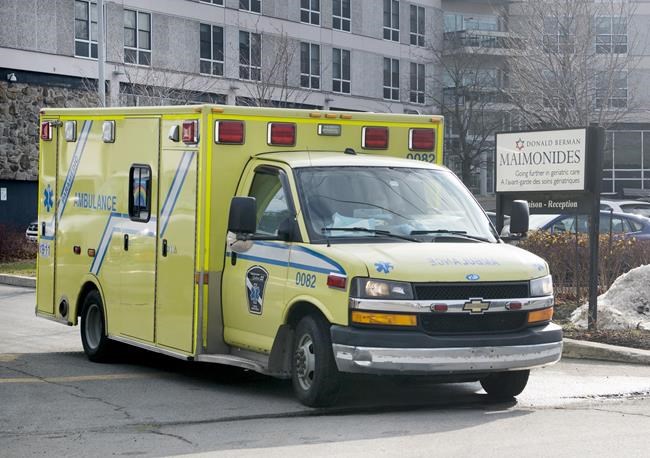
An ambulance leaves the Maimonides Geriatric Center in Montreal, Sunday, Nov. 29, 2020. Seven residents of the Montreal long-term care centre who received a first dose of the Pfizer-BioNTech vaccine have contracted COVID-19. THE CANADIAN PRESS/Graham Hughes

“It is a small number to draw a conclusion,” Drouin said of Maimonides, but she added health experts were looking at possible reasons and whether any recommendations need to be changed as a result.

Quebec has decided to delay administering second doses to patients and has instead chosen to give a first dose to as many people as possible. Last week, a dozen Maimonides residents sued the province to obtain a second dose within 21 days of their first dose — the time frame set by the vaccine manufacturer.

Lawyer Vanessa Paliotti said residents had consented to be vaccinated subject to receiving two doses of the Pfizer-BioNTech vaccine in the 21-day time frame. “They would not have agreed to receive a single dose,” Paliotti said in an interview.

She said residents feared contracting the coronavirus if the wait for the second dose was extended for an indefinite period.

News of the COVID-19 infections at Maimonides did not surprise Dr. Donald Vinh, microbiologist and infectious disease specialist at the McGill University Health Center.

He said it takes about 12 to 14 days after vaccination for the body to build enough immunity to be protected against the novel coronavirus. Vinh said it is possible to be vaccinated and contract the coronavirus afterwards, as with any other vaccine. He noted the flu vaccine does not provide 100 per cent protection, but people who get the flu after being vaccinated have less severe symptoms.

At the St-Antoine facility in Quebec City, an outbreak four days before the inoculation campaign began on Dec. 14 is believed to be a factor in the cases among those who were vaccinated.

Mathieu Boivin, a spokesman for the health authority serving Quebec City, said that an unspecified number of residents developed COVID-19 after receiving the vaccine, but he could not say if any of them died, citing confidentiality surrounding medical records.

“Analyses are underway to fully understand the situation at the (long-term care home), but it is likely that several of these users were infected before receiving the vaccine and did not begin to develop symptoms until after receiving the vaccine,” Boivin said in an email. “In these cases, the immune response was not complete and instantaneous.”

Because the immune system needs two weeks to develop antibodies to resist infection, some users may have also been exposed after being inoculated and before their bodies had produced sufficient immune defence.

“It is likely that several of these users were infected before receiving the vaccine and did not begin to develop symptoms until after receiving the vaccine.”–Mathieu Boivin, Quebec City health authority

As of Tuesday, there were 73 active cases of COVID-19 at St-Antoine and 35 deaths linked to the virus.

None of it should call into question the efficacy of the vaccines, Boivin said.

“They have all demonstrated their effect in a scientifically convincing manner, and we wholeheartedly encourage all citizens to receive it as soon as their turn comes,” Boivin said.

This report by The Canadian Press was first published Jan. 13, 2021.

———

This story was produced with the financial assistance of the Facebook and Canadian Press News Fellowship.

Report Error Submit a Tip

More Stories

Family history, solo sojourns paved path for celebrated author’s latest novel

Ben Sigurdson 7 minute read Preview

Family history, solo sojourns paved path for celebrated author’s latest novel

Ben Sigurdson 7 minute read 2:01 AM CDT

It’s 1967 and Lee Clarke has just been kicked out of UCLA when he receives his draft letter in the mail. Rather than report for basic training, he hops in a car and sets off across America on an amphetamine-fuelled road trip to bid farewell to his fractured, dysfunctional family before crossing the border into Canada.

Such is the premise for B.C.-born, Portland-based Patrick deWitt’s sixth novel Dodge City, published in September by House of Anansi. He’s in Winnipeg tonight at McNally Robinson Booksellers’ Grant Park location to launch the book.

The 51-year-old deWitt came to prominence with his sophomore novel, 2011’s The Sisters Brothers. The book was a critical and commercial success, winning the author the Governor General’s Literary Award for Fiction, the Rogers Writers’ Trust Fiction Prize and the Stephen Leacock Medal for Humour, and was adapted for the big screen in a film starring John C. Reilly and Joaquin Phoenix.

His 2018 novel French Exit was also adapted for cinema, and his 2023 novel The Librarianist won deWitt the Leacock Medal for the second time. Dodge City is deWitt’s fourth novel to make the Giller Prize long list.

Read
2:01 AM CDT

Alberta sees its way through the fog

Editorial 4 minute read Preview

Alberta sees its way through the fog

Editorial 4 minute read 2:01 AM CDT

“The owls are not what they seem.”

It was a confusing line in a confusing television show, back when television watchers had to wait a week, or sometimes more, for a new episode of a show.

What the owls were — or weren’t — was one small element of the astounding panoply of events in Twin Peaks.

In case this is all flying right over your head, Twin Peaks was a surrealist television show, a mystery/horror/something that premiered in 1990. It had an amazing ability to leave viewers both entertained and, well, hanging.

Read
2:01 AM CDT

Rocky Horror star prepared for a rude reception in all the best ways

Conrad Sweatman 5 minute read Preview

Rocky Horror star prepared for a rude reception in all the best ways

Conrad Sweatman 5 minute read 2:01 AM CDT

While it enjoys the longest theatrical release of any movie in history, The Rocky Horror Picture Show was all but ignored by critics when its revolutionary brand of camp first hit silver screens in 1975.

And before it whipped up a cult following, Rocky was a fringe theatre hit in London whose first run’s final night — which had attracted such luminaries as Mick and Bianca Jagger — was derailed by an unlikely culprit: glitter. According to the late Tim Curry (who died at 80 in August), the shiny stuff ended up where the sun don’t shine.

“Well, Rocky got some glitter down his trunks and it set up an irritation. When we arrived at the theatre, he was standing in the shower and the show couldn’t go on,” he told the press in 1974, after crossing the Atlantic to lead the show’s American theatre debut.

Glitter is one of the things audiences may not throw at the stage at The Rocky Horror Picture Show screening tonight at the Centennial Concert Hall. Unlike in the anarchic midnight screenings at the New York’s Waverly Theater beginning in 1976, where audiences chucked everything but the kitchen sink, a prop bag will be courteously supplied at the door.

Read
2:01 AM CDT

Election results: Winnipeg mayor, council and plebiscite

2 minute read Preview

Election results: Winnipeg mayor, council and plebiscite

2 minute read Wednesday, Oct. 24, 2018

Below you'll find all results for the ward, mayoral and plebiscite in the 2018 municipal election.

MayorBrian BOWMAN

53.30%

114,222 votesJenny MOTKALUK

Read
Wednesday, Oct. 24, 2018

Feared cuts to facilities, services not in proposed four-year civic budget

Joyanne Pursaga 6 minute read Preview

Feared cuts to facilities, services not in proposed four-year civic budget

Joyanne Pursaga 6 minute read Friday, Mar. 6, 2020

Winnipeg’s 2020-23 draft budget includes far fewer civic facility closures than some critics have feared, but the proposed cuts that remain are sparking backlash.

Under the city’s four-year preliminary operating budget, all pools, arenas and libraries that are currently open will remain open — if the spending blueprint is finalized, as is.

Mayor Brian Bowman said the decision comes in response to community rallies against proposals that could have resulted in the closure of up to five pools, five arenas, and three libraries.

“Our priority in this budget process was to keep the lights on at libraries and pools and rec facilities,” he said Friday.

Read
Friday, Mar. 6, 2020

Province chips in $15M to bring Pantages Playhouse back to life

Gabrielle Piché 4 minute read Preview

Province chips in $15M to bring Pantages Playhouse back to life

Gabrielle Piché 4 minute read Tuesday, May. 5, 2026

A string quartet performed at the Pantages Playhouse Theatre Tuesday in celebration of a $15-million contribution from the province to raise the curtain at the historic landmark again.

The musicians provided the backdrop to Premier Wab Kinew’s announcement of the cash injection to “help bring the Pantages Playhouse back to life.”

The theatre — which opened in 1914 and was once a hub for vaudeville performers, including Charlie Chaplin — has been closed for eight years.

“This is a tremendous project to advance arts and culture in Winnipeg and across Manitoba, but it’s also a big investment in our downtown,” Kinew said.

Read
Tuesday, May. 5, 2026