Trudeau says he hopes to see COVID-19 vaccines roll out in Canada in early 2021

Advertisement

Advertise with us

Prime Minister Justin Trudeau said Monday he hopes to see COVID-19 vaccines roll out in Canada early next year, but warned that won't bring an immediate resolution to the pandemic currently seeing a resurgence in several provinces.

Read this article for free:


By clicking the button above, an account will be created and you will begin to receive some of our recommended newsletters. You may opt out of any newsletter by visiting your Email and Communication Preferences page or by clicking "unsubscribe" at the bottom of any email.

or

Already have an account? Log in here »

To continue reading, please subscribe:

Digital Subscription

One year of digital access for only $1.44 a week*

  • Enjoy unlimited reading on winnipegfreepress.com
  • Read the E-Edition, our digital replica newspaper
  • Access News Break, our award-winning app
  • Play interactive puzzles

*Billed as $5.77 plus GST every four weeks. After 52 weeks, price increases to the regular rate of $19.95 plus GST every four weeks. Offer available to new and qualified returning subscribers only. Cancel any time.

To continue reading, please subscribe:

Add Free Press access to your Brandon Sun subscription for only an additional

$1 for the first 4 weeks*

  • Enjoy unlimited reading on winnipegfreepress.com
  • Read the E-Edition, our digital replica newspaper
  • Access News Break, our award-winning app
  • Play interactive puzzles
Start now

*Your next Brandon Sun subscription payment will increase by $1.00 and you will be charged $17.95 plus GST for four weeks. After four weeks, your payment will increase to $24.95 plus GST every four weeks.

Hey there, time traveller!
This article was published 09/11/2020 (2182 days ago), so information in it may no longer be current.

Prime Minister Justin Trudeau said Monday he hopes to see COVID-19 vaccines roll out in Canada early next year, but warned that won’t bring an immediate resolution to the pandemic currently seeing a resurgence in several provinces.

The prime minister said news from Pfizer that one of its vaccine candidates appears very effective in clinical trials is “very encouraging” but won’t help anyone who catches the virus in the meantime.

Speaking in Ottawa, Trudeau said other vaccine candidates have also appeared to progress well, and Canada has secured access to several, given the uncertainty regarding which will be ready first, which will be more effective with certain populations, and other variables.
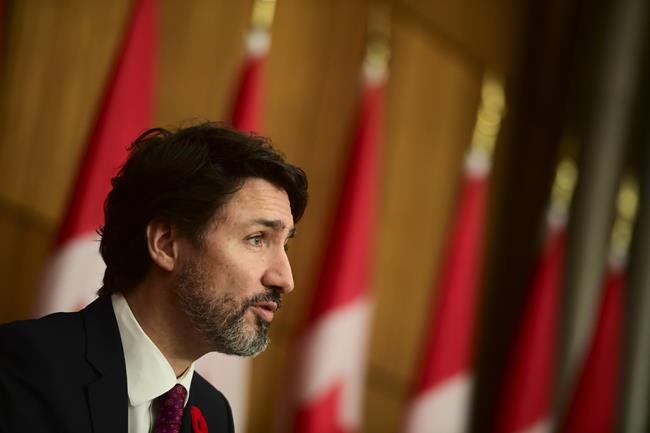
Prime Minister Justin Trudeau speaks during a press conference on broadband internet in Ottawa on Monday, Nov. 9, 2020. THE CANADIAN PRESS/Sean Kilpatrick

When a vaccine is safe to distribute, the government will begin dispensing it to high-priority groups first, he said.

“We hope to see vaccines landing in the early next year but between now and then it’s really, really important that we double down on our efforts,” Trudeau said.

“We need to make sure we are controlling the spread of COVID-19 in the coming months so that when vaccines get here we will be able to act quickly to protect all Canadians.”

His comments came after a weekend that saw the two provinces hardest hit by the pandemic report record-breaking daily case counts.

Quebec and Ontario reported 1,397 and 1,328 new cases respectively on Sunday, followed by 1,169 and 1,242 on Monday.

Health officials in Quebec said Monday that while the situation has improved in some parts of the province, such as Quebec City and Montreal, it is worsening in others – including the Saguenay-Lac-St-Jean area, which currently has more than double the provincial rate of cases per 100,000 people.

Public health authorities reported 94 new cases in the region on Monday, for a total of 312 active cases per 100,000 people.

The region was placed under Quebec’s highest COVID-19 alert level on Nov. 2, and the province’s health minister said it will take some time before any effects from the new restrictions are seen.

In Ontario, Premier Doug Ford was asked Monday whether the ballooning cases in the province pushed him to reconsider its new colour-coded system for pandemic measures, which loosened public health restrictions in all regions but Toronto when it took effect Saturday.

The tiered system places health units in colour-coded categories based on their caseload and transmission levels, and has drawn criticism for allowing activities such as indoor dining in restaurants in all alert levels short of a lockdown.

In Peel Region, the only area currently in the red category, local health officials imposed additional measures over the weekend in order to reduce the risk of transmission.

But Ford defended the system Monday, saying it was built to give each region the flexibility to enact further rules, as Peel did. “That’s the reason we have the framework,” he said.

Toronto, meanwhile, is remaining under a previous, more stringent system until the end of the week, at the request of local officials. The city accounted for 483 of Ontario’s new cases on Monday.

Mayor John Tory said the city would likely follow in Peel Region’s footsteps and impose “an enhanced suite of measures” to stem the spread of the virus, with more details to come Tuesday.

The city’s top doctor, Dr. Eileen de Villa, said the COVID-19 numbers seen over the last few days were among the “most concerning” she’s seen since the start of the pandemic.

Further west, Manitoba reported 365 new COVID-19 cases Monday as it continued to lead the country in per-capita active cases.

Chief public health officer Dr. Brent Roussin said the province is at a critical point in time, pointing to increased strain on the health system.

Roussin said he has talked with Premier Brian Pallister about imposing further restrictions.

Meanwhile, Trudeau said the federal government is already working on the logistics of distributing a COVID-19 vaccine, particularly since the Pfizer candidate needs to be stored at around -75C to remain stable.

Canada has bought the rights to 20 million doses of Pfizer’s vaccine, if it proves effective and Health Canada approves it for use here, and Trudeau said the government would purchase more if the initial round goes well.

The company said in a news release that early results from a large-scale trial show its vaccine is 90 per cent effective at combating the virus.

This report by The Canadian Press was first published Nov. 9, 2020.

Report Error Submit a Tip

More Stories

A profile of one of Winnipeg’s worst-kept secret singer/songwriters

Ben Waldman 16 minute read Preview

A profile of one of Winnipeg’s worst-kept secret singer/songwriters

Ben Waldman 16 minute read Thursday, Dec. 8, 2022

Roman Clarke lives in the last house on his street, with the silently shimmering Seine River as his next-door neighbour. Seated at the picnic table in his backyard are knee-high piles of snow. In the window sill by the front door rests a can of Labatt Blue, the leftover sips frozen by the mid-November chill.

Read
Thursday, Dec. 8, 2022

Court ruling concludes Canadian Wheat Board saga

Laura Rance-Unger 4 minute read Preview

Court ruling concludes Canadian Wheat Board saga

Laura Rance-Unger 4 minute read 2:01 AM CDT

It remains to be seen whether the recent court ruling in a lawsuit filed after Canadian Wheat Board’s dissolution in 2012 puts the whole debate to rest, as some no doubt hope.

But either way, the dust has settled on the post-CWB world. The sun still rises and a new generation of farmers on the land only knows by name an institution that for generations influenced every aspect of Prairie grain farming.

The first Rural Revival column I wrote for this newspaper more than 30 years ago was about a thousand farmers from Western Canada demonstrating in support of the Wheat Board. It was in the aftermath of the Western Grain Marketing Panel report, one of several efforts that eventually included a plebiscite to help the federal government decide what to do about a vocal minority of farmers who wanted marketing “freedom.”

The polls at the time suggested about two-thirds of farmers were comfortable enough with the single-desk system for food wheat and barley to keep it around. It served as a counterbalance to canola, which they sold on the open market. They essentially had a dual market.

Read
2:01 AM CDT

Haunted houses aren’t the only places to find jump scares

Jen Zoratti 3 minute read Preview

Haunted houses aren’t the only places to find jump scares

Jen Zoratti 3 minute read 2:01 AM CDT

C’est l’Halloween, to quote the 1981 elementary school French class banger by Matt Maxwell, but you know what’s already plenty scary? Life.

We all have our personal haunted houses, so to speak, hence the popularity of the “a haunted house but it’s just…” meme that pops up every October. Sample: “a haunted house but it’s just a bunch of men telling you you’d be prettier if you smiled.”

In the spirit of the season, I thought I’d offer up a few jump scares of my own.

A haunted house but it’s just Gate E25

Read
2:01 AM CDT

Brandon manufacturer says Canadian steel in demand, but high costs, long delivery times hit hard

Gabrielle Piché 6 minute read Preview

Brandon manufacturer says Canadian steel in demand, but high costs, long delivery times hit hard

Gabrielle Piché 6 minute read 2:01 AM CDT

Something’s different in a Brandon plant.

Building envelope panels — or shells for homes and commercial buildings — keep being produced at Greenstone Building Products.

But the galvanized steel used by workers has been arriving later and the price is constantly increasing, according to company leadership.

“It’s just a little bit nerve-wracking for us to hear the opposite narrative,” said Tilda Fortier, Greenstone Building Products’ business manager.

Read
2:01 AM CDT

Actor-director Cooper takes new approach to familiar tale

Randall King 4 minute read Preview

Actor-director Cooper takes new approach to familiar tale

Randall King 4 minute read Thursday, Oct. 4, 2018

TORONTO — In his self-directed version of A Star Is Born, Bradley Cooper plays a rock star named Jackson Maine.

Note the name: it marks the character as a member of a cinematic lineage that descends all the way to 1937.

That year, the first A Star Is Born was made, with Frederick March in the role of alcoholic actor Norman Maine. The name stayed in 1954, when James Mason took over the role of an actor who first nurtures the career of Judy Garland’s up-and-coming star Vicki Lester before his drunken shenanigans threaten to derail it. By 1976, Kris Kristofferson played the role of musician John Norman Howard, a rock singer with a musical stake in the ascent of Barbra Streisand’s Esther Hoffman.

Cooper, 43, remembered the Maine name, but also brought his own vision as a first-time feature filmmaker to the new version, which opens Thursday, Oct. 4, opposite Lady Gaga after the originally designated director, Clint Eastwood, dropped out. While actors might not want to see different interpretations of a role, Cooper embraced the opportunity to see all the past iterations.

Read
Thursday, Oct. 4, 2018

Has the political wind changed?

Gwynne Dyer 5 minute read 2:01 AM CDT

It has been quite a week. First we had “Lula” – Luiz Inácio da Silva (as nobody but his mother ever called him) – defying everybody’s expectations. After winding up two million votes behind his challenger, Flávio Bolsonaro, in the first round of the Brazilian presidential election, he made a “miraculous” comeback in the second.

It was like a man going into a revolving door behind you and coming out in front. At the end of the first round, Lula was two million votes behind; at the end of the second round on Oct. 25 he was four million votes ahead. So how did he win a fourth term without cheating?

That’s what Bolsonaro claims he did, having fled to the United States; Trump, Flávio’s mentor, hints at the same. But Lula’s victory was not miraculous. He only learned to read when he was 10, and at 80 he still refused to have a mobile phone. His team finally made him get one and use it.

He wouldn’t do social media videos, so they created a WhatsApp channel called Lula’s Army, and made him appear on it at least daily. The channel went from zero to 10.8 million viewers in two weeks, and Lula won.