Ontario making bars and restaurants close earlier, shuts down strip clubs

Advertisement

Advertise with us

TORONTO - Bars and restaurants across Ontario will shut down earlier and all strip clubs will close, Premier Doug Ford announced Friday, saying the new rules were needed to fight a surge in COVID-19 cases.

Read this article for free:


or

Already have an account? Log in here »

To continue reading, please subscribe:

Subscribe and receive a limited-edition Free Press branded hat or tote.

Digital Subscription

One year of digital access for only $205*

  • Enjoy unlimited reading on winnipegfreepress.com
  • Read the E-Edition, our digital replica newspaper
  • Access News Break, our award-winning app
  • Play interactive puzzles

*First annual payment billed as $205.00 + GST for one year. This annual subscription will automatically renew at $233.00 + GST every 52 weeks (10% off the regular annual price of $259.35). Offer available to new and qualified returning subscribers only. Cancel any time.

To continue reading, please subscribe:

Add Free Press access to your Brandon Sun subscription for only an additional

$1 for the first 4 weeks*

  • Enjoy unlimited reading on winnipegfreepress.com
  • Read the E-Edition, our digital replica newspaper
  • Access News Break, our award-winning app
  • Play interactive puzzles
Start now

*Your next Brandon Sun subscription payment will increase by $1.00 and you will be charged $17.95 plus GST for four weeks. After four weeks, your payment will increase to $24.95 plus GST every four weeks.

Hey there, time traveller!
This article was published 25/09/2020 (2186 days ago), so information in it may no longer be current.

TORONTO – Bars and restaurants across Ontario will shut down earlier and all strip clubs will close, Premier Doug Ford announced Friday, saying the new rules were needed to fight a surge in COVID-19 cases.

Ford said the latest restrictions would help reduce transmission in high-risk businesses.

Bars and restaurants will now be required to close at midnight, except for takeout and delivery, and will have to stop serving alcohol by 11 p.m.
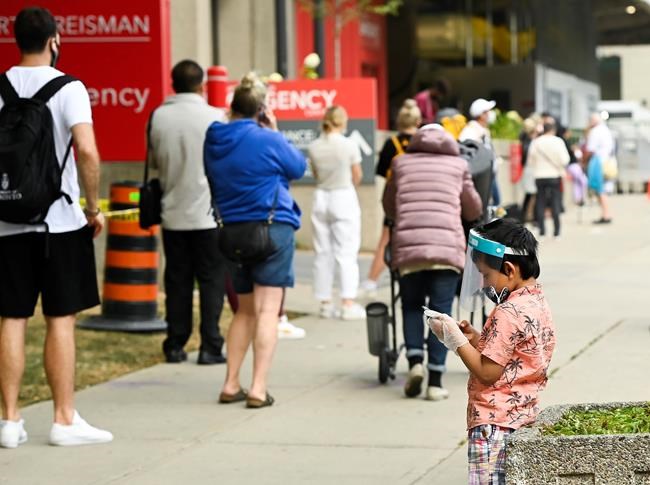
A young boy plays on a phone as he waits in line at a COVID assessment centre at Mount Sinai Hospital during the COVID-19 pandemic in Toronto on Thursday, September 24, 2020. THE CANADIAN PRESS/Nathan Denette

“We’ve seen doubling in cases in a very short period of time and it’s very, very concerning,” Ford said. “There’s been outbreaks and … we just can’t chance it.”

Some mayors in the Greater Toronto Area had requested similar measures for weeks, and Ford had initially resisted taking action, saying municipalities had the power to impose restrictions on businesses under public health regulations if they wanted to.

On Friday, however, Ford said a change was necessary.

“We just can’t have these places open until three o’clock in the morning,” he said. “But we’re being very balanced, I feel.”

The new rules follow a decision by the province last week to change limits on social gatherings, lowering the number of people permitted at outdoor events to 25 and indoor events to 10.

A spokesman for Restaurants Canada said Friday that the government had not shown that organization any data to backup the restrictions, but the businesses will continue to do their part to fight the pandemic.

James Rilett, the group’s vice-president of Central Canada, said the new restrictions would have a detrimental impact on night clubs and bars, many of which are already struggling to survive.

“It will have an incredibly bad impact on some restaurants at a time where you have historic debt loads and you’re starting to close down outdoor patios,” he said.

Green party Leader Mike Schreiner said with the new restrictions on bars and restaurants in place the province must offer some financial support.

“I feel for owners and employees who will be affected by these new restrictions,” he said in a statement. “(They) must be accompanied by help for small businesses to stay afloat during a second wave.”

NDP Leader Andrea Horwath said the Ford government has let COVID-19 infections rise by delaying putting new public health measures in place.

“We are teetering on another health and economic disaster because this government has not been listening, and not been acting,” she said in a statement.

Ford also announced Friday that the province will spend an additional $741 million to help clear a backlog of surgeries that has developed at Ontario hospitals during the pandemic.

Health Minister Christine Elliott said the funds will help the health-care system to build more capacity to manage surges in COVID-19 cases and outbreaks.

“We are working directly with our health-care partners to ensure our … system is ready to respond to the challenges that we face with future waves of COVID-19,” she said.

The president of the Ontario Hospital Association warned Friday that the pandemic is straining health-care resources across the province and further action will be needed to respond to rising case rates.

Anthony Dale said currently hospitals are running assessment centres, processing COVID-19 tests, helping manage some long-term care homes, working to cut the surgical backlogs and handling their normal operations.
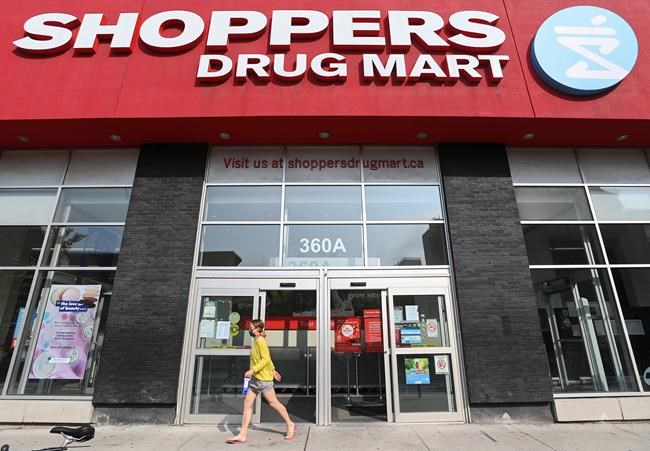
A woman leaves a Shoppers Drug Mart store where they are providing COVID-19 testing by appointment only during the COVID-19 pandemic in Toronto on Friday, September 25, 2020. THE CANADIAN PRESS/Nathan Denette

“Any serious wave of COVID-19 means that it will be impossible for hospitals to continue all those roles at once, full stop,” he said. “And the only way to keep hospitals functioning in the way that the public wants and expects is to help stop the spread of COVID-19.”

Dale urged people across the province to follow basic health guidelines like practising physical distancing, hand-washing and wearing a mask to stop the rise in case numbers.

“I think it’s about helping people understand that things have changed, and change very quickly, in just a little under two weeks,” he said. “And we don’t have much time at all.”

Ontario reported 409 new cases of COVID-19 on Friday, and one new death related to the virus.

The province said it processed 41,865 tests over the previous day, with another 65,227 under investigation.

Meanwhile, Toronto’s top public health official ordered four hospitality businesses to close on Friday.

The businesses were flouting public health protocols and evading investigators, Dr. Eileen de Villa said, adding that some were pressuring staff to work, even when sick.

The businesses, whose names she did not share because the operation to shut them down was not yet complete, will be allowed to reopen once the city is satisfied they’ll follow the rules.

Also in Toronto, officials declared an outbreak at Glen Park Public School in North York — the city’s first school-based outbreak — after two students tested positive for the virus.

Two class cohorts — one with 17 children and the other with 18 — were sent home to self-isolate for 14 days, as was one staff member, de Villa said.

“All steps have been followed as expected in a situation of this nature,” she said.

“One of the realities of living in a world with COVID-19 is that there will be cases in schools. Today’s news is expected. I expect there will be similar announcements in future and you can be confident the steps developed to manage the situation and reduce the risk of spread will be followed.”

This report by The Canadian Press was first published Sept. 25, 2020.

Report Error Submit a Tip

More Stories

Letters, Sept. 18

7 minute read Friday, Sep. 18, 2026

Efficiency matters

Re: A development infused with personal memory, Think Tank, Sept. 15

Columnist Brent Bellamy mentions “a focus on high energy efficiency and near-zero carbon emissions over the life of the building.”

I hope this means geothermal heating, which is not specifically mentioned. This environmentally friendly feature is highly touted and is supposedly being employed in the new Southwood Circle development. This project at The Forks would also seem to be a prime candidate for the same.

Grieving child builds backyard rocket ship

Harriet Zaidman 4 minute read Yesterday at 2:01 AM CDT

I Built a Rocket Ship (Kids Can Press, 32 pages, hardcover, $22) by Winnipegger Anna Lazowski is a tender story for children ages 4-8 about a little girl trying to make sense of her mother’s death. The child engages in conversation with her late mom, agreeing and disagreeing about things said as she carries objects (and of course, the cat) to the backyard. There, she is building a rocket ship she will pilot into the skies to find her mom again.

Jennica Lounsbury’s varied perspectives show the range of emotions the little girl experiences.

● ● ●

Northwoods Lullaby by Mary Casanova (University of Minnesota Press, 32 pages, hardover, $25) is a bedtime book for readers up to age eight, perfect to bring a busy, happy day to a close. Just like children who are listening to adults reading the book, all the animal babies are being tucked into their nests and burrows by loving parents: “Thump and scamper,/nimble clover./ Soon it’s time to rest. Baby loon/ nestles in/as Papa floats along.”

Give-and-take relationship of Roman leaders takes centre stage in Harris’s historical fiction

Reviewed by Kathryne Cardwell 4 minute read Preview

Give-and-take relationship of Roman leaders takes centre stage in Harris’s historical fiction

Reviewed by Kathryne Cardwell 4 minute read Yesterday at 2:01 AM CDT

British novelist Robert Harris’s latest work is a reflection on tyranny, corruption and betrayal among all-powerful political leaders.

You might be forgiven for thinking it’s a contemporary thriller — it’s actually historical fiction set in ancient Rome.

A former BBC journalist, Harris debuted as a novelist in 1992 with Fatherland, an alternative history where Nazi Germany won the Second World War.

Since then, the prolific author has become best-known for his works of historical fiction, especially his ancient Rome trilogy released from 2006-2015 and the novel Conclave, which was published in 2016 and was made into the film of the same name in 2024.

Read
Yesterday at 2:01 AM CDT

Near-future U.S. the setting for surreal dual-world storyline

Reviewed by Morley Walker 4 minute read Preview

Near-future U.S. the setting for surreal dual-world storyline

Reviewed by Morley Walker 4 minute read Yesterday at 2:01 AM CDT

It’s not every day you encounter a seriously intended literary novel that attempts to dramatize a mind-bending physics theory like quantum entanglement.

But then the B.C.-born-and-raised Emily St. John Mandel is not your everyday Canadian literary writer.

In her late 40s, she has lived in the U.S. for her entire writing career. She is best known for her 2014 dystopian novel Station Eleven, about a Shakespearean acting troupe navigating a pandemic-ravaged America.

Her new outing, her seventh, Exit Party, shares DNA with detective and sci-fi genres more than with conventional literary fiction.

Read
Yesterday at 2:01 AM CDT

Family account spiced with magic realism, geopolitical intrigue and a ghost story

Reviewed by Zilla Jones 4 minute read Preview

Family account spiced with magic realism, geopolitical intrigue and a ghost story

Reviewed by Zilla Jones 4 minute read Yesterday at 2:01 AM CDT

Tom Lin’s second novel Babylon, South Dakota moves beyond a historical account of an immigrant family’s struggle, delightfully blending and bending genres.

Lin is a Chinese-born novelist whose family emigrated to the U.S. when he was four years old. His debut novel, The Thousand Crimes of Ming Tsu, won the 2022 Andrew Carnegie Medal for Excellence in Fiction, making him the youngest ever recipient of that award. He earned a PhD in English from the University of California Davis and is currently an assistant professor of English and creative writing at the University of Iowa.

Babylon, South Dakota takes place in an unspecified time period that can be understood to be during the Mao era — likely the 1950s or ’60s. A young Chinese couple, the Hsuis, immigrate to the rural community that gives the book its title. They take the names Saul and Mei and settle on a 160-acre homestead left to them by a distant relative.

Saul’s dream is to breed and sell chrysanthemums from seeds he brought from China, while Mei wants to raise livestock. They speak no English, know nothing of life in the United States, are unprepared for the harshness of winter and the isolation of the farm and bring nothing with them except some gold, which Mei hides around the house for emergencies. Their only link to the outside world is a discarded and marginally functioning TV set, which Saul rescues and rigs up.

Read
Yesterday at 2:01 AM CDT

Literary imprint led by Winnipeg author Wong

Ben Sigurdson 4 minute read Yesterday at 2:01 AM CDT

A new imprint from Arsenal Pulp Press is being spearheaded by Winnipeg author and professor Lindsay Wong (Villain Hitting for Vicious Little Nobodies).

The aim of the 9-Tailed Fox imprint is to publish “literary adult fiction and non-fiction titles by BIPOC Canadian writers that are innovative and unconventional in form and content,” according to a Sept. 4 news release. The first book to be released as a 9-Tailed Fox title will be Phoenix Poon’s coming-of-age novel Fox Fox Flux, which will be published in fall 2027.

● ● ●

Winnipeg Swampy Cree author David A. Robertson and B.C. illustrator Maya McKibbin have won the Sheila Barry Best Canadian Picturebook of the Year Award for Little Shoes, published in July 2025 by Tundra Books.