Power play

Give-and-take relationship of raucous Roman leaders takes centre stage in gripping historical fiction

Advertisement

Advertise with us

British novelist Robert Harris’s latest work is a reflection on tyranny, corruption and betrayal among all-powerful political leaders.

Read this article for free:


or

Already have an account? Log in here »

To continue reading, please subscribe:

Subscribe and receive a limited-edition Free Press branded hat or tote.

Digital Subscription

One year of digital access for only $205*

  • Enjoy unlimited reading on winnipegfreepress.com
  • Read the E-Edition, our digital replica newspaper
  • Access News Break, our award-winning app
  • Play interactive puzzles

*First annual payment billed as $205.00 + GST for one year. This annual subscription will automatically renew at $233.00 + GST every 52 weeks (10% off the regular annual price of $259.35). Offer available to new and qualified returning subscribers only. Cancel any time.

To continue reading, please subscribe:

Add Free Press access to your Brandon Sun subscription for only an additional

$1 for the first 4 weeks*

  • Enjoy unlimited reading on winnipegfreepress.com
  • Read the E-Edition, our digital replica newspaper
  • Access News Break, our award-winning app
  • Play interactive puzzles
Start now

*Your next Brandon Sun subscription payment will increase by $1.00 and you will be charged $17.95 plus GST for four weeks. After four weeks, your payment will increase to $24.95 plus GST every four weeks.

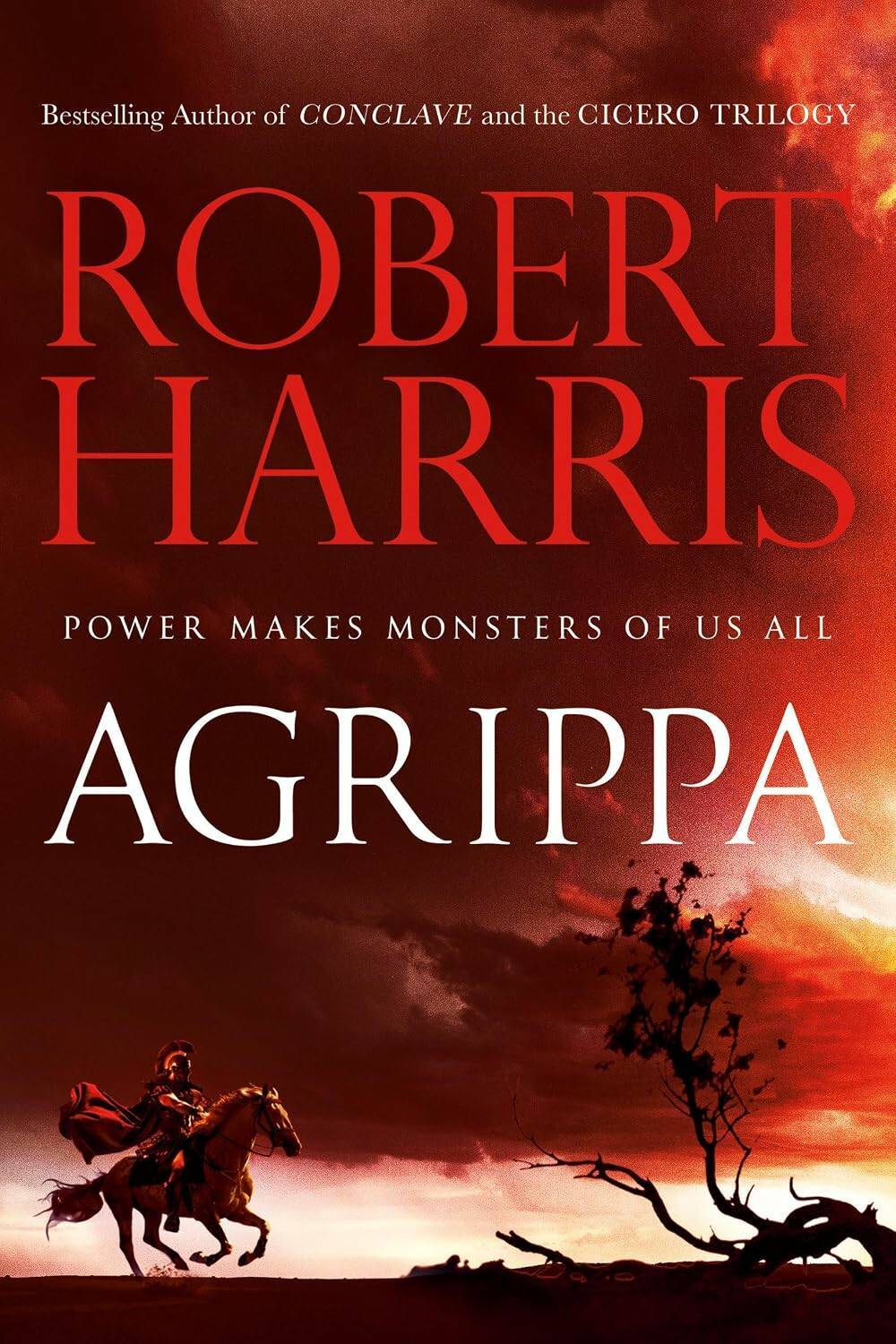
British novelist Robert Harris’s latest work is a reflection on tyranny, corruption and betrayal among all-powerful political leaders.

You might be forgiven for thinking it’s a contemporary thriller — it’s actually historical fiction set in ancient Rome.

A former BBC journalist, Harris debuted as a novelist in 1992 with Fatherland, an alternative history where Nazi Germany won the Second World War.
Agrippa

Agrippa

Since then, the prolific author has become best-known for his works of historical fiction, especially his ancient Rome trilogy released from 2006-2015 and the novel Conclave, which was published in 2016 and was made into the film of the same name in 2024.

His latest, Agrippa, returns to Rome, exploring the life of the titular general and engineer, Marcus Vipsanius, known in life and legend by the nickname Agrippa.

The novel opens in 12 BC, with the sickly Agrippa returning wearily from yet another battle, determined to complete his memoirs.

“Over the years, my reputation has grown and hardened like armour around me,” Agrippa tells us. “And it is this reputation that has led me, by an unexpected turn of events, at the age of fifty, to begin setting down my memories.”

Narrating in the first person, Agrippa tells us that he was born a plebeian, or commoner, in Rome, but gets sent to an elite school thanks to a secret benefactor.

Here, Agrippa befriends the weakly outcast Octavius, soon finding out that Octavius’s uncle is the despised dictator Julius Caesar.

Agrippa comes to admire Caesar, who in turn appreciates Agrippa’s loyalty to him and to Octavius.

When Julius Caesar is assassinated, Octavius is named as Caesar’s heir but has to fight to be recognized — with Agrippa to help him.

But while Octavius succeeds in taking over Rome, Agrippa becomes one of the biggest power players behind the scenes.

Harris skilfully depicts the give-and-take relationship between Octavius and Agrippa.

Octavius values Agrippa’s military and political expertise, but keeps the credit for himself.

Meanwhile, Agrippa accepts Octavius’s arrogance, cruelty and greed since Agrippa still benefits from their relationship.

Agrippa even agrees to divorce his beloved wife and remarry Octavius’s niece to cement a political alliance. “(T)here were things I wanted to do — to avoid more wars if possible, and to build: to leave behind great construction projects in Rome and throughout the empire for the benefit of future generations. If that meant giving up my marriage, then so be it,” he admits.

Nick Gregan photo 
                                Robert Harris’s journalistic background shows in his direct, accessible prose, simplifying the complexities of ancient Roman politics for readers.

Nick Gregan photo

Robert Harris’s journalistic background shows in his direct, accessible prose, simplifying the complexities of ancient Roman politics for readers.

Along with recounting Agrippa’s military triumphs, Harris covers his storied engineering career, especially his constructing the original Roman Parthenon.

Harris’s journalistic background shows in his direct, readable prose, simplifying the complexities of ancient Roman politics for readers.

However, readers unfamiliar with Roman history may have trouble keeping track of characters, especially those with similar names to the main characters.

Some historical fiction novelists, such as Sharon Kay Penman and Bernard Cornwell, seem to take particular pleasure in describing gory battle and torture scenes.

Harris does include plenty of historical cruelties, such as the Roman practice of proscription — strategically picking wealthy but innocent citizens to be executed so the government can steal their fortunes.

However, he recounts them matter-of-factly and kindly spares readers the details.

He also adds a few sly modern commentaries, such as when Agrippa notes, “I had seen how much the poor suffered, in peacetime as well as war, and how often our soldiers had gone hungry. Let the rich who ordered them about now have a taste of it.”

Agreed.

Kathryne Cardwell is a writer in Treaty One territory.
Report Error Submit a Tip

More Stories

The dangers of growing government debt

David McLaughlin 5 minute read Preview

The dangers of growing government debt

David McLaughlin 5 minute read Saturday, May. 2, 2026

What a difference a year makes. The federal government’s economic update was released one year ago to the day Mark Carney became prime minister. What was front and centre in Canadian politics has now been reduced to a passing reference.

It was 162 words. That’s it. That is the sum total contained in the spring economic update on renegotiating the Canada-United States-Mexico Agreement. That reference takes up barely a third of a page in a 150-page update tabled in Parliament.

Even then, there was no actual update provided. Just a banal note that “the government is working to ensure that the review of CUSMA continues to provide predictable and favourable conditions for Canadian trade and investment with the United States and Mexico.”

The explanation can be found in this other sentence: “In an uncertain world, Canada focuses on what it can control.” That means U.S. President Donald Trump, tariffs, and trade with America. The government is admitting it cannot control any aspect of CUSMA negotiations. This is remarkably, if backhandedly, honest.

Read
Saturday, May. 2, 2026

Opaskwayak Cree Nation tabs up to $20 million to get into aerospace, defence manufacturing

Gabrielle Piché 5 minute read Preview

Opaskwayak Cree Nation tabs up to $20 million to get into aerospace, defence manufacturing

Gabrielle Piché 5 minute read Wednesday, Sep. 16, 2026

Darryl Bauer arrived with open ears and a business plan: aims for Opaskwayak Cree Nation to enter aerospace and defence manufacturing, either through acquisition or partnership.

Paskwayak Business Development Corp.’s economic development director carried the physical plan through an aerospace procurement event Wednesday in Winnipeg. The day-long conference drew all levels of government and industry executives.

“There could be significant long-term benefits,” Bauer said of breaking into the sector. “The government’s committing a lot of financial resources.”

Ottawa released a $6.6-billion defence industrial strategy in February.

Read
Wednesday, Sep. 16, 2026

Near-future U.S. the setting for surreal dual-world storyline

Reviewed by Morley Walker 4 minute read Preview

Near-future U.S. the setting for surreal dual-world storyline

Reviewed by Morley Walker 4 minute read 2:01 AM CDT

It’s not every day you encounter a seriously intended literary novel that attempts to dramatize a mind-bending physics theory like quantum entanglement.

But then the B.C.-born-and-raised Emily St. John Mandel is not your everyday Canadian literary writer.

In her late 40s, she has lived in the U.S. for her entire writing career. She is best known for her 2014 dystopian novel Station Eleven, about a Shakespearean acting troupe navigating a pandemic-ravaged America.

Her new outing, her seventh, Exit Party, shares DNA with detective and sci-fi genres more than with conventional literary fiction.

Read
2:01 AM CDT

Dynacare must treat workers fairly: health minister

Carol Sanders 4 minute read Preview

Dynacare must treat workers fairly: health minister

Carol Sanders 4 minute read Wednesday, Sep. 16, 2026

Manitoba’s health minister defended the government’s contract with Dynacare, saying the for-profit company is expected to treat its workers fairly — but wouldn’t say if that expectation was spelled out in the deal.

The 350 private lab workers, who are represented by the Manitoba Association of Health Care Professionals, have been without a contract since March 31 and went on strike on Sept. 8.

The Manitoba Labour Board ordered them back to work and they returned to the job one day later.

Health Minister Uzoma Asagwara was asked Wednesday about the lack of an essential services agreement and why the government didn’t intervene in March, knowing that a labour dispute could interrupt community lab services.

Read
Wednesday, Sep. 16, 2026

Folklorama unites Canadians of all ethnicities

By Jen Zoratti 5 minute read Preview

Folklorama unites Canadians of all ethnicities

By Jen Zoratti 5 minute read Friday, Aug. 7, 2015

On Wednesday night, I found myself sitting at a cafeteria table with a bunch of strangers in an elementary school gymnasium, watching a high-octane tae kwon do demonstration set to Korean pop music.

Where else but Folklorama could you have such a surreal experience?

First, a confession: before I finagled my way onto Wednesday night's VIP bus tour -- which is kind of like a pub crawl for the older set -- I hadn't been to the festival since I was a teenager. Back then, it was mostly obligatory. I dutifully supported the pavilions friends were representing as proud and vaguely embarrassed youth ambassadors, decked out in resplendent cultural dress so far removed from the jeans and T-shirts I saw them in every day.

But once I got there, I was always struck by the strong sense of community. And I always had fun. I loved seeing the fruits of the dance classes they spent their evenings and weekends in. I admired how connected many of them were to their roots; it made me want to learn more about mine. Like many third-generation Canadians, I have roots in many countries: Italy, Austria, Ireland, Scotland and England, to name a few.

Read
Friday, Aug. 7, 2015

Media Literacy & Learning

0 minute read Tuesday, Oct. 28, 2025