Trudeau stresses vigilance, announces vaccine pact as COVID-19 cases reach 150,000

Advertisement

Advertise with us

OTTAWA - Quebeckers were urged to stop socializing, Ontarians were barred from late-night pub-hopping, and the entire country was sternly warned of "critical" containment measures required in coming weeks as soaring COVID-19 case counts edged past 150,000 on Friday.

Read this article for free:


or

Already have an account? Log in here »

To continue reading, please subscribe:

Subscribe and receive a limited-edition Free Press branded hat or tote.

Digital Subscription

One year of digital access for only $205*

  • Enjoy unlimited reading on winnipegfreepress.com
  • Read the E-Edition, our digital replica newspaper
  • Access News Break, our award-winning app
  • Play interactive puzzles

*First annual payment billed as $205.00 + GST for one year. This annual subscription will automatically renew at $233.00 + GST every 52 weeks (10% off the regular annual price of $259.35). Offer available to new and qualified returning subscribers only. Cancel any time.

To continue reading, please subscribe:

Add Free Press access to your Brandon Sun subscription for only an additional

$1 for the first 4 weeks*

  • Enjoy unlimited reading on winnipegfreepress.com
  • Read the E-Edition, our digital replica newspaper
  • Access News Break, our award-winning app
  • Play interactive puzzles
Start now

*Your next Brandon Sun subscription payment will increase by $1.00 and you will be charged $17.95 plus GST for four weeks. After four weeks, your payment will increase to $24.95 plus GST every four weeks.

Hey there, time traveller!
This article was published 25/09/2020 (2180 days ago), so information in it may no longer be current.

OTTAWA – Quebeckers were urged to stop socializing, Ontarians were barred from late-night pub-hopping, and the entire country was sternly warned of “critical” containment measures required in coming weeks as soaring COVID-19 case counts edged past 150,000 on Friday.

The escalating pandemic drew repeated pleas for vigilance from Prime Minister Justin Trudeau and Chief Public Health Officer Theresa Tam in a joint press conference that also outlined a deal with AstraZeneca, which would guarantee up to 20 million doses of an experimental vaccine.

With cases surging in Ontario and Quebec hot-spots, Trudeau implored the public to adhere to public health guidelines, stressing that “what we do now, will be critical for the weeks and months to come.”
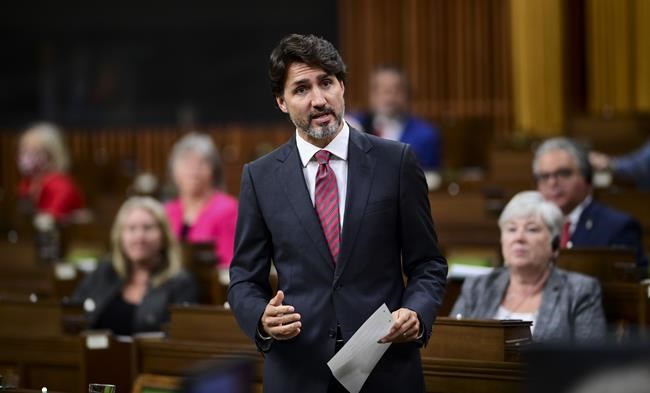
Sean Kilpatrick / THE CANADIAN PRESS
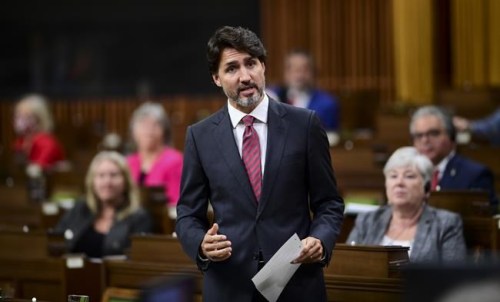
Prime Minister Justin Trudeau stands during question period in the House of Commons on Parliament Hill in Ottawa on Thursday, Sept. 24, 2020. Trudeau is expected to have an announcement about his government's ongoing efforts to protect Canadians and combat the potentially deadly novel coronavirus that causes COVID-19. THE CANADIAN PRESS/Sean Kilpatrick
Sean Kilpatrick / THE CANADIAN PRESS Prime Minister Justin Trudeau stands during question period in the House of Commons on Parliament Hill in Ottawa on Thursday, Sept. 24, 2020. Trudeau is expected to have an announcement about his government's ongoing efforts to protect Canadians and combat the potentially deadly novel coronavirus that causes COVID-19. THE CANADIAN PRESS/Sean Kilpatrick

This was a repeated refrain across the country as political and public health officials took pains to tell the public it was time to scale back parties, dinners out, group activities and other individual actions they said were key factors in an alarming spike in transmission.

In Quebec, Health Minister Christian Dube told residents to a “make a special effort” to limit contact with other people for at least 28 days in order to contain spread and save hospitals from increased burden.

“I insist on this,” said Dube, nevertheless saying he had no problem with people dining in small numbers, within their bubble.

“We’re asking you (for) a month of effort to break the second wave.”

Dube called it a “28-day challenge” to flatten the curve, which on Friday pushed Quebec’s daily tally to 637 new cases, bringing the total number in the province to 70,307.

There have been 5,814 deaths in Quebec.

In Ontario, Premier Doug Ford said bars and restaurants must now close by midnight, with alcohol service to stop at 11 p.m., but that takeout and delivery will be permitted to continue into the wee hours.

All strip clubs will also close, he said, while explaining that the new restrictions strike a balance between public health needs and the province’s financial future.

“I don’t think it’s a huge ask if they can stop serving drinks at 11 o’clock and close their establishments at 12 o’clock,” he said during his daily media briefing.

The measures were not good enough for NDP Leader Andrea Horwath, who criticized the Ford government for failing to provide “a proper, comprehensive and effective second wave strategy.”

Ontario reported 409 new cases of COVID-19 and one new death — about half of the new cases in Toronto and 65 per cent of them in people younger than 40.

The total number of cases in Ontario stood at 48,905, including 2,837 deaths.

Elsewhere, Alberta reported 17,190 confirmed cases, while British Columbia stood at 8,543 confirmed.

COVID-19 cases jumped in Manitoba, too, where masks will be mandatory in Winnipeg’s indoor spaces starting Monday.
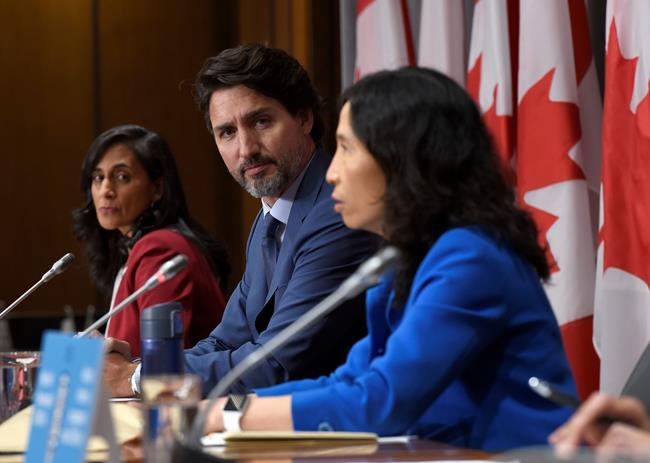
Prime Minister Justin Trudeau and Minister of Public Services and Procurement Anita Anand listen to Chief Public Health Officer of Canada Dr. Theresa Tam during a news conference on the COVID-19 pandemic on Parliament Hill in Ottawa, on Friday, Sept. 25, 2020. THE CANADIAN PRESS/Justin Tang

Officials also limited indoor and outdoor gatherings to 10 people after 54 new cases emerged in the province — 44 of them in the capital region.

COVID-19 cases reached about 150,140 nationwide, with caseloads spiking dramatically in the four largest provinces over the past few weeks.

In the joint televised press conference with Trudeau, Tam said Canadians still have a chance to keep the epidemic from escalating, “if we all act together now.”

“Local public health authorities cannot do this alone. Each of us must take action to protect ourselves, our loved ones and our communities,” she said.

Despite the sombre warnings, Trudeau offered assurances that Ottawa has taken steps to secure a COVID-19 vaccine as soon as one proves viable.

The latest deal is the sixth such arrangement to ensure Canadians have access to crucial supply.

Trudeau also addressed urgent calls to make more COVID-19 testing options available, stating “there are a number of rapid tests in the process of being evaluated by Health Canada, and they will be made available as quickly as possible.”

Tam added that Health Canada was trying to evaluate a variety of new tools including point-of-care devices and serological tests but suggested that work was hindered by a lack of clinical data from the companies seeking approvals.

“There was really little data submitted to the regulator, and you need basic, minimal clinical information. And so we’re also looking at how do we help in the assessment of those types of tests,” said Tam.

“The whole thing has to work in real life, if you like, but I think we’ll be providing more information to people next week and as things evolve.”

This report by The Canadian Press was first published Sept. 25, 2020.

Report Error Submit a Tip

More Stories

COVID-19 tracking apps raise concerns: watchdogs

Nick Wells, The Canadian Press 6 minute read Preview

COVID-19 tracking apps raise concerns: watchdogs

Nick Wells, The Canadian Press 6 minute read Saturday, May. 2, 2020

VANCOUVER - Privacy watchdogs are voicing concerns over proposals across the country to implement smartphone apps to help track COVID-19.

New Brunswick, Manitoba, Newfoundland and Labrador, and Saskatchewan are among the provinces looking at or planning on creating smartphone apps that would track a user's whereabouts.

Alberta is the first province to launch an app.

Known as contact tracing, the apps track those who the user comes in to contact with, commonly by monitoring a device's Bluetooth signal.

Read
Saturday, May. 2, 2020

Trudeau urges vigilance as COVID cases reach 150K

The Canadian Press 5 minute read Preview

Trudeau urges vigilance as COVID cases reach 150K

The Canadian Press 5 minute read Friday, Sep. 25, 2020

OTTAWA - Quebeckers were urged to stop socializing, Ontarians were barred from late-night pub-hopping, and the entire country was sternly warned of "critical" containment measures required in coming weeks as soaring COVID-19 case counts edged past 150,000 on Friday.

The escalating pandemic drew repeated pleas for vigilance from Prime Minister Justin Trudeau and Chief Public Health Officer Theresa Tam in a joint press conference that also outlined a deal with AstraZeneca, which would guarantee up to 20 million doses of an experimental vaccine.

With cases surging in Ontario and Quebec hot-spots, Trudeau implored the public to adhere to public health guidelines, stressing that "what we do now, will be critical for the weeks and months to come."

This was a repeated refrain across the country as political and public health officials took pains to tell the public it was time to scale back parties, dinners out, group activities and other individual actions they said were key factors in an alarming spike in transmission.

Read
Friday, Sep. 25, 2020

Port of Churchill expansion could chase belugas away, U of M researcher says

Nicole Buffie 4 minute read Preview

Port of Churchill expansion could chase belugas away, U of M researcher says

Nicole Buffie 4 minute read Yesterday at 9:07 AM CDT

As plans to expand the Port of Churchill into a four-season trade corridor gathers momentum, a University of Manitoba researcher has published a report on what ship traffic could mean for the beluga whales that gather in the Churchill River estuary each summer.

Veronica Coppolaro said more vessels in the waterways bring a risk that belugas will stop using the estuary for migration, which would impact the ecological landscape, tourism and communities that rely on the animals for food and cultural purposes.

“There are studies showing that (noises) change the way they swim, they change the way (the whales) are vocalizing, they change their main activity, and so this (expansion) can have consequences at different levels,” she said.

The Churchill river estuary is a marine habitat where the Churchill River empties into Hudson Bay. During the summer months belugas gather in the area to feed and give birth.

Read
Yesterday at 9:07 AM CDT

Sinclair named Canada’s columnist of the year

5 minute read Preview

Sinclair named Canada’s columnist of the year

5 minute read Saturday, May. 4, 2019

Winnipeg Free Press Indigenous writer Niigaan Sinclair has been named Canada’s best columnist, winning a distinguished National Newspaper Award, which was presented at a gala in Toronto Friday evening.

Sinclair, who is Anishinaabe, joined the Free Press as a regular columnist in June 2018. Sinclair, who is on sabbatical from his job as an associate professor at the University of Manitoba, writes about Indigenous issues.

In accepting the award, Sinclair said it was his childhood dream to write for the Free Press. He said Winnipeg is the centre of reconciliation in Canada, calling it “the most imperfect city, but the most perfect.”

“I’m honoured to receive the National Newspaper Award for column writing, the same award Richard Wagamese received in 1990. It’s a testament to the incredible support and belief the Free Press has in me, and also how critically important the conversations and issues in Winnipeg are for the national stage.”

Read
Saturday, May. 4, 2019

Treating the disease we simply won’t insure

Rafiq Andani 5 minute read 2:00 AM CDT

There is a condition affecting tens of thousands of Canadians.

In 2024, one national measure estimated that almost 120,000 people had the condition. The estimate captures only part of the problem.

The same data show its chronic form becoming more common. In 2017, an estimated 28,900 people met the definition for its chronic form. By 2024, there were 36,058, an increase of almost 25 per cent.

This condition carries an unfortunate prognosis.

Convicted mail bomber loses parole-denial appeal

Tyler Searle 4 minute read Preview

Convicted mail bomber loses parole-denial appeal

Tyler Searle 4 minute read Thursday, Apr. 2, 2026

Convicted mail bomber Guido Amsel has lost his fight for full parole, after his appeal for release was shot down by the Parole Board of Canada.

In 2018, Amsel received a life sentence with no chance of parole for 10 years for the attempted murders of his ex-wife Iris Amsel and lawyers Maria Mitousis and George Orle in 2015 by mailing explosives to them. One of the bombs, placed inside a hand-held tape recorder with instructions to press the “play” button, exploded in Mitousis’s office, resulting in the loss of her right hand.

He was also sentenced to 12 years minus time served for an earlier attempt to murder his ex-wife in 2013.

He was 59 years old in August, when he appeared before the board to argue for full parole. Had it been granted, he would have been released from federal custody and deported to Germany, where he was born and lived for decades.

Read
Thursday, Apr. 2, 2026