High vaccine use urged by Tam, Njoo to beat COVID-19, restore pre-pandemic life

Advertisement

Advertise with us

OTTAWA - Canadians will need to roll up their sleeves and get vaccinated in large numbers to finally corral COVID-19 before life can return to a semblance of its pre-pandemic state, Canada's top public health officers said Tuesday.

Read this article for free:


By clicking the button above, an account will be created and you will begin to receive some of our recommended newsletters. You may opt out of any newsletter by visiting your Email and Communication Preferences page or by clicking "unsubscribe" at the bottom of any email.

or

Already have an account? Log in here »

To continue reading, please subscribe:

Digital Subscription

One year of digital access for only $1.44 a week*

  • Enjoy unlimited reading on winnipegfreepress.com
  • Read the E-Edition, our digital replica newspaper
  • Access News Break, our award-winning app
  • Play interactive puzzles

*Billed as $5.77 plus GST every four weeks. After 52 weeks, price increases to the regular rate of $19.95 plus GST every four weeks. Offer available to new and qualified returning subscribers only. Cancel any time.

To continue reading, please subscribe:

Add Free Press access to your Brandon Sun subscription for only an additional

$1 for the first 4 weeks*

  • Enjoy unlimited reading on winnipegfreepress.com
  • Read the E-Edition, our digital replica newspaper
  • Access News Break, our award-winning app
  • Play interactive puzzles
Start now

*Your next Brandon Sun subscription payment will increase by $1.00 and you will be charged $17.95 plus GST for four weeks. After four weeks, your payment will increase to $24.95 plus GST every four weeks.

Hey there, time traveller!
This article was published 01/09/2020 (2251 days ago), so information in it may no longer be current.

OTTAWA – Canadians will need to roll up their sleeves and get vaccinated in large numbers to finally corral COVID-19 before life can return to a semblance of its pre-pandemic state, Canada’s top public health officers said Tuesday.

“Widespread vaccine uptake is the best shot Canadians have in regaining some of what we’ve lost and returning to things that we cherish — things like holding family and friends closely, having community events and living our lives without the fear of contracting the disease,” said Dr. Theresa Tam, the country’s chief medical officer.

Tam and her deputy, Dr. Howard Njoo, offered that assessment one day after the Trudeau government announced the latest instalment in its plan to pre-buy tens of millions of doses of potential vaccines, signing deals with two American firms.
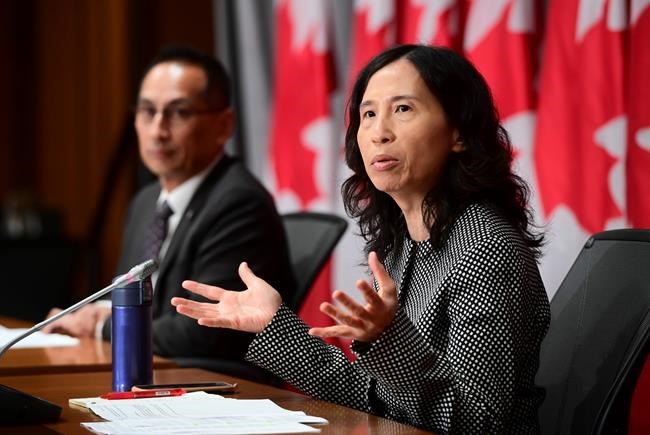
Chief Public Health Officer Dr. Theresa Tam and Dr. Howard Njoo, Deputy Chief Public Health Officer, hold a press conference on Parliament Hill in Ottawa on Tuesday, Sept. 1, 2020. THE CANADIAN PRESS/Sean Kilpatrick

The newest deals will allow Canada to buy as many as 76 million doses of a vaccine candidate from Maryland-based biotech company Novavax, and up to 38 million doses of the vaccine being developed by Johnson & Johnson’s pharmaceutical company Janssen Inc.

Last month, the government signed similar deals with U.S. companies Pfizer and Moderna that would give Canada access to up to 76 million more doses.

Njoo said it is not clear what percentage of Canadians will need to get vaccinated to achieve broad immunity but “the more Canadians that take advantage, the better.”

Both physicians evoked the dark days of forced quarantines, school closures and bans on public gatherings during the measles and polio outbreaks of the 1930s, ’40s and ’50s.

“Most of us are lucky. We have not had to live through these types of measures because of safe and effective vaccines for these diseases,” said Tam.

“What Canada and the world needs to have for the best shot at normalcy is safe and effective vaccines.”

Tam suggested that the threshold for effective immunization is a moving target because understanding the science around COVID-19 is itself a work in progress.

For regulatory purposes, she said, that level has to be continuously evaluated.

“The international consensus is that we should at least look at around the 50 per cent vaccine efficacy mark,” said Tam, adding that there simply isn’t a “yes or no” answer.

More will be known when the data from ongoing Phase 3 clinical trials become available, she said.

“It’s a matter of remaining open to the evidence and being flexible.”

Right now, there appears to be low immunity to the disease around the world, “so getting a high enough vaccine uptake is going to be quite important,” said Tam.

Njoo said a vaccine could be available sometime in 2021, perhaps as early as the spring.

“We’re very optimistic here in Canada and because there are number of vaccine candidates being evaluated,” said Njoo.

“There could be an effective and safe vaccine, perhaps in 2021. We don’t know exactly when. Perhaps in the spring, maybe a little bit later. But it’s a very good thing to stay optimistic.”

As for whether such a vaccine should be mandatory, Njoo said it is better for people to educated about the benefits of immunization rather than have it forced upon them because that’s the best way to increase the number of vaccinations.

“I think it is more important to maybe change people’s attitudes who may be more reticent about getting vaccinated rather than having regulations to make vaccination mandatory,” Njoo said.

While vaccines have never been made compulsory in Canada, the practice in hospitals and long-term care facilities that have had outbreaks of respiratory illnesses has been for health-care workers to be vaccinated before being allowed to return to work, he noted.

As for testing for COVID-19, Njoo said the gold standard remains the so-called PCR test, or polymerase chain reaction testing which relies on a sample collected from a person’s nose or throat.

Asked about the possibility of a home test for the disease, Njoo said: “It’s quite complicated but the bottom line is: we’re open to examining all types of testing technologies because the more tools we have in the toolbox in terms of different types of tests available to use in different types of contexts, the better.”

This report by The Canadian Press was first published Sept. 1, 2020.

Report Error Submit a Tip

More Stories

Westman to lose sole medical oncologist

Rylee Gerrard 5 minute read Preview

Westman to lose sole medical oncologist

Rylee Gerrard 5 minute read Updated: 9:26 AM CDT

BRANDON — Western Manitoba is about to lose its only medical oncologist, leaving just 22 in the province — all of whom are in Winnipeg.

Brandon West MLA Wayne Balcaen raised the issue during question period Thursday, saying the departure of Dr. Brady Anderson will be a “major loss” for the region.

After four years working out of the Western Manitoba Cancer Centre in Brandon, Anderson’s last day will be Nov. 13.

“He literally sees hundreds of patients within the Westman area, and now those individuals will have to travel to Winnipeg to get that personal service,” Balcaen said, calling Anderson’s impending departure “catastrophic.”

Read
Updated: 9:26 AM CDT

City rec facilities crumbling

Ryan Thorpe 6 minute read Preview

City rec facilities crumbling

Ryan Thorpe 6 minute read Monday, Oct. 22, 2018

Throughout Winnipeg, decades-old community assets — pools, arenas and recreation and leisure centres — are deteriorating so quickly that service disruptions are inevitable.

Meanwhile, the city’s community services department, which is responsible for managing those assets, operates with an annual deficit of roughly $80 million, meaning there are scant resources to do little more than bail water on a sinking ship.

Soon, Winnipeggers will have a choice: fewer community services or higher costs.

“It poses a huge challenge because we have very limited dollars that we have to invest in our existing facilities. We also have growing demands for new amenities in new areas. We have to be very strategic,” said Ken McKim, manager of asset management for the department.

Read
Monday, Oct. 22, 2018

Meteorologist behind Rob’s Obs is moving weather station to Ontario

Ben Waldman 7 minute read Preview

Meteorologist behind Rob’s Obs is moving weather station to Ontario

Ben Waldman 7 minute read Monday, Jun. 13, 2022

In a Winnipeg winter, there are always at least two certainties: it will be cold, and it will snow. A third certainty: the people will talk endlessly about how frigid the temperature is, and argue about how much snow is cloaking their driveways. Is it colder than it ever has been? Is there more snow today than the same time last year?

Rob Paola likely knows the answers to those questions.

Paola possesses no super powers. He is but a man with a metre stick and 40 years of professional meteorological experience, in the midst of a lifelong love affair with Mother Nature, a most turbulent mistress who rarely, if ever, reciprocates.

Each year when snow begins to fall, Paola heads outside his Charleswood home to figure out how much. He sticks his ruler in the ground, grabs his clipboard, and clicks his pen. In neat script, he records the temperature, what time precipitation began, how deep the powder is stacked. Then, he shares his data and insights online with thousands of followers who want a clear answer to the eternal questions: Why is this happening? When will it stop? How much snow has fallen in the city of Winnipeg?

Read
Monday, Jun. 13, 2022

Ottawa announces $500 million for North End sewage plant upgrade

Joyanne Pursaga 4 minute read Preview

Ottawa announces $500 million for North End sewage plant upgrade

Joyanne Pursaga 4 minute read 5:03 PM CDT

The federal government will provide $500 million to help complete the major upgrade to Winnipeg’s North End sewage treatment plant.

Winnipeg South MP Terry Duguid confirmed the total funding at a news conference at the plant Friday, calling the work critical to Winnipeg’s future.

“The stakes could not be higher. Without expanded wastewater treatment, Winnipeg would run out of capacity to build new homes and accommodate new industries within six years,” said Duguid.

The commitment offers the final funding needed to cover the $1.57-billion third and final phase of the upgrade. The city and province will also pay $500 million each for the work.

Read
5:03 PM CDT

Trump touts USMCA win in state of the union

James McCarten, The Canadian Press 6 minute read Preview

Trump touts USMCA win in state of the union

James McCarten, The Canadian Press 6 minute read Tuesday, Feb. 4, 2020

WASHINGTON - President Donald Trump declared his scorched-earth political style an unmitigated success Tuesday in a fiercely partisan, made-for-TV state of the union speech that made it clear he expects to be back in the White House next year on the strength of the U.S. economy and his trade deals with Canada, Mexico and China.

Trump, addressing a joint session of Congress in the very chamber where House Democrats voted to impeach him less than two months ago, became only the second president in American history — Bill Clinton was the first — to deliver a state of the union while standing trial in the Senate.

Unrepentant, he pointedly refused to shake the offered hand of House Speaker Nancy Pelosi on the dais before singing the praises of what he billed as "the great American comeback," pointing to strong job growth, a soaring stock market and low unemployment as evidence of his leadership. And when he was done, Pelosi ripped up the speech in full view of the television cameras.

"America's enemies are on the run, America's fortunes are on the rise, and America's future is blazing bright. The years of economic decay are over," Trump declared, taking full credit for the country's "roaring economy," including what he billed as seven million new jobs and the lowest jobless rate in half a century — a "blue-collar boom" that he's counting on to help his re-election chances in November.

Read
Tuesday, Feb. 4, 2020

Actor-director Cooper takes new approach to familiar tale

Randall King 4 minute read Preview

Actor-director Cooper takes new approach to familiar tale

Randall King 4 minute read Thursday, Oct. 4, 2018

TORONTO — In his self-directed version of A Star Is Born, Bradley Cooper plays a rock star named Jackson Maine.

Note the name: it marks the character as a member of a cinematic lineage that descends all the way to 1937.

That year, the first A Star Is Born was made, with Frederick March in the role of alcoholic actor Norman Maine. The name stayed in 1954, when James Mason took over the role of an actor who first nurtures the career of Judy Garland’s up-and-coming star Vicki Lester before his drunken shenanigans threaten to derail it. By 1976, Kris Kristofferson played the role of musician John Norman Howard, a rock singer with a musical stake in the ascent of Barbra Streisand’s Esther Hoffman.

Cooper, 43, remembered the Maine name, but also brought his own vision as a first-time feature filmmaker to the new version, which opens Thursday, Oct. 4, opposite Lady Gaga after the originally designated director, Clint Eastwood, dropped out. While actors might not want to see different interpretations of a role, Cooper embraced the opportunity to see all the past iterations.

Read
Thursday, Oct. 4, 2018