Mass gatherings, erosion of trust upend coronavirus control

Advertisement

Advertise with us

NEW YORK - Protests erupting across the nation over the past week — and law enforcement's response to them — are threatening to upend efforts by health officials to track and contain the spread of coronavirus just as those efforts were finally getting underway.

Read this article for free:


or

Already have an account? Log in here »

To continue reading, please subscribe:

Subscribe and receive a limited-edition Free Press branded hat or tote.

Digital Subscription

One year of digital access for only $205*

  • Enjoy unlimited reading on winnipegfreepress.com
  • Read the E-Edition, our digital replica newspaper
  • Access News Break, our award-winning app
  • Play interactive puzzles

*First annual payment billed as $205.00 + GST for one year. This annual subscription will automatically renew at $233.00 + GST every 52 weeks (10% off the regular annual price of $259.35). Offer available to new and qualified returning subscribers only. Cancel any time.

To continue reading, please subscribe:

Add Free Press access to your Brandon Sun subscription for only an additional

$1 for the first 4 weeks*

  • Enjoy unlimited reading on winnipegfreepress.com
  • Read the E-Edition, our digital replica newspaper
  • Access News Break, our award-winning app
  • Play interactive puzzles
Start now

*Your next Brandon Sun subscription payment will increase by $1.00 and you will be charged $17.95 plus GST for four weeks. After four weeks, your payment will increase to $24.95 plus GST every four weeks.

Hey there, time traveller!
This article was published 01/06/2020 (2280 days ago), so information in it may no longer be current.

NEW YORK – Protests erupting across the nation over the past week — and law enforcement’s response to them — are threatening to upend efforts by health officials to track and contain the spread of coronavirus just as those efforts were finally getting underway.

Health experts need newly infected people to remember and recount everyone they’ve interacted with over several days in order to alert others who may have been exposed, and prevent them from spreading the disease further. But that process, known as contact tracing, relies on people knowing who they’ve been in contact with — a daunting task if they’ve been to a mass gathering.

And the process relies on something that may suddenly be in especially short supply: Trust in government.
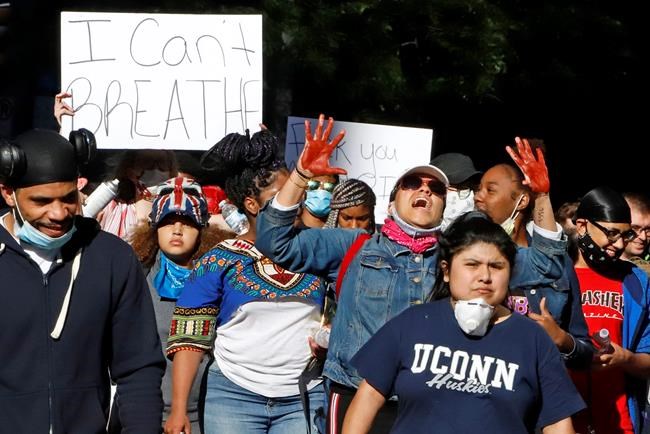
A group marches through the streets of downtown Pittsburgh Sunday, May 31, 2020 protesting the death of George Floyd, who died after being restrained by Minneapolis police officers on Memorial Day, May 25. (AP Photo/Gene J. Puskar)

“These events that are happening now are further threats to the trust we need,” said Dr. Sandro Galea, dean of the Boston University School of Public Health. “If we do not have that, I worry our capacity to control new outbreaks becomes more limited,” he said.

Government officials have been hoping to continue reopening businesses, churches and other organizations after months of stay-at-home orders and other infection-prevention measures. But health experts also hoped that any reopening would be accompanied by widespread testing, contact tracing and isolation to prevent new waves of illness from beginning.

Over the past week, protests sparked by the death of George Floyd, a black man who died after a white Minneapolis police officer pinned a knee to his neck, have involved thousands of people gathered tightly together in large crowds in more than 20 cities nationwide.

It’s unclear if the protests themselves will trigger large new outbreaks. The protests were outside, where infections don’t spread as readily as indoors. Also, many of the protesters were wearing masks, and much of the contact was likely less-hazardous “transient” moments of people moving around, passing each other, said Dr. William Schaffner, an infectious diseases expert at Vanderbilt University.

But, still, experts worry that public efforts to contain the disease in the future could be undermined.

In Los Angeles, the city’s mayor announced Saturday that COVID-19 testing centres were being closed because of safety concerns related to violent protests. Testing in Minneapolis will be affected because some of the clinics that provide the service have been damaged in the protests, according to a city government spokesperson.

Reduced testing could “be giving the virus another head start,” Schaffner said.

And contact tracing, which is only just getting going in several states, is an even bigger concern. It involves people who work for or with health departments asking intimate questions about where a person has been and who they’ve been talking to — and getting full, truthful answers in return.

“In this current environment which has enhanced or brought forth a mistrust of governmental authority, it might make them disinclined to speak with anyone in government,” Schaffner said.
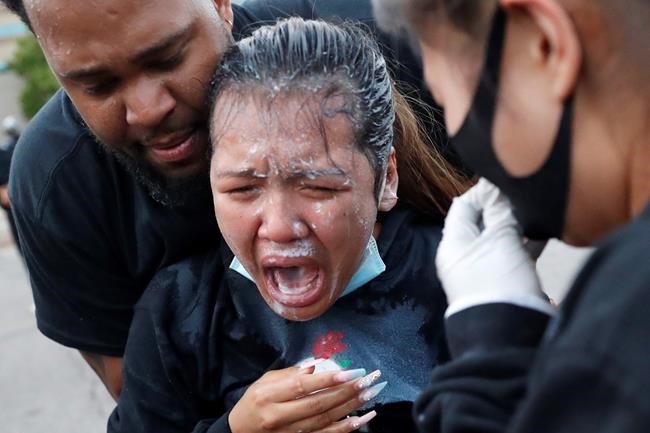
A woman is helped after being hit with pepper spray after curfew on Sunday, May 31, 2020 in Minneapolis. Protests continued following the death of George Floyd, who died after being restrained by Minneapolis police officers on Memorial Day. (AP Photo/John Minchillo)

That is especially true in black communities trying to cope with episodes of police violence and longstanding frustrations with how they have been marginalized and mistreated by people who work for government agencies. And those are the communities that have been hardest hit by the coronavirus in the U.S. and most in need of public health measures to help control it.

Protests in Salt Lake City that drew several thousand people are a setback for contact tracers already struggling to contain the spread of the coronavirus, said Tair Kiphibane, infectious disease bureau manager for the Salt Lake County Health Department.

She became concerned as she watched hundreds of protesters go by her downtown Salt Lake City office Saturday afternoon where she and her staff were working another weekend day after seeing increases in COVID-19 cases last week.

She sent contact tracers home three hours early Saturday as protests grew violent near the office. She expects further increases in cases because so many people were close to one another during the protest. Tracing the web of infected people that may have been exposed will be daunting since protesters likely won’t have names and phone numbers for many of the people they were around.

“It is going to make it so much harder,” Kiphibane said. “It could be anybody. They don’t know most of those people … It is just too many people.”

In a press conference Saturday, Minnesota Public Safety Commissioner John Harrington used the term “contact tracing” when describing an investigation into arrested protesters there. He said the goal is to “see if there are crime or white supremacy organizations that have played a role” and “to understand how do we go after them, legally,” Harrington said.

But Harrington’s use of “contact tracing” by law enforcement may complicate the job of health workers as they try to track the virus’s spread, some experts said.

“That was an abuse of the word ‘contact tracing.’ That is not what contact tracing is,” said Dr. Tom Frieden, former director of the federal Centers for Disease Control and Prevention.

“Contact tracing is a service to patients and their contacts to provide services for patients and warning for contacts. It has nothing to do with police activity. Nothing,” said Frieden, who is now president of Resolve to Save Lives, a non-profit that works to prevent epidemics.
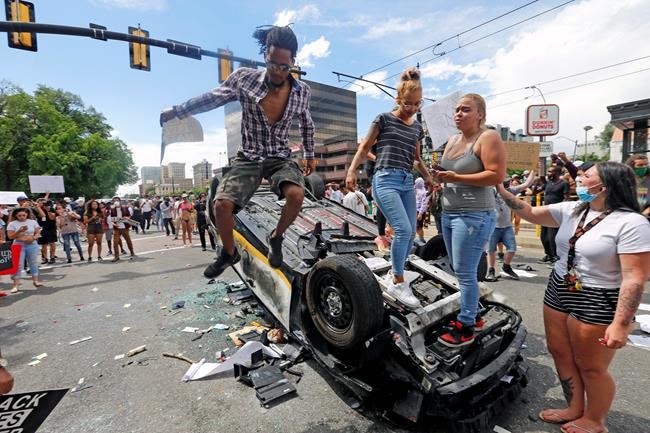
FILE - in this Saturday, May 30, 2020 file photo, protesters climb on a flipped over police vehicle, in Salt Lake City. Protests in Salt Lake City that drew several thousand people are a setback for contact tracers already struggling to contain the spread of the coronavirus, said Tair Kiphibane, infectious disease bureau manager for the Salt Lake County Health Department. (AP Photo/Rick Bowmer, File)

Galea said he hopes many people will separate in their minds the contact tracing done by public health workers from crime investigations by the police. But, he added, “I do think sometimes it’s difficult to make a distinction when you feel marginalized by, and targeted by, the entire government.”

___

Associated Press writer Brady McCombs contributed to this report in Salt Lake City.

___

The Associated Press Health and Science Department receives support from the Howard Hughes Medical Institute’s Department of Science Education. The AP is solely responsible for all content.

Report Error Submit a Tip

More Stories

Beware invasive, ‘frightening’ waterhemp

Laura Rance-Unger 4 minute read Preview

Beware invasive, ‘frightening’ waterhemp

Laura Rance-Unger 4 minute read 2:01 AM CDT

There’s a threat lurking on the edge of Manitoba farmers’ fields this fall that’s even scarier than the escalating trade war with their biggest customer.

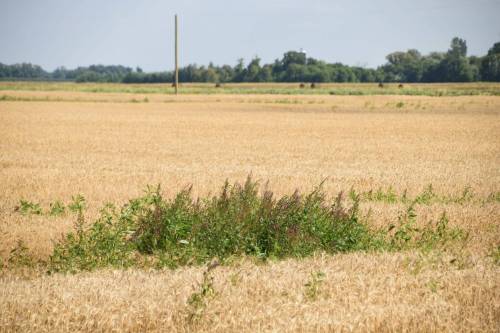
Provincial extension advisers are warning farmers to watch for a weed known as “tall waterhemp,” which, true to its name, may already be towering above ready-to-harvest crops.

Those wispy tentacles waving in the breeze look pretty innocuous from a distance. But this highly invasive member of the pigweed family produces hundreds of thousands of seeds that are just itching for dispersal through farmers’ combines and across their fields.

Each of those tiny seeds — one small pill container filled halfway holds 44,000 — can produce plants with stems the width of saplings and heights of two to five metres. One or two plants can quickly turn into a patch. If waterhemp takes over a field, it can choke out the growing crop and cut yields by more than 90 per cent.

Read
2:01 AM CDT

Paralympics open in empty stadium - just like Olympics

Stephen Wade, The Associated Press 6 minute read Preview

Paralympics open in empty stadium - just like Olympics

Stephen Wade, The Associated Press 6 minute read Tuesday, Aug. 24, 2021

On Wednesday at 12 p.m. ET, Toronto Star baseball columnist and Deep Left Field podcast host Mike Wilner will answer your questions about the Blue Jays and anything else baseball-related.

Read
Tuesday, Aug. 24, 2021

Province urges federal government to continue vital health-care funding

Carol Sanders 4 minute read Preview

Province urges federal government to continue vital health-care funding

Carol Sanders 4 minute read Saturday, Nov. 8, 2025

Manitoba wants the federal government to renew an annual $150-million health-care agreement that, for the last three years, has helped the province go “further, faster” to staff up the front lines.

“The loss of these agreements would mean that we’re losing predictable targeted federal contributions that have helped us stabilize staffing and strengthen health care — not just health care in our hospitals, but community-based care as well,” Health Minister Uzoma Asagwara said Friday.

The program, dubbed “Working Together to Improve Health Care for Canadians,” was announced in February 2023; the federal government has earmarked close to $150 million a year in 2023-24, 2024-25 and 2025-26. Tuesday’s federal budget made no mention of renewing those funding agreements.

“I think there was an opportunity missed today to signal that the bilateral funding agreements for your health care are going to continue,” Premier Wab Kinew noted in his response to the budget on Tuesday. One of the deals Manitoba signed is set to expire at the end of March.

Read
Saturday, Nov. 8, 2025

Tories likely to follow giant leap towards balanced budget with a step or two in other direction

Tom Brodbeck 5 minute read Preview

Tories likely to follow giant leap towards balanced budget with a step or two in other direction

Tom Brodbeck 5 minute read Friday, Sep. 27, 2019

The only problem with slashing the size of the deficit as much as the province did last year is it’s going be tough for government officials to explain why the shortfall will likely be higher this year — and maybe next year, too.

Last year’s deficit came in at a surprising $163 million, according to the province’s public accounts released Thursday. That’s well below the budgeted shortfall of $521 million. It’s great news. The sooner the province stops borrowing money to finance its daily operating costs, the closer it will be to paying down debt and freeing up more money for front-line services (and cutting taxes). It’s a major accomplishment for a government that, just three years earlier, inherited a deficit of $932 million and a debt that was growing at about $2 billion a year.

Considering government is so close to balance, it’s tempting to assume they could be back in the black as early as next year. After all, what’s $163 million in a $17.4-billion budget? It’s less than one per cent.

But there were some unique reasons why the deficit fell so dramatically last year, many of which were due to one-time events. The stars probably won’t align like that anytime soon. Which means this year's deficit, and maybe next year's, could be higher.

Read
Friday, Sep. 27, 2019

Leaked data prompts news backlash in Canada, U.S.

James McCarten, The Canadian Press 5 minute read Preview

Leaked data prompts news backlash in Canada, U.S.

James McCarten, The Canadian Press 5 minute read Friday, Feb. 18, 2022

WASHINGTON - Journalists in Canada and the United States, veterans of a daily grind that entails tracking down and chatting up newsmakers, politicians and ordinary citizens by whatever means necessary, are encountering a very different — and hostile — world as they work to learn more about supporters of the protests in Ottawa.

Reporters are being harassed, spammed, "doxxed" and even threatened for reaching out to donors to an online crowdfunding campaign that was targeted last week by hackers who disclosed the contact details of thousands of pro-trucker contributors.

"I actually had someone come to my door and leave a threatening note," said Bryan Schott, a political reporter with the Salt Lake Tribune who used the list to send emails to donors with Utah zip codes.

In Schott's case, along with countless others, people have been using social media to post screen shots of emails they've received from reporters — usually innocuous queries asking for confirmation that they had donated to the protesters and whether they'd agree to an interview.

Read
Friday, Feb. 18, 2022

The silent stalker overtaking our sidewalks

Russell Wangersky 6 minute read Preview

The silent stalker overtaking our sidewalks

Russell Wangersky 6 minute read 2:00 AM CDT

Under the McPhillips railway bridge lives an overload of a sensory experience — and not in a nice way.

Once in a while, the city sidewalk sweepers make their way through the narrow, dark passageway, clearing away the sometimes inch-deep pigeon droppings along the edges. But most of the time, it’s the worst part of my walk.

There’s the guano — slick as grease when the sidewalk’s filled wall to wall with standing puddles — plus dead pigeons, broken pigeon eggs, discarded needles. Regularly, small handfuls of discarded, opened, probably stolen mail, as well as torn-open delivery packaging. The smell is overpowering, and it all seems like ground zero in an avian-flu-breeding sci-fi movie.

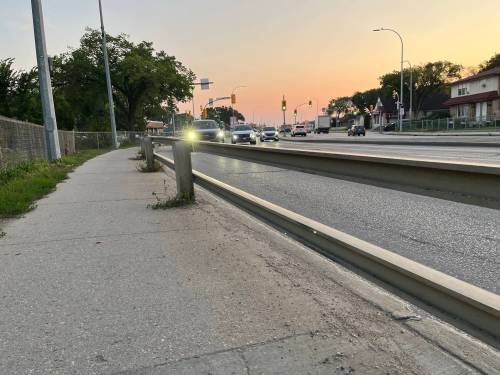
It’s also a pinch-point on McPhillips: the roadway has narrowed to two lanes to fit under the old bridge, and the sidewalks are narrow as well, tucked between a concrete wall on one side and steel girders that can only be described as encrusted on the other.

Read
2:00 AM CDT