Quebec to reopen retail, construction and manufacturing businesses

Advertisement

Advertise with us

MONTREAL - Quebec's economic recovery plan unveiled Tuesday aims to reopen the province's retail, construction and manufacturing sectors by mid-May, allowing roughly 500,000 people who had been temporarily laid off during the pandemic to return to work.

Read this article for free:


By clicking the button above, an account will be created and you will begin to receive some of our recommended newsletters. You may opt out of any newsletter by visiting your Email and Communication Preferences page or by clicking "unsubscribe" at the bottom of any email.

or

Already have an account? Log in here »

To continue reading, please subscribe:

Digital Subscription

One year of digital access for only $1.44 a week*

  • Enjoy unlimited reading on winnipegfreepress.com
  • Read the E-Edition, our digital replica newspaper
  • Access News Break, our award-winning app
  • Play interactive puzzles

*Billed as $5.77 plus GST every four weeks. After 52 weeks, price increases to the regular rate of $19.95 plus GST every four weeks. Offer available to new and qualified returning subscribers only. Cancel any time.

To continue reading, please subscribe:

Add Free Press access to your Brandon Sun subscription for only an additional

$1 for the first 4 weeks*

  • Enjoy unlimited reading on winnipegfreepress.com
  • Read the E-Edition, our digital replica newspaper
  • Access News Break, our award-winning app
  • Play interactive puzzles
Start now

*Your next Brandon Sun subscription payment will increase by $1.00 and you will be charged $17.95 plus GST for four weeks. After four weeks, your payment will increase to $24.95 plus GST every four weeks.

Hey there, time traveller!
This article was published 28/04/2020 (2376 days ago), so information in it may no longer be current.

MONTREAL – Quebec’s economic recovery plan unveiled Tuesday aims to reopen the province’s retail, construction and manufacturing sectors by mid-May, allowing roughly 500,000 people who had been temporarily laid off during the pandemic to return to work.

Despite the fact Quebec has more than half of Canada’s total number of deaths related to COVID-19 and continues to record hundreds of new cases per day, Premier Francois Legault said the pandemic — outside long-term care homes — “is under control.”

“Our challenge is to gradually restart the economy without restarting the pandemic,” Legault told reporters in Quebec City.
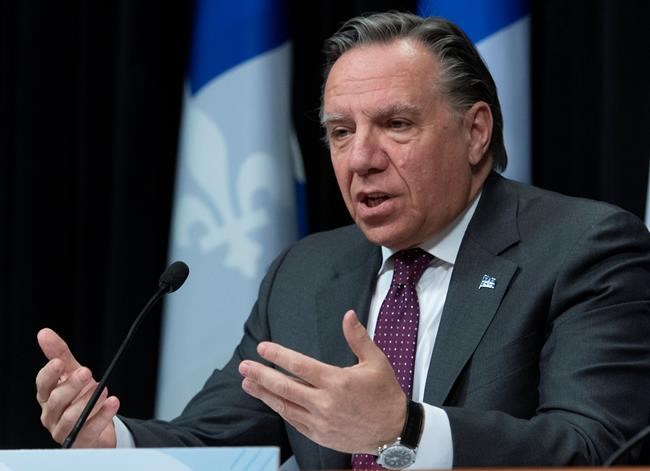
Quebec Premier Francois Legault announces his intention to re-open primary schools in tow weeks, during a news conference on the COVID-19 pandemic, Monday, April 27, 2020 at the legislature in Quebec City. THE CANADIAN PRESS/Jacques Boissinot

Under his government’s plan, stores outside Montreal can reopen next Monday while those in the greater Montreal region will reopen May 11. Stores in shopping malls will remain closed, unless they can be accessed from outside.

The construction industry will completely reopen starting May 11, while manufacturing companies can resume operations the same day, with initial limits on the total number of employees who can work per shift.

All businesses that reopen will be required to follow guidelines put in place by the province’s workplace safety board, which will monitor and enforce the directives.

Quebec’s top doctor, Horacio Arruda, remained sanguine even as he gave reporters a dose of reality about the risks associated with gradually reopening the economy.

“It’s clear … there will be an increase in transmission in the community as soon we open a little,” said the province’s director of public health. “There could even be deaths.”

But health authorities will monitor the rate of infection, he said, adding that if they feel they are beginning to lose control of the contagion they will order businesses to shut their doors once again.

The question, Arruda explained, is how the province balances the risk of infection with the risks associated with confining millions of people and shuttering businesses for many more months.

“There are other determinants of public health in a society other than infectious disease,” Arruda said, citing divorce, child abuse and even suicide.

Authorities, Arruda continued, don’t want to keep everything closed until September and then reopen when the regular flu season comes.

“We are taking people who maybe will catch (COVID-19), but whose lives will be less affected by it,” he said. “Some people will be asymptomatic, others might need to be hospitalized. I hope not too many people will die.”

“But the virus is here,” he added. “It will be here for a while…. We know it’s a risky bet.”

Economy Minister Pierre Fitzgibbon said 1.2 million Quebecers have had to temporarily stop work since the province was put “on pause” last month to slow the spread of the novel coronavirus. The three sectors scheduled to reopen will permit roughly 500,000 people to return to work, he said.

The situation is stabilizing in most regions, Fitzgibbon added, and the measures announced Tuesday were drafted in consultation with organizations responsible for public health and worker safety. Fitzgibbon warned that if COVID-19 trends worsen, he won’t hesitate to restore the restrictions.

Quebec’s workplace safety board has created a series of guides for how businesses in retail, manufacturing and construction can safely reopen. Legault said the agency will be responsible for ensuring that businesses comply with the health and safety directives, but the premier did not give details on fines or other penalties that could be incurred.

The province’s business community rejoiced at Tuesday’s news. Labour unions were supportive yet cautious, saying they wanted employers to be held accountable for ensuring safe workplaces.

“We cannot fail, because no one wants to be responsible for a second wave of contagion,” said Pierre Brassard, president of CSN-Construction, a major union in Quebec.

Charles Millard, president of a prominent business lobby group, Federation des chambres de commerce du Quebec, called on the government to prepare a financial aid package to help companies comply with safety regulations.

“In some cases, such as in the food, manufacturing and construction sectors, companies will have to completely reorganize and renovate their workplaces as well as their production lines,” he said.

Quebec’s recovery strategy for businesses came a day after Legault announced elementary schools and daycares across the province would be reopened by May 19.

The province has reported 25,757 cases of COVID-19 to date and 1,682 deaths. Sixty-five per cent of those deaths came from people who were living in long-term care homes, which continue to struggle with controlling the contagion.

A new poll conducted by Leger in partnership with the Association for Canadian Studies indicated francophone Quebecers are less fearful of getting COVID-19 than are other Canadians. The web poll, which surveyed 2,015 Canadians between April 24 and 26, revealed 52 per cent of francophone Quebec respondents said they were not afraid of catching the virus, compared with 42 per cent of all respondents.

This report by The Canadian Press was first published April 28, 2020.

Report Error Submit a Tip

More Stories

Meteorologist behind Rob’s Obs is moving weather station to Ontario

Ben Waldman 7 minute read Preview

Meteorologist behind Rob’s Obs is moving weather station to Ontario

Ben Waldman 7 minute read Monday, Jun. 13, 2022

In a Winnipeg winter, there are always at least two certainties: it will be cold, and it will snow. A third certainty: the people will talk endlessly about how frigid the temperature is, and argue about how much snow is cloaking their driveways. Is it colder than it ever has been? Is there more snow today than the same time last year?

Rob Paola likely knows the answers to those questions.

Paola possesses no super powers. He is but a man with a metre stick and 40 years of professional meteorological experience, in the midst of a lifelong love affair with Mother Nature, a most turbulent mistress who rarely, if ever, reciprocates.

Each year when snow begins to fall, Paola heads outside his Charleswood home to figure out how much. He sticks his ruler in the ground, grabs his clipboard, and clicks his pen. In neat script, he records the temperature, what time precipitation began, how deep the powder is stacked. Then, he shares his data and insights online with thousands of followers who want a clear answer to the eternal questions: Why is this happening? When will it stop? How much snow has fallen in the city of Winnipeg?

Read
Monday, Jun. 13, 2022

Fawcett promises growth in second term as Brandon mayor

Alex Lambert 2 minute read Preview

Fawcett promises growth in second term as Brandon mayor

Alex Lambert 2 minute read 9:39 AM CDT

BRANDON — Jeff Fawcett promises “incredible opportunities” for Brandon over the next four years.

The incumbent was handily re-elected for a second term as Brandon mayor Wednesday evening, receiving 54 per cent of the vote. He defeated his only challenger, former councillor and MLA Len Isleifson, by 907 votes.

“The next four years presents incredible opportunities for our city,” Fawcett told supporters after the victory. “We’ll continue to support responsible growth, strengthening our neighbourhoods, investing in infrastructure, supporting local businesses, and ensuring Brandon remains a place where families and future generations can thrive.”

Isleifson, a Brandon councillor from 2010 to 2014 and Brandon East Tory MLA from 2016 to 2023, called the result disappointing but said he wouldn’t change anything about his campaign.

Read
9:39 AM CDT

Letters, Oct. 30

7 minute read 2:00 AM CDT

Embarrassed by turnout

I am ashamed by the poor turnout of voters in the recent municipal election in Winnipeg. Just 38 per cent of eligible voters is a disgrace to the thousands of men and women who gave their lives in past wars, where they were defending democracy and the right to vote.

My grandfather was an infantry soldier in the First World War, and my father-in-law flew in Avro Lancasters in the Second World War. For both I am grateful.

Maybe the 62 per cent that had a flimsy excuse for not voting will keep this mind for the next election. People died for our right to vote.

Trump touts USMCA win in state of the union

James McCarten, The Canadian Press 6 minute read Preview

Trump touts USMCA win in state of the union

James McCarten, The Canadian Press 6 minute read Tuesday, Feb. 4, 2020

WASHINGTON - President Donald Trump declared his scorched-earth political style an unmitigated success Tuesday in a fiercely partisan, made-for-TV state of the union speech that made it clear he expects to be back in the White House next year on the strength of the U.S. economy and his trade deals with Canada, Mexico and China.

Trump, addressing a joint session of Congress in the very chamber where House Democrats voted to impeach him less than two months ago, became only the second president in American history — Bill Clinton was the first — to deliver a state of the union while standing trial in the Senate.

Unrepentant, he pointedly refused to shake the offered hand of House Speaker Nancy Pelosi on the dais before singing the praises of what he billed as "the great American comeback," pointing to strong job growth, a soaring stock market and low unemployment as evidence of his leadership. And when he was done, Pelosi ripped up the speech in full view of the television cameras.

"America's enemies are on the run, America's fortunes are on the rise, and America's future is blazing bright. The years of economic decay are over," Trump declared, taking full credit for the country's "roaring economy," including what he billed as seven million new jobs and the lowest jobless rate in half a century — a "blue-collar boom" that he's counting on to help his re-election chances in November.

Read
Tuesday, Feb. 4, 2020

Neo-Nazi group members plotted to kill Free Press reporter

5 minute read Preview

Neo-Nazi group members plotted to kill Free Press reporter

5 minute read Wednesday, Aug. 10, 2022

Disturbing details of a plan to kill a Free Press reporter who had infiltrated a white nationalist hate group were revealed for the first time Wednesday.

Read
Wednesday, Aug. 10, 2022

A fond farewell to the Hercules

Editorial 4 minute read Preview

A fond farewell to the Hercules

Editorial 4 minute read 2:00 AM CDT

Fans at the NHL’s outdoor Heritage Classic game last weekend were no doubt thrilled by the sight and sound of two CF-18 Hornet fighter jets conducting a flyover at Princess Auto Stadium shortly before the puck was dropped for the much-anticipated Winnipeg Jets/Montreal Canadiens matchup.

Flyovers such as these always create a spectacular scene, as the speed and power of the jets are on full display for the brief moments they’re in view above the stadium bowl. But fans who maintained their skyward gaze for a few seconds after the Hornets’ blink-and-you’ll-miss-it appearance were treated to a much more poignant aeronautical exhibition, as a CC-130H Hercules aircraft passed over the stadium in the fighter jets’ wake.

Compared to the supersonic CF-18s, the massive, propeller-driven transport plane probably seemed to be doing more of a “crawl-over”; what most folks at the outdoor game probably didn’t realize, however, was that this was almost certainly the last time they’ll see one of these ubiquitous Canadian Forces aircraft in the sky.

The CC-130H is being retired after more than half a century as the RCAF’s combat, rescue and transport workhorse. The “Herc” will be replaced by more modern aircraft, including the smaller and more nimble CC-295 Kingfisher, which will be used for search-and-rescue missions out of 17 Wing Winnipeg, beginning next month.

Read
2:00 AM CDT