WEATHER ALERT

Bibeau says Canada has enough food but COVID-19 will still bring challenges

Advertisement

Advertise with us

OTTAWA - Higher prices and less variety on store shelves is a possibility as the agriculture industry confronts a wide range of challenges created by COVID-19, the federal agriculture minister said Wednesday.

Read this article for free:


By clicking the button above, an account will be created and you will begin to receive some of our recommended newsletters. You may opt out of any newsletter by visiting your Email and Communication Preferences page or by clicking "unsubscribe" at the bottom of any email.

or

Already have an account? Log in here »

To continue reading, please subscribe:

Digital Subscription

One year of digital access for only $1.44 a week*

  • Enjoy unlimited reading on winnipegfreepress.com
  • Read the E-Edition, our digital replica newspaper
  • Access News Break, our award-winning app
  • Play interactive puzzles

*Billed as $5.77 plus GST every four weeks. After 52 weeks, price increases to the regular rate of $19.95 plus GST every four weeks. Offer available to new and qualified returning subscribers only. Cancel any time.

To continue reading, please subscribe:

Add Free Press access to your Brandon Sun subscription for only an additional

$1 for the first 4 weeks*

  • Enjoy unlimited reading on winnipegfreepress.com
  • Read the E-Edition, our digital replica newspaper
  • Access News Break, our award-winning app
  • Play interactive puzzles
Start now

*Your next Brandon Sun subscription payment will increase by $1.00 and you will be charged $17.95 plus GST for four weeks. After four weeks, your payment will increase to $24.95 plus GST every four weeks.

Hey there, time traveller!
This article was published 15/04/2020 (2392 days ago), so information in it may no longer be current.

OTTAWA – Higher prices and less variety on store shelves is a possibility as the agriculture industry confronts a wide range of challenges created by COVID-19, the federal agriculture minister said Wednesday.

Agriculture Minister Marie-Claude Bibeau said she’s confident the country has enough food and stopped short of suggesting Canadians start growing war-era “victory gardens” to supplement their own supplies.

But everything from a potential labour shortage on farms to COVID-19 outbreaks among workers at food processing plants will have an impact, she said.
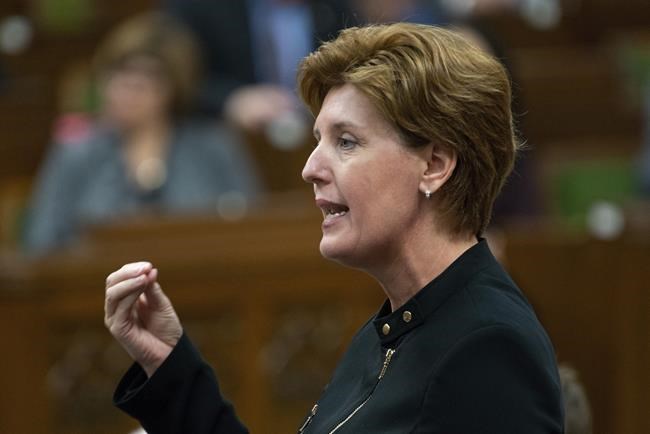
Agriculture Minister Marie-Claude Bibeau responds to a question during Question Period in the House of Commons, Monday April 29, 2019 in Ottawa. Bibeau is not worried about food shortages overall but acknowledging really challenges in the industry. THE CANADIAN PRESS/Adrian Wyld

“I think our system is strong enough and resilient enough that it will adapt, but these days it is particularly challenging,” Bibeau said during a video news conference Wednesday, where she fielded questions from her home in Sherbrooke, Que.

“I do not worry that we will not have enough food,” she added.

“But we might see some differences in the variety and, hopefully not, but maybe in the prices as well.”

The federal government has announced millions in new spending for farmers this week alone, including $20 million for the Canadian Food Inspection Agency so it can have enough inspectors on hand to carry out its work.

The funds are partially designed to guard against the potential for CFIA inspectors to be stricken with the virus and be unable to work, further slowing down an already struggling supply chain.

The other labour issue facing the industry is a farm worker shortage. Some 60,000 temporary foreign workers come to Canada annually to work on farms and in plants but border closures mean fewer are expected this year.

They are also required to quarantine for two weeks upon arrival, and this week, the federal government announced $1,500 per worker to help employers cover salary payments or revamp living quarters to ensure workers can abide by distancing protocols.

Checks on those measures will be carried out by local, provincial and federal authorities, Bibeau said.

Workers’ rights group Justicia for Migrant Workers has raised concerns the onus is actually being placed on workers — not their employers — to comply.

They cite a video being produced by the Ontario Provincial Police telling workers in Spanish what their obligations are, and say there are already efforts by communities to “name and shame” migrant labourers.

“We find it disconcerting that local community members are so concerned about migrant workers’ social distancing while in public, yet do not share the same concerns regarding the lack of protections and accommodations provided by the employer to ensure that migrant farm workers are able to socially distance in their workplace and home,” they said in a statement Wednesday.

The arrival of temporary foreign workers is being stymied by global travel restrictions, and what’s ordinarily an annual shortage of several thousand workers is likely to be made worse, Bibeau said.

The government is examining efforts to get unemployed or under-employed Canadians into jobs on farms, she said.

That’s despite the fact that the very reason the temporary foreign worker program exists is due to Canadians not wanting those jobs — and farmers don’t necessarily want to hire them either, as the work can require extensive training. Many workers return to the same area every year because they’ve developed a specific skill set.

“It’s a challenge, but we have to do even more to encourage them to join the industry,” Bibeau said of the workers the government hopes to recruit.

Another issue facing the sector is outbreaks in processing plants. An Olymel pork processing plant northeast of Montreal reopened this week after the spread of illness among its workers forced a two-week shutdown.

The Cargill Meat Solutions plant south of Calgary, which represents more than one-third of Canada’s beef-processing capacity, announced this week it is idling its second shift of workers.

The union representing those staff said there have been 38 cases of COVID-19 at the plant in High River, Alta.

Bibeau said she is reviewing a pitch by the cattle industry to help weather the crisis. The Canadian Cattlemen’s Association wants a federally co-ordinated “set-aside” program that would enable producers to keep their animals longer.

The program would slow down the supply chain because there’s not enough processing capacity, the group has said.

The Conservatives called Wednesday for Bibeau to immediately implement that program and be far more transparent about what else the government is examining.

“Farmers, producers and processors work hard day and night to ensure that Canadians have the food they need while they stay home,” three Conservative MPs who work on agriculture issues — John Barlow, Richard Lehoux and Lianne Rood — wrote in a letter to Bibeau.

“These hard-working Canadians need to know that their jobs will be safe during this pandemic and that they can continue to produce world class products.”

This report by The Canadian Press was first published April 15, 2020.

Report Error Submit a Tip

More Stories

Killer pleads guilty in three-year-old daughter’s fatal stabbing

Dean Pritchard 4 minute read Preview

Killer pleads guilty in three-year-old daughter’s fatal stabbing

Dean Pritchard 4 minute read Thursday, May. 26, 2022

A Winnipeg man has pleaded guilty to second-degree murder in the shocking stabbing death of his three-year-old daughter.

Frank Nausigimana, 29, entered his plea before Queen’s Bench Justice Joan McKelvey during a brief hearing Thursday morning.

Asked if he understood he was waiving his right to a trial, Nausigimana, through an American Sign Language interpreter, told McKelvey: “ Yes, I accept the punishment and I am following the law of God.”

“I’ve decided that I am going to pray,” Nausigimana said. “I admit I am guilty.”

Read
Thursday, May. 26, 2022

Why are Manitoba's school immunization programs so far from achieving herd immunity?

Maggie Macintosh  26 minute read Preview

Why are Manitoba's school immunization programs so far from achieving herd immunity?

Maggie Macintosh  26 minute read Saturday, May. 1, 2021

Sometimes, neither a lollipop nor a dinosaur sticker is enough to convince someone to get a needle.

Dr. Michele Feierstein, a pediatrician for more than 35 years, knows that all too well.

Feierstein has given thousands of immunizations to young patients throughout her career, but she has also had her fair share of difficult conversations with parents who are vaccine-hesitant or outright anti-vaxxers.

She does not bar families who have lukewarm feelings about or adamant views against immunization, whether they be rooted in misinformation, distrust, religious belief, or any other reason, from her practice at the Manitoba Clinic.

Read
Saturday, May. 1, 2021

Oleksiak makes history with seventh Olympic medal

The Canadian Press 8 minute read Preview

Oleksiak makes history with seventh Olympic medal

The Canadian Press 8 minute read Sunday, Aug. 1, 2021

TOKYO - The Canadian women finished their impressive medal haul in the pool – including a record-setting performance from Penny Oleksiak – and Andre De Grasse finally got Canada's men on the board with his second consecutive Olympic bronze in the men's 100 metres.

After finishing third in the medley relay, Maggie Mac Neil draped a bronze medal brimming with significance around Oleksiak's neck as their teammates Kylie Masse and Sydney Pickrem celebrated on the podium.

"Most decorated," they chanted in unison with their arms around each other during post-ceremony interviews with reporters.

On the final day of swimming competition at the Tokyo Olympics, Toronto's Oleksiak took her place at the top among Canada's greatest Olympians. In helping the medley relay team win bronze, she earned her seventh career Olympic medal, and at just 21 became the most decorated Canadian Olympian of all time.

Read
Sunday, Aug. 1, 2021

Third fire hits troubled Manitoba Housing apartment block

Malak Abas 4 minute read Preview

Third fire hits troubled Manitoba Housing apartment block

Malak Abas 4 minute read Yesterday at 3:19 PM EST

Residents of a North End Manitoba Housing apartment block with a long history of trouble say they’re shaken after the building was hit with its third fire in eight months Friday night.

An apartment complex at 145 Powers St. was evacuated by firefighters after a fire broke out at around 7:45 p.m.

When longtime resident Sharon Markwell heard the fire alarm go off, she chalked it up to a false alarm — kids will get into the building and pull the fire alarm around once or twice a month, she said — until smoke began billowing into the hallway of her fifth-floor apartment.

“Once I realized that I could smell smoke very, very strongly, and the smoke was seeping into my room, into my apartment, I said to myself, ‘This is no false alarm. This is the real thing,’” Markwell, 64, told the Free Press Sunday.

Read
Yesterday at 3:19 PM EST

The ‘Gang of Nine’ and business as usual at city hall

Editorial 4 minute read Preview

The ‘Gang of Nine’ and business as usual at city hall

Editorial 4 minute read 2:00 AM EST

In the early 1990s, after the province reduced the number of municipal wards in Winnipeg to 15, critics spoke at length of how a theoretical “Gang of Eight” could control all decision making at city hall. In subsequent years, there were various incarnations of a Gang of Eight, although it was never conclusively shown that eight members of city council could consistently stay on the same page long enough to dominate civic affairs.

That is an apt tale to consider now, as Winnipeg city hall welcomes nine rookie councillors, the largest number of non-incumbents elected in more than 30 years.

Theoretically, this new group of councillors could band together and push through various reforms. It’s a highly intriguing scenario for anyone who has watched the city, on occasion, shun riskier strategies in favor of status quo politics.

However, as was the case in the early 1990s, the chances of that happening begin to fall apart once you consider the work of building and sustaining a coalition of rookie councillors who come from a broad array of backgrounds.

Read
2:00 AM EST

New council, new opportunies for Winnipeg

Brent Bellamy 6 minute read Preview

New council, new opportunies for Winnipeg

Brent Bellamy 6 minute read 2:00 AM EST

Last week, Winnipeg voters returned Mayor Scott Gillingham to city hall for a second term, but the more surprising election storyline is that nine of the 15 councillors surrounding him will be new faces.

One encouraging aspect of the results is the community-building experience several of these new councillors bring to the job. Their backgrounds in urban planning, neighbourhood advocacy and community development offer valuable perspectives as Winnipeg confronts difficult questions about how it grows.

These perspectives will be particularly important because some of the most consequential decisions councillors can make happen when they evaluate residential development proposals at committee meetings. Over the next four years, the 16 people we’ve just elected will bear the enormous responsibility of deciding where and how Winnipeggers live. These choices will have profound implications for quality of life, social opportunity and the economic viability of our city. They will shape not only the Winnipeg we know today, but the city we leave to our children and grandchildren.

At committee meetings, councillors will hear endless arguments about parking, traffic, and protecting “neighbourhood character.”

Read
2:00 AM EST