Feds plan $30M ad buy to help media deal with COVID-19 fallout

Advertisement

Advertise with us

OTTAWA - The federal government announced Wednesday that it is planning a $30-million COVID-19 awareness advertising campaign and moving closer to implementing long-promised tax credits for newspapers as it seeks to support Canada's struggling media industry during the pandemic.

Read this article for free:


By clicking the button above, an account will be created and you will begin to receive some of our recommended newsletters. You may opt out of any newsletter by visiting your Email and Communication Preferences page or by clicking "unsubscribe" at the bottom of any email.

or

Already have an account? Log in here »

To continue reading, please subscribe:

Digital Subscription

One year of digital access for only $1.44 a week*

  • Enjoy unlimited reading on winnipegfreepress.com
  • Read the E-Edition, our digital replica newspaper
  • Access News Break, our award-winning app
  • Play interactive puzzles

*Billed as $5.77 plus GST every four weeks. After 52 weeks, price increases to the regular rate of $19.95 plus GST every four weeks. Offer available to new and qualified returning subscribers only. Cancel any time.

To continue reading, please subscribe:

Add Free Press access to your Brandon Sun subscription for only an additional

$1 for the first 4 weeks*

  • Enjoy unlimited reading on winnipegfreepress.com
  • Read the E-Edition, our digital replica newspaper
  • Access News Break, our award-winning app
  • Play interactive puzzles
Start now

*Your next Brandon Sun subscription payment will increase by $1.00 and you will be charged $17.95 plus GST for four weeks. After four weeks, your payment will increase to $24.95 plus GST every four weeks.

Hey there, time traveller!
This article was published 25/03/2020 (2410 days ago), so information in it may no longer be current.

OTTAWA – The federal government announced Wednesday that it is planning a $30-million COVID-19 awareness advertising campaign and moving closer to implementing long-promised tax credits for newspapers as it seeks to support Canada’s struggling media industry during the pandemic.

Yet the measures were immediately deemed by some as insufficient to deal with the financial pinch that newspapers, broadcasters and other media organizations, many of which were struggling even before COVID-19, are now facing as their advertising revenues evaporate.

Several media organizations have blamed that collapse in revenue for their decision this week to lay off hundreds of journalists and support workers, and shift their operations by closing or combining publications and ending print editions during the week.

Prime Minister Justin Trudeau addresses Canadians on the COVID-19 situation from Rideau Cottage in Ottawa on Wednesday, March 25, 2020. THE CANADIAN PRESS/Sean Kilpatrick

Prime Minister Justin Trudeau previewed the coming support during his daily appearance outside his Ottawa residence, where he emphasized the importance of Canadians having accurate information while thanking journalists for doing their jobs.

“Right now, it is more important than ever that Canadians have access to the latest news and information,” Trudeau said. “To ensure that journalists can continue to do this vital work, our government is announcing new measures to support them.”

Heritage Minister Steven Guilbeault later announced the government plans to spend $30 million on an advertising campaign to raise awareness about COVID-19 — money that he promised would go primarily to Canadian media organizations.

Those include Canadian newspapers, magazines, television stations and online publications, Guilbeault said, “so the revenues generated by this campaign can breathe new life into our media.”

The federal government has spent on average about $39 million per year on advertising since the Liberals came to power in 2016, according to official figures. That represented just more than half what it spent each year between 2010 and 2015 when the Conservatives were in government.

Those increasingly scarce advertising dollars have also shifted more and more away from newspapers, radio and television toward online platforms such as Facebook, Twitter and Instagram, which are not Canadian-owned.

Guilbeault also said the government has finished putting together a panel tasked with assessing whether media organizations qualify for three different tax measures that were first promised last year.

The most significant is a tax credit that qualified newspapers can claim on up to 25 per cent of the wages or salaries they pay to their journalists or other eligible employees. The credit, which is not available to broadcasters, is retroactive to salaries that were paid starting on Jan. 1, 2019.

“It is essential that Canadians can obtain authoritative, well-sourced and factual information related to COVID-19,” Guilbeault said. “This is why the government of Canada is taking immediate action so Canadians can continue to access diverse and reliable sources of news.”

The measures were widely criticized as too little to make a real difference, including by the head of one large newspaper chain in Atlantic Canada that laid off 240 employees — or about 40 per cent of its workforce — on Tuesday and shuttered several of its publications.

“This is not going to help us,” said SaltWire Network president Mark Lever. “Our business, we see two-thirds of our revenue at risk here. I mean it went away overnight with cancellations and businesses shuttered.”

Lever was skeptical newspapers would get very much of the promised new advertising money, suggesting broadcasters and online platforms would see the lion’s share. And he said newspapers were already working the tax credits into their business models before COVID-19.

“It’s money due to us that’s been frankly already spent,” he said. “So it’s a shame to see that the aid package is repurposing money already committed.”

Bob Cox, publisher of the Winnipeg Free Press and chair of News Media Canada, bluntly accused Trudeau of lying when he spoke of new measures to support journalism.

All the government has done is re-announce measures “that were first announced a year ago that have been mismanaged and delayed and to date have provided zero dollars to news outlets,” Cox said in an opinion piece to be published Thursday in some newspapers.

SaltWire wasn’t the only newspaper group to lay off staff this week. More than 140 employees of a co-operative that owns six daily newspapers outside Montreal were also temporarily laid off on Monday and the organization said it was ceasing print editions during the week.

Lever said what news organizations really need is more liquidity to be able to ride out the precipitous drop in revenue until after COVID-19. That and for the government to finally take action against foreign social-media sites that circulate news content for free while stealing ad revenue.

Daniel Bernhard, executive director of Friends of Canadian Broadcasting, echoed that assessment, noting Facebook, Twitter and other sites continue to benefit from Canadian journalism while being free of having to pay any corporate tax.

Bernhard was also skeptical that the measures announced on Wednesday would make a huge difference to media organizations, adding he was worried the government would be slow in approving tax credits or other assistance at a time when it is facing so many other challenges.

“Not only are these measures small and were probably insufficient when times were normal, I’m not confident that they’ll be able to get this package out the door with enough time to be helpful,” he said.

This report by The Canadian Press was first published March 25, 2020.

Report Error Submit a Tip

More Stories

Trump touts USMCA win in state of the union

James McCarten, The Canadian Press 6 minute read Preview

Trump touts USMCA win in state of the union

James McCarten, The Canadian Press 6 minute read Tuesday, Feb. 4, 2020

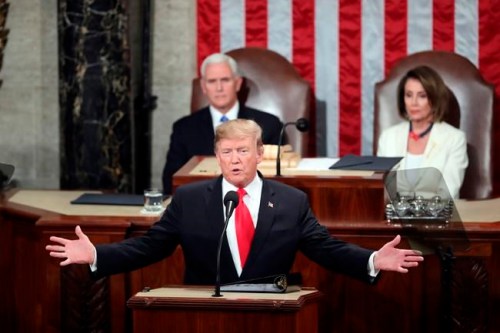
WASHINGTON - President Donald Trump declared his scorched-earth political style an unmitigated success Tuesday in a fiercely partisan, made-for-TV state of the union speech that made it clear he expects to be back in the White House next year on the strength of the U.S. economy and his trade deals with Canada, Mexico and China.

Trump, addressing a joint session of Congress in the very chamber where House Democrats voted to impeach him less than two months ago, became only the second president in American history — Bill Clinton was the first — to deliver a state of the union while standing trial in the Senate.

Unrepentant, he pointedly refused to shake the offered hand of House Speaker Nancy Pelosi on the dais before singing the praises of what he billed as "the great American comeback," pointing to strong job growth, a soaring stock market and low unemployment as evidence of his leadership. And when he was done, Pelosi ripped up the speech in full view of the television cameras.

"America's enemies are on the run, America's fortunes are on the rise, and America's future is blazing bright. The years of economic decay are over," Trump declared, taking full credit for the country's "roaring economy," including what he billed as seven million new jobs and the lowest jobless rate in half a century — a "blue-collar boom" that he's counting on to help his re-election chances in November.

Read
Tuesday, Feb. 4, 2020

Shocking development

Kelly Taylor 6 minute read Preview

Shocking development

Kelly Taylor 6 minute read 2:00 AM CDT

HOCKLEY VALLEY, Ont. — It’s not too often you get into a new vehicle, look at the interior, and say to yourself, “Wow, this is different… in a good way.”

Automakers tend to stick pretty close to defined norms, and when they differ, it’s not always successful. I’m looking at you, Toyota Yaris and Nissan X-Trail.

So, stepping into the 2027 BMW iX3 was refreshing. A bright parallelogram of a main touchscreen is closer to the driver than most, aided in no small part by pushing the instrument cluster to a narrow band just under the windscreen.

The effect is to clean up the look of the dash but without moving to a centre-mount instrument panel like the Yaris and X-Trail. The most valuable information (speed, battery charge, range) is right in front of the driver, visible above the top rim of the steering wheel.

Read
2:00 AM CDT

Science-art collaboration injects dose of emotion into cold, hard truths

Sarah Lawrynuik 5 minute read Preview

Science-art collaboration injects dose of emotion into cold, hard truths

Sarah Lawrynuik 5 minute read Wednesday, Apr. 28, 2021

Looking at spreadsheets and map plots of trees is far beyond Rhian Brynjolson’s typical day as a visual artist, but she became entranced and inspired by data collected by Canadian scientists for a new art project.

Her hope is to try and bring the numbers, map dots and statistics to life in a new way to help the public better connect to climate science.

Falcon Lake’s Brynjolson is one of 12 Canadian artists who participated in an art-science collaboration exhibit, co-ordinated by the Global Water Futures program out of the University of Saskatchewan. The project saw the artists paired with researchers and scientists across the country who then engaged in conversations to try to inspire a new angle to their art.

“The whole idea behind it is: water is life,” says Louise Arnal, the project lead, and a post-doctoral fellow at the Centre for Hydrology and Coldwater Laboratory.

Read
Wednesday, Apr. 28, 2021

Kinew will listen to city request for new taxes — but no promises

Nicole Buffie 5 minute read Preview

Kinew will listen to city request for new taxes — but no promises

Nicole Buffie 5 minute read Friday, Nov. 1, 2024

Premier Wab Kinew remained coy about whether he would support a new municipal tax in Winnipeg as the city struggles to maintain services.

Kinew dodged questions on the matter Friday afternoon.

“We want to see services strong, we want to see roads getting fixed,” Kinew said. “Affordability is really top of mind … we got to keep life affordable for the average person out there.”

Some of the items being considered for a new tax are: alcohol, online deliveries, vehicle registration, vacant homes, commercial parking and land transfers with an exemption for first-time homebuyers.

Read
Friday, Nov. 1, 2024

A fond farewell to the Hercules

Editorial 4 minute read Preview

A fond farewell to the Hercules

Editorial 4 minute read 2:00 AM CDT

Fans at the NHL’s outdoor Heritage Classic game last weekend were no doubt thrilled by the sight and sound of two CF-18 Hornet fighter jets conducting a flyover at Princess Auto Stadium shortly before the puck was dropped for the much-anticipated Winnipeg Jets/Montreal Canadiens matchup.

Flyovers such as these always create a spectacular scene, as the speed and power of the jets are on full display for the brief moments they’re in view above the stadium bowl. But fans who maintained their skyward gaze for a few seconds after the Hornets’ blink-and-you’ll-miss-it appearance were treated to a much more poignant aeronautical exhibition, as a CC-130H Hercules aircraft passed over the stadium in the fighter jets’ wake.

Compared to the supersonic CF-18s, the massive, propeller-driven transport plane probably seemed to be doing more of a “crawl-over”; what most folks at the outdoor game probably didn’t realize, however, was that this was almost certainly the last time they’ll see one of these ubiquitous Canadian Forces aircraft in the sky.

The CC-130H is being retired after more than half a century as the RCAF’s combat, rescue and transport workhorse. The “Herc” will be replaced by more modern aircraft, including the smaller and more nimble CC-295 Kingfisher, which will be used for search-and-rescue missions out of 17 Wing Winnipeg, beginning next month.

Read
2:00 AM CDT

Is Canada headed for time chaos this weekend?

Michelle Bastian 5 minute read 2:00 AM CDT

When Manitoba Premier Wab Kinew declared Sept. 17 that the province would remain on permanent daylight time, he suggested it was a historical moment people would share with their “great-great-grandkids.” But, while Sunday, Nov. 1 has been heralded as the date many Canadians will stop changing their clocks, there are rumblings behind the scenes suggesting this will actually cause more trouble than ever before.

There are, of course, the warnings from chrono-biologists and sleep scientists about the damage permanent daylight time will do. The lighter evenings will mean many more dark mornings. But there is another set of problems in the offing in the critical infrastructure that underpins our digital lives.

While it used to be common to spend the Sunday morning after a time change going around our homes updating the clocks, we now wake up to devices that have already adjusted to the new time. These automatic updates occur regularly for daylight time, as well as when we travel to new time zones.

Our clocks are able to change by themselves owing to the hard work of a group of volunteers who were recently named in a list of the people who hold up the internet. This group, led by Paul Eggert, a computer scientist at UCLA, maintains a little-known tool called the Time Zone Database. Since the 1980s, it has kept track of regional, national and international debates about clock time and provided an up-to-date table of what time it should be on our walls.