COVID-19 threatens Canadian aerospace companies as global air travel plummets

Advertisement

Advertise with us

MONTREAL - The novel coronavirus is wreaking havoc on the global airline sector, rippling outward to aerospace companies in Canada.

Read this article for free:


By clicking the button above, an account will be created and you will begin to receive some of our recommended newsletters. You may opt out of any newsletter by visiting your Email and Communication Preferences page or by clicking "unsubscribe" at the bottom of any email.

or

Already have an account? Log in here »

To continue reading, please subscribe:

Digital Subscription

One year of digital access for only $1.44 a week*

  • Enjoy unlimited reading on winnipegfreepress.com
  • Read the E-Edition, our digital replica newspaper
  • Access News Break, our award-winning app
  • Play interactive puzzles

*Billed as $5.77 plus GST every four weeks. After 52 weeks, price increases to the regular rate of $19.95 plus GST every four weeks. Offer available to new and qualified returning subscribers only. Cancel any time.

To continue reading, please subscribe:

Add Free Press access to your Brandon Sun subscription for only an additional

$1 for the first 4 weeks*

  • Enjoy unlimited reading on winnipegfreepress.com
  • Read the E-Edition, our digital replica newspaper
  • Access News Break, our award-winning app
  • Play interactive puzzles
Start now

*Your next Brandon Sun subscription payment will increase by $1.00 and you will be charged $17.95 plus GST for four weeks. After four weeks, your payment will increase to $24.95 plus GST every four weeks.

Hey there, time traveller!
This article was published 06/03/2020 (2431 days ago), so information in it may no longer be current.

MONTREAL – The novel coronavirus is wreaking havoc on the global airline sector, rippling outward to aerospace companies in Canada.

“The spread of the COVID-19 virus has already had a severe impact on demand for global air travel and the global airline industry and represents a clear threat to the sustainability of the current aerospace cycle,” National Bank analyst Cameron Doerksen said in a research note.

The International Air Transport Association (IATA) trade group forecasts that global passenger revenue could decline by US$113 billion or 13.5 per cent this year due to COVID-19, which has caused at least 3,200 deaths and spread to more than 100,000 people across some 90 countries as governments ramp up containment measures.
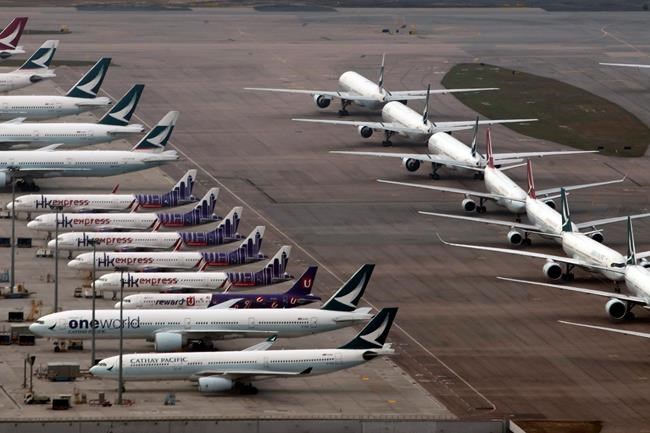
Cathay Pacific and Hong Kong Express aircrafts line up on the tarmac at the Hong Kong International Airport, Friday, March 6, 2020. The global airline's flying schedules have declined since the outbreak of new coronavirus COVID-19. (AP Photo/Kin Cheung)

That revenue figure, released Thursday, is four times the number sent out just two weeks ago by IATA, which is imploring governments for assistance.

It would also surpass the revenue dip of 6.7 per cent that followed the Sept. 11 attacks, approaching the 16.5 per cent fall after the 2008 financial crisis.

The outbreak is taking a toll on Air Canada, whose shares have fallen 27 per cent since Feb. 18.

That day, Air Canada forecasted a “small increase” in adjusted earnings for 2020 based on the assumption that its cancelled routes to mainland China and Hong Kong will be fully recovered by the third quarter, along with a gradual return to service of its 36 grounded Boeing 737 Max jets starting late in the same quarter.

Since then, however, the virus has propagated at a prodigious rate with recorded cases on every continent save Antarctica, sending markets tumbling.

“The impact on airline profitability appears to be worsening by the day, and the spread of the virus and the impact on air travel has rapidly exceeded expectations of just a few days and weeks ago,” wrote Ken Herbert, an industry analyst with Canaccord Genuity.

Declining airline reservations have trickled down to commercial aerospace companies.

Bombardier Inc., reduced to a single revenue stream after selling its rail division to French train giant Alstom SA last month, will likely face falling demand for new business jets in the event of a broader economic slowdown triggered by the outbreak, said Doerksen.

He said that while Chorus Aviation Inc.’s regional flight service for Air Canada will remain insulated from the headwinds, its global plane-leasing business is at risk.

Chorus spokeswoman Manon Stuart declined to comment on the potential effects of the virus.

“The impact of the COVID-19 virus is being felt worldwide. We are watching the developments carefully, but won’t speculate on hypothetical outcome,” she said.

Disruption could also reach flight simulator maker CAE Inc. if carriers impose a pilot hiring freeze, park planes and hold off on new deliveries.

New aircraft production rates are poised to come down as a result of the outbreak, Doerksen said.

“Most airlines have already cut capacity in the short term and we see lower capacity over the medium term and possible airline failures leading to fewer new aircraft orders,” he said.

Aircraft landing gear manufacturer Heroux-Devtek Inc. could feel the pinch if Boeing Co. lowers production for the 777X wide-body jetliner, but the company says it’s not anticipating any impact yet.

“We have multi-year long-term agreements with our clients. We don’t foresee any impact on our revenues related to COVID-19,” Heroux-Devtek said in an email.

This report by The Canadian Press was first published March 6, 2020.

Companies in this story: (TSX:AC, TSX:BBD.B, TSX:CHR, TSX:CAE, TSX:HRX)

With files from The Associated Press

Report Error Submit a Tip

More Stories

Defunding police ‘illogical step’: Pallister

Carol Sanders 5 minute read Preview

Defunding police ‘illogical step’: Pallister

Carol Sanders 5 minute read Tuesday, Jun. 9, 2020

Manitoba Premier Brian Pallister says he’s open to channelling justice funding to preventive programs, but questions whether defunding police is the best approach — warning there will always be criminals taking advantage of vulnerable people.

“I think the motivation that lies in frustrations of the actions of some police services — not necessarily here in Winnipeg exclusively, but elsewhere — is justifiable and understandable, and I get it,” Pallister said Tuesday, when asked to comment on the 30,000 signatures collected for a Justice 4 Black Lives Winnipeg petition calling for the abolition of the city police.

“But then moving to defunding police is, to me, an illogical step from that one. Don’t let your frustration lose your common sense... There’s a lot of people out there in vulnerable communities who depend on the police to protect them and make sure they’re safe from the action of criminals.”

There has been a widespread call to restructure police funding in the wake of George Floyd’s death May 25 in Minneapolis.

Read
Tuesday, Jun. 9, 2020

Court ruling concludes Canadian Wheat Board saga

Laura Rance-Unger 4 minute read Preview

Court ruling concludes Canadian Wheat Board saga

Laura Rance-Unger 4 minute read 2:01 AM CDT

It remains to be seen whether the recent court ruling in a lawsuit filed after Canadian Wheat Board’s dissolution in 2012 puts the whole debate to rest, as some no doubt hope.

But either way, the dust has settled on the post-CWB world. The sun still rises and a new generation of farmers on the land only knows by name an institution that for generations influenced every aspect of Prairie grain farming.

The first Rural Revival column I wrote for this newspaper more than 30 years ago was about a thousand farmers from Western Canada demonstrating in support of the Wheat Board. It was in the aftermath of the Western Grain Marketing Panel report, one of several efforts that eventually included a plebiscite to help the federal government decide what to do about a vocal minority of farmers who wanted marketing “freedom.”

The polls at the time suggested about two-thirds of farmers were comfortable enough with the single-desk system for food wheat and barley to keep it around. It served as a counterbalance to canola, which they sold on the open market. They essentially had a dual market.

Read
2:01 AM CDT

The new normal in Canadian politics

David McLaughlin 5 minute read Preview

The new normal in Canadian politics

David McLaughlin 5 minute read 2:01 AM CDT

“Nothing happening, all at once.”

Welcome to the new normal of Canadian politics, where normality is the new normal. Routine and stable are in; disruptive and excessive are out. Exhibits A and B are the Alberta referendum and the British Columbia election. Voters opted for stability over volatility.

The opposite of being normal is being different from the norm. In politics that means different from where we’ve been and what we’ve come to expect. Two competing trends have dominated our politics for the past decade and a half — progressivism and populism. Think Justin Trudeau and liberal, progressive identity politics in Canada, and Donald Trump and conservative, populist MAGA politics in America. We are now experiencing a swing away from both those trends.

Representing this “new normal” are Prime Minister Mark Carney, for one, and newly elected British Columbia premier, Lorne Doerksen, for another. Both are considered normal because they talk and act like adults in a childish political world. Their political flair is to not have any political flair. They stand out for not standing out.

Read
2:01 AM CDT

RRC Polytech program cuts take bite out of hospitality, tourism sector

Maggie Macintosh 4 minute read Preview

RRC Polytech program cuts take bite out of hospitality, tourism sector

Maggie Macintosh 4 minute read Saturday, May. 2, 2026

Manitoba’s tourism industry is bracing for the disappearance of hospitality training programs — once-popular courses among international students.

Citing budgetary challenges related to a shift in federal immigration policy, Red River College Polytechnic is scrapping 11 programs and scaling back three others in 2026-27. Its hospitality business management diploma is one of seven permanent casualties.

The announcement, while unsurprising, is but the latest blow to a sector trying to “build back the workforce” in the wake of the COVID-19 pandemic, said Michael Juce, president of the Manitoba Hotel Association.

“Are people going to go outside of Manitoba for training? And if they leave, are they going to come back?” Juce said, adding that rural hotels in particular are already grappling with staffing shortages.

Read
Saturday, May. 2, 2026

Doctor’s departure stressful for teen

Kevin Rollason 6 minute read Preview

Doctor’s departure stressful for teen

Kevin Rollason 6 minute read Sunday, Oct. 24, 2021

Morgan Walker is a typical teen — but only because a piece of his brain the size of a deck of cards was removed four years ago.

Walker, who had seizures multiple times a day before his surgery, fears other people might not be so lucky.

That’s because his surgeon, Dr. Demitre Serletis, is leaving the province and Health Sciences Centre. Serletis will start practising at the Cleveland Clinic in the new year.

“I was kind of shocked, but I understood why,” Walker said from his home in Brandon. “The government really hasn’t been respecting doctors.”

Read
Sunday, Oct. 24, 2021

Ottawa announces $500 million for North End sewage plant upgrade

Joyanne Pursaga 4 minute read Preview

Ottawa announces $500 million for North End sewage plant upgrade

Joyanne Pursaga 4 minute read Yesterday at 5:03 PM CDT

The federal government will provide $500 million to help complete the major upgrade to Winnipeg’s North End sewage treatment plant.

Winnipeg South MP Terry Duguid confirmed the total funding at a news conference at the plant Friday, calling the work critical to Winnipeg’s future.

“The stakes could not be higher. Without expanded wastewater treatment, Winnipeg would run out of capacity to build new homes and accommodate new industries within six years,” said Duguid.

The commitment offers the final funding needed to cover the $1.57-billion third and final phase of the upgrade. The city and province will also pay $500 million each for the work.

Read
Yesterday at 5:03 PM CDT