New virus could disrupt global economy as markets, consumers change behaviour
Advertisement
Read this article for free:
or
Already have an account? Log in here »
To continue reading, please subscribe:

Digital Subscription
One year of digital access for only $205*
- Enjoy unlimited reading on winnipegfreepress.com
- Read the E-Edition, our digital replica newspaper
- Access News Break, our award-winning app
- Play interactive puzzles
*First annual payment billed as $205.00 + GST for one year. This annual subscription will automatically renew at $233.00 + GST every 52 weeks (10% off the regular annual price of $259.35). Offer available to new and qualified returning subscribers only. Cancel any time.
To continue reading, please subscribe:
Add Free Press access to your Brandon Sun subscription for only an additional
$1 for the first 4 weeks*
- Enjoy unlimited reading on winnipegfreepress.com
- Read the E-Edition, our digital replica newspaper
- Access News Break, our award-winning app
- Play interactive puzzles
*Your next Brandon Sun subscription payment will increase by $1.00 and you will be charged $17.95 plus GST for four weeks. After four weeks, your payment will increase to $24.95 plus GST every four weeks.
Read unlimited articles for free today:
or
Already have an account? Log in here »
Hey there, time traveller!
This article was published 23/01/2020 (2448 days ago), so information in it may no longer be current.
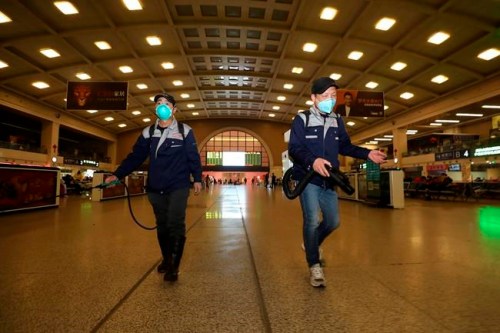
MONTREAL – A deadly new virus that emerged in China is raising concerns beyond the public health sphere as experts warn about the potential economic cost of a global outbreak that is already drawing comparisons to the SARS epidemic 17 years ago.
Stock markets around the world fell Thursday as health authorities rushed to monitor and contain the outbreak, and keep it from spreading globally.
Asian markets bore the brunt of the effects, with Hong Kong’s Hang Seng Index down 1.52 per cent, the Shanghai Stock Exchange plunging 2.75 per cent and the Tokyo Stock Exchange down 0.78 per cent.
North American markets fell initially before ending the day on a flat note, with the S&P/TSX composite index up 0.12 per cent, the Dow Jones industrial average down 0.09 per cent, S&P 500 index up 0.11 per cent and the Nasdaq composite up 0.20 per cent.
At least 26 people have died and more than 800 have been infected by the ailment identified as a novel coronavirus, whose early cases are linked to a market in the central Chinese city of Wuhan. On Thursday, the World Health Organization decided against declaring the outbreak a global emergency for now.
China and other nations have ramped up screenings for fever on aircraft and at airports. Wuhan, where the virus is concentrated, closed down its train station and airport Thursday to prevent people from entering or leaving the city. Chinese authorities moved to lock down seven other cities with similar measures, halting public transit in an unprecedented effort to contain the mysterious virus.
Authorities are looking to avoid a repeat of the spread of Severe Acute Respiratory Syndrome, which cost the Canadian economy an estimated US$4 billion in 2003.
“The cost to the global economy can be quite staggering, in negative GDP terms, if this outbreak reaches epidemic proportions as until this week, the market was underestimating the potential of the flu spreading,” Stephen Innes, chief Asian strategist for AxiCorp, said in a report.
The travel sector has already started to feel the hit as shares of four North American airlines that fly to China, including Air Canada, fell this week amid growing anxiety about the viral infection.
None of the airlines fly directly to Wuhan, but their Chinese partner airlines do, and some passengers transfer from a Chinese carrier to a Canadian one, offering the potential for the virus to spread here.
Shares at the three biggest U.S. cruise lines have also fallen, with Royal Caribbean Cruises Ltd. — which boasts a major Chinese presence — dropping more than four per cent this week.
Analyst Chris Murray of AltaCorp Capital pointed to the past for clues on the market volatility, propelled by “an unknown level of potential disruption.”
“History suggests shares may be in for a rough ride,” he said of airline and tourism stocks in a research note. He recalled jittery stock movements after the SARS outbreak in 2002 and 2003, as well as with H1N1 influenza in 2009 and the Ebola virus in 2014.
“These larger-scale epidemics can have a more pronounced near-term impact. However, once a better understanding of the magnitude of the spread and severity was understood, stock prices recovered quite sharply in all three cases within months,” he said.
The extent of the epidemic to date falls well short of the spread of SARS, a virus from the same family as coronavirus that spread from China to more than two dozen countries — including Canada.
SARS infected more than 8,000 people worldwide, killing close to 800, according to the World Health Organization. The disease sickened about 438 Canadian patients and caused 44 deaths in the Toronto area.
SARS cost the country US$4 billion and about 28,000 jobs, according to a 2014 report by Kai Ostwald, an assistant professor at the University of British Columbia’s School of Public Policy and Global Affairs.
The damage came in large part from fear-based shifts in consumer behaviour rather than higher medical expenditures, Ostwald said.
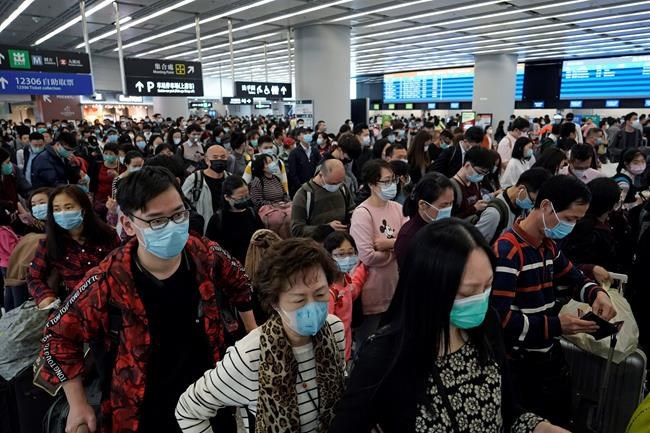
“Specifically, fear of contagion prompted widespread aversion behaviour, in which people significantly reduced activities that put them in close proximity with others. This included not only things like flying and eating in restaurants, but also activities like workplace and school attendance,” he wrote.
Hotels in the Greater Toronto Area, where the Canadian outbreak was centred, lost out on an estimated $39 million in revenues in April 2003 alone, according to the Canadian Tourism Commission.
Lower traffic volumes through the city’s Lester B. Pearson airport resulted in $220 million in losses, according to the Conference Board of Canada. More than 800 bus tours were cancelled by the end of April — when the World Health Organization issued a one-week travel advisory for Toronto — with an economic loss of up to $6 million.
Air Canada declined to speculate on the potential impact from coronavirus. In 2003 financial reports, it said passenger revenues decreased in part due to lower demand for travel resulting from the SARS crisis, particularly in the Pacific market that “was severely adversely impacted with large reductions in traffic and capacity.”
Chang Hoon Oh, a business professor at Simon Fraser University, warned against alarmist reactions to relatively small outbreaks.
Canadian authorities are now more prepared for SARS-like viruses, he said. But he also noted that the number of annual visitors to Canada from China has shot up. The figure has grown by a factor of 10 since 2000 to 757,000 travellers in 2018, according to Statistics Canada.
On Tuesday a U.S. citizen who had recently returned from China was diagnosed in the Seattle area, making the United States the sixth country to report a case, following China, Thailand, Japan, Taiwan and South Korea.

While the ordinary flu kills hundreds of thousands of people each year, uncertainty over how deadly and transmittable the new virus may be has amplified concerns, especially on the cusp of the annual mass travel surrounding lunar New Year, which begins this week.
Dr. Theresa Tam, Canada’s chief public health officer, said Thursday the risk of an outbreak in the country remains low.
— With files from The Associated Press
This report by The Canadian Press was first published Jan. 23, 2020.
Companies in this story: (TSX:AC)
Related Articles
Mass virus quarantine not in Canada's cards






Advertisement Advertise With Us
Advertisement Advertise With Us