Humanity will survive, even as things ‘get weird’

Advertisement

Advertise with us

When U.S. science journalist Annalee Newitz, founding editor of the science website io9.com, set out to write a book about the future of humanity, she expected to find the end was nigh.

Read this article for free:

or

Already have an account? Log in here »

To continue reading, please subscribe:

Subscribe and receive a limited-edition Free Press branded hat or tote.

Digital Subscription

One year of digital access for only $205*

  • Enjoy unlimited reading on winnipegfreepress.com
  • Read the E-Edition, our digital replica newspaper
  • Access News Break, our award-winning app
  • Play interactive puzzles

*First annual payment billed as $205.00 + GST for one year. This annual subscription will automatically renew at $233.00 + GST every 52 weeks (10% off the regular annual price of $259.35). Offer available to new and qualified returning subscribers only. Cancel any time.

To continue reading, please subscribe:

Add Free Press access to your Brandon Sun subscription for only an additional

$1 for the first 4 weeks*

  • Enjoy unlimited reading on winnipegfreepress.com
  • Read the E-Edition, our digital replica newspaper
  • Access News Break, our award-winning app
  • Play interactive puzzles
Start now

*Your next Brandon Sun subscription payment will increase by $1.00 and you will be charged $17.95 plus GST for four weeks. After four weeks, your payment will increase to $24.95 plus GST every four weeks.

Opinion

Hey there, time traveller!
This article was published 25/05/2013 (4817 days ago), so information in it may no longer be current.

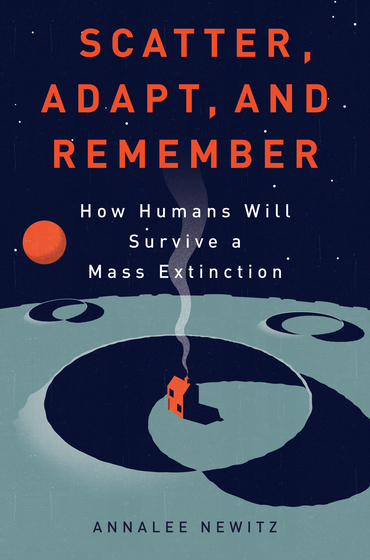
When U.S. science journalist Annalee Newitz, founding editor of the science website io9.com, set out to write a book about the future of humanity, she expected to find the end was nigh.

Instead, her research led her to believe the opposite: that “humanity has a lot more than a fighting chance at making it for another million years.”

The optimistic result is Scatter, Adapt, and Remember, a refreshing pop-science book that examines ways humans could prevail at Armageddon.

What does humanity’s future look like? You might be surprised: Newitz, who is based in California, thinks it looks like Saskatoon.

The Saskatchewan city “has survived despite its hard climate, and people there have found ways to incorporate the latest scientific advances into their agriculture and urban design without overspending,” she writes in the introduction to the book’s Canadian edition.

Scatter, Adapt and Remember is not a manual; it will not help you duck and cover or stock your survival shelter.

Rather, Newitz takes a page from Alan Weisman’s 2010 book, The World Without Us — which conjured the changes coming to a depopulated world — and imagines instead how Homo sapiens can survive whatever attempts to depopulate us, be it nuclear war, plague, asteroid, or some other curse we have not imagined or invented.

Newitz begins with a review of the history of mass extinctions on Earth — from the Proterozoic microbes of 2.5 billion years ago through dinosaurs and whales and Neanderthals. The book is at its driest here, a sort of super-condensed Brief History of Everything, with a special focus on dying.

By the middle of the book we’re considering the lessons previous mass extinctions — and their survivors — have taught, the lessons of the book’s title: scatter, to escape adversity as best you can; adapt as the world around you changes, and remember: pass on the knowledge of how to survive.

It’s worth enduring the rather arid history lesson at the beginning to get to Parts 4 and 5, where Newitz is at her most speculative. Here she really leave Weisman far in the dust, imagining how humanity will survive a million years into the future, perhaps as part-robot, or perhaps living on the Moon, on Mars, or beyond.

“Our kids are the last generation who will see no city lights on the Moon,” predicts a NASA scientist, one of a hundred fascinating experts Newitz interviews.

Did you know the United Nations has an “action team” on the “Committee on the Peaceful Uses of Outer Space” that would co-ordinate Earth’s defences if an asteroid appears to be headed our direction? Scatter, Adapt and Remember will help you rest easy, safe in the knowledge that someone out there is working hard to keep space rocks from killing us all.

“Our kids are the last generation who will see no city lights on the Moon.”

-Scientist interviewed in Scatter, Adapt and Remember

By the time you get to the end of the book, you might find yourself downloading CD3WD, a “backup copy of everything history has taught us about creating an early industrial society.”

Stored on a few DVDs or (perhaps more practically) printed and secured in your post-apocalypse survival kit, it’ll help you rebuild human civilization from scratch — just in case the future goes a bit sideways.

“Things are going to get weird,” Newitz concludes. “But don’t worry. As long as we keep exploring, humanity is going to survive.”


Wendy Sawatzky is associate editor digital news at winnipegfreepress.com and commander in chief at wendysawatzky.com.

Wendy Sawatzky

Wendy Sawatzky
Associate Editor Digital News

Wendy Sawatzky brought her twin passions for writing and technology to the Winnipeg Free Press in 2008. She's currently the paper's associate editor for digital news.

Our newsroom depends on a growing audience of readers to power our journalism. If you are not a paid reader, please consider becoming a subscriber.

Our newsroom depends on its audience of readers to power our journalism. Thank you for your support.

Report Error Submit a Tip

More Stories

Long journey to home ownership for Eritrean couple

Zoe Pierce 4 minute read Preview

Long journey to home ownership for Eritrean couple

Zoe Pierce 4 minute read Yesterday at 2:01 AM CDT

Solomon Ghebru and his family have been building a life together in Winnipeg for the past three years after years of living apart in various countries. Now, they are working toward a new goal: owning a home.

Their story is the focus of this year’s Habitat for Humanity Manitoba Cycle of Hope fundraising ride, a seven-day cycling event through southern Manitoba that begins Monday. The ride aims to raise $150,000 to support Ghebru, his wife, Mehret Awate, and their two daughters as they work toward affordable homeownership.

The couple’s journey to Canada started in Eritrea, where they grew up and attended the same church together. They left Eritrea separately, hoping to build a better life together out of the country. Ghebru travelled through Sudan and Libya before reaching Malta, while Awate travelled to Sudan and then Uganda.

After he found work in Malta, he tried to have his family join him, but government policies prevented them from reuniting. The couple married in Uganda in 2016, and their first daughter, Peniel, was born there the following year.

Read
Yesterday at 2:01 AM CDT

Tory government betting on wrong numbers

Dan Lett 5 minute read Preview

Tory government betting on wrong numbers

Dan Lett 5 minute read Friday, Jul. 15, 2022

It is often said, in the heat of political battle, combatants have the right to their own opinions but they do not have the right to their own version of the facts.

When it comes to the debate over the future of Manitoba Hydro, that essential principal seems to have eluded the Progressive Conservative government.

For several years, the Tories have attempted to severely limit Public Utilities Board authority over Hydro rate applications. Former premier Brian Pallister and current Premier Heather Stefanson both introduced legislation that would essentially gut any hope of an independent review and give cabinet new authority to control rates.

When asked why, both Pallister and Stefanson and their ministers have repeatedly claimed the cost to Hydro for a PUB rate application hearing is $10 million annually, an expense that was, in and of itself, driving up electricity rates.

Read
Friday, Jul. 15, 2022

Humanity will survive, even as things ‘get weird’

Reviewed by Wendy Sawatzky 4 minute read Preview

Humanity will survive, even as things ‘get weird’

Reviewed by Wendy Sawatzky 4 minute read Saturday, May. 25, 2013

When U.S. science journalist Annalee Newitz, founding editor of the science website io9.com, set out to write a book about the future of humanity, she expected to find the end was nigh.

Instead, her research led her to believe the opposite: that "humanity has a lot more than a fighting chance at making it for another million years."

The optimistic result is Scatter, Adapt, and Remember, a refreshing pop-science book that examines ways humans could prevail at Armageddon.
What does humanity's future look like? You might be surprised: Newitz, who is based in California, thinks it looks like Saskatoon.

Read
Saturday, May. 25, 2013

Need to make an apology? Ask the experts

Carl DeGurse 5 minute read Thursday, Feb. 15, 2018

Plenty of people are saying sorry these days, but their apologies often seem cheap.

Some people do it only after they are confronted with their misdeeds and have no chance of escape. Their apologies are like tapping out during a mixed martial arts bout.

Some don’t apologize directly to their victims, but issue a general statement on social media. It’s as if they’re more concerned with restoring their reputation than restoring relations with people they’ve hurt.

MLA Stan Struthers, a former NDP finance minister, apologized Feb. 8 in a public statement for “inappropriate” interactions with women, but there’s been no indication he offered respectful, in-person apologies to the eight or more women he reportedly tickled and groped in a sexual manner.

Netflix comedy set will make you think

Alison Gillmor  5 minute read Preview

Netflix comedy set will make you think

Alison Gillmor  5 minute read Friday, Jul. 6, 2018

The title of Hannah Gadsby’s new 70-minute comedy set (currently available on Netflix) has absolutely nothing to do with the material. The 40-year-old Aussie standup makes that clear right away: Nanette is someone she met in a café, a possibly interesting woman who turned out not to be, and that is the last we hear of her.

Instead, this wonderfully misleading title signals that whatever we are expecting will not be what we get. And that is the whole point of this show, a funny, powerful bait-and-switch ploy that uses comedy to deconstruct comedy.

Gadsby keeps the paradoxes coming in this farewell-to-comedy tour that has actually launched her international career. She tells jokes — lightly, casually, almost shyly — and then circles around and comes back to them, forcing us to confront the pain that was hiding in plain sight.

Like one of those thrillers where a twist ending reveals everything that has come before in a new and blinding light, Nanette forces a tough and timely re-evaluation of humour and its tricky relations with power, trauma and misogyny. Watching Nanette in the #MeToo era of comedy, you’ll laugh. You’ll cry. Most of all, you’ll think.

Read
Friday, Jul. 6, 2018

Prepare to be … blutterbunged?

David McLaughlin 5 minute read Preview

Prepare to be … blutterbunged?

David McLaughlin 5 minute read Yesterday at 2:01 AM CDT

Are you not blutterbunged?

If Russell Crowe’s second-century gladiator character had uttered a 19th century equivalent of “Are you not entertained?” that fit the mood of today’s 21st century, that would be it.

Definitions first. Blutterbunged is an obscure regional dialect word from England that means everything from astonished to confounded to bemused or shocked into speechlessness. Its composition suggests something both more and less, namely blustering bloviation (that’s the more part) and empty words (that’s the empty part). These days we would more naturally punctuate our reaction to an event or statement with a profanity. But you get the drift.

Unearthed by lexicologist Susie Dent, it speaks volumes about our times that it fits now. That we need to reach back hundreds of years to find the right word to adequately capture a contemporary civic reaction to what the hell is going on in politics and the world today.

Read
Yesterday at 2:01 AM CDT