

Weed control increasingly important part of harvest

Advertisement
Read this article for free:
or
Already have an account? Log in here »
To continue reading, please subscribe:

Digital Subscription
One year of digital access for only $205*
- Enjoy unlimited reading on winnipegfreepress.com
- Read the E-Edition, our digital replica newspaper
- Access News Break, our award-winning app
- Play interactive puzzles
*First annual payment billed as $205.00 + GST for one year. This annual subscription will automatically renew at $233.00 + GST every 52 weeks (10% off the regular annual price of $259.35). Offer available to new and qualified returning subscribers only. Cancel any time.
To continue reading, please subscribe:
Add Free Press access to your Brandon Sun subscription for only an additional
$1 for the first 4 weeks*
- Enjoy unlimited reading on winnipegfreepress.com
- Read the E-Edition, our digital replica newspaper
- Access News Break, our award-winning app
- Play interactive puzzles
*Your next Brandon Sun subscription payment will increase by $1.00 and you will be charged $17.95 plus GST for four weeks. After four weeks, your payment will increase to $24.95 plus GST every four weeks.
Read unlimited articles for free today:
or
Already have an account? Log in here »
Hey there, time traveller!
This article was published 08/09/2023 (1126 days ago), so information in it may no longer be current.
We often think of harvest as an annual “rush,” but in reality, it moves at more of a rhythmic pace, especially when the sun is shining, the fields are ripe, and the equipment is running smoothly.
Operators and machinery steadily grind away at the unharvested crops, moving from field to field as needed. Grain carts and trucks roll back and forth, hauling the grain into storage, often sidling up to the moving combine so it can unload on the fly.
Of course, the equipment needs servicing, and the people need food, but every operation has a system that minimizes the downtime and maximizes the effort. So far this season, Manitoba farmers are running ahead of the five-year average for harvest progress.
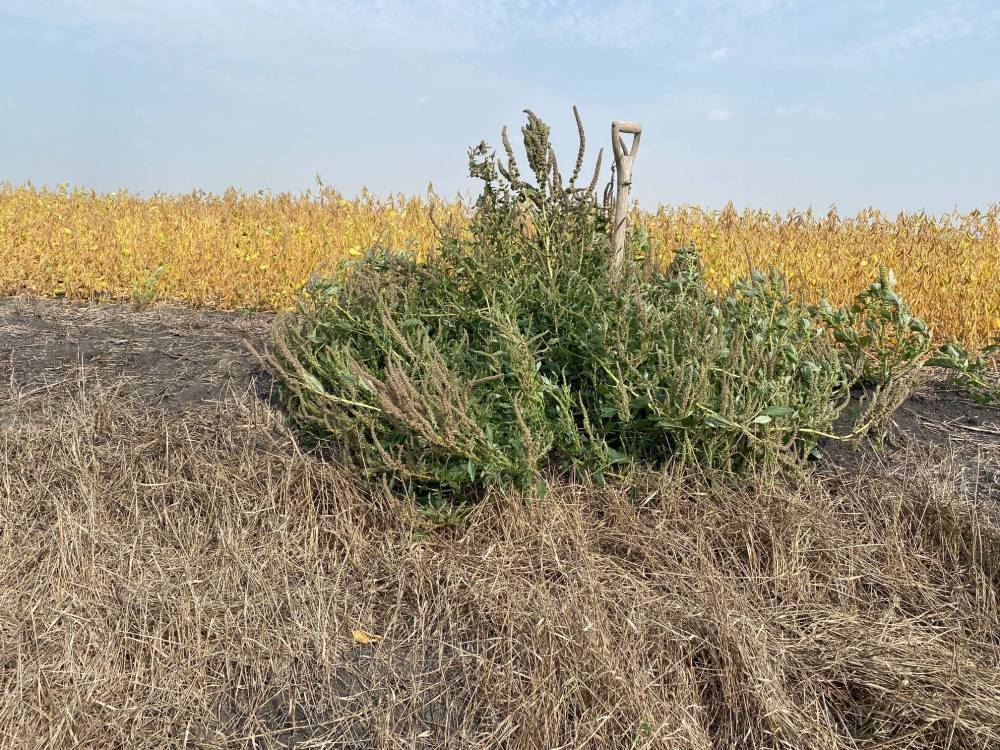
PHOTO: KIM BROWN / MANITOBA AGRICULTURE
Waterhemp is one of the herbicide-resistant weeds farmers are being urged to watch for this harvest.
However, a brief reference in the latest crop report urges producers to break up that synchronicity and pause to closely examine patches of weeds in their fields before they push them through with the combine.
Extension workers advise farmers to watch for weed “escapes” and carefully inspect any plants that didn’t die when treated with the appropriate herbicides earlier in the season. If they aren’t sure what they are, they must take samples and send them off for testing to establish their identity and confirm their herbicide resistance.
It means stopping — sometimes even taking the time to climb down, pull out plants and bag them — when time is precious.
However, if they go ahead and combine through those patches, they are simply spreading those weed seeds over a much broader section of the field.
Managing the so-called “weed seed bank” has become an increasingly important piece of the weed control puzzle for farmers as the number of plant species resistant to herbicides grows.
Weed control is no longer something farmers only do in the spring with sprays or tillage. It is a season-long effort as farmers incorporate a variety of approaches to prevent these plants from going to seed and then spreading those seeds around.
In Manitoba, there are at least 14 weed species with known herbicide resistance, and some of these populations have developed resistance to multiple types of herbicides. That’s in addition to volunteer populations of herbicide-tolerant canola, varieties bred to allow farmers to spray the crop with herbicides to control other weeds. If the farmer doesn’t have the combine settings calibrated just right or the operator is travelling too fast through the field, they can lose up to 10 per cent of their canola crop out the back end of the combine.
That lost yield becomes next year’s weed problem because some of that seed will germinate in following years.
Not only have weeds native to the Prairie ecosystem developed resistance, but new, highly invasive yield-crippling species such as waterhemp and Palmer amaranth, members of the pigweed family, are moving in from the south.
A few waterhemp plants were first discovered in Manitoba in 2016. By 2019, it had crept into eight municipalities and is showing up in a few more this year.
These are considered noxious weeds under provincial legislation and must be destroyed whereever they are found. Their ability to rapidly become herbicide resistant makes that harder to do. Here in Manitoba waterhemp is already exhibiting resistance to glyphosate.

In Ontario and southern states, it is resistant to everything farmers can throw at it, short of shovels and hoes.
These plants can grow to the size of a Christmas tree. One plant can produce more than a million seeds.
Yet farmers get so focused on keeping their harvest humming along they see these patches and fool themselves into thinking that they must have missed a spot or the sprayer had a plugged nozzle — or that maybe they need to switch to another herbicide.
They could be sparing themselves a heap of trouble by resisting the urge to continue rolling through those patches.
Laura Rance is vice-president of content for Glacier FarmMedia. She can be reached at lrance@farmmedia.com
Laura Rance is editorial director at Farm Business Communications.
Our newsroom depends on a growing audience of readers to power our journalism. If you are not a paid reader, please consider becoming a subscriber.
Our newsroom depends on its audience of readers to power our journalism. Thank you for your support.
Laura Rance is editorial director at Farm Business Communications.
Our newsroom depends on a growing audience of readers to power our journalism. If you are not a paid reader, please consider becoming a subscriber.
Our newsroom depends on its audience of readers to power our journalism. Thank you for your support.
Advertisement Advertise With Us
Advertisement Advertise With Us