

Whatever happened to Canada standing up to the U.S.?
Advertisement
Read this article for free:
or
Already have an account? Log in here »
To continue reading, please subscribe:

Digital Subscription
One year of digital access for only $205*
- Enjoy unlimited reading on winnipegfreepress.com
- Read the E-Edition, our digital replica newspaper
- Access News Break, our award-winning app
- Play interactive puzzles
*First annual payment billed as $205.00 + GST for one year. This annual subscription will automatically renew at $233.00 + GST every 52 weeks (10% off the regular annual price of $259.35). Offer available to new and qualified returning subscribers only. Cancel any time.
To continue reading, please subscribe:
Add Free Press access to your Brandon Sun subscription for only an additional
$1 for the first 4 weeks*
- Enjoy unlimited reading on winnipegfreepress.com
- Read the E-Edition, our digital replica newspaper
- Access News Break, our award-winning app
- Play interactive puzzles
*Your next Brandon Sun subscription payment will increase by $1.00 and you will be charged $17.95 plus GST for four weeks. After four weeks, your payment will increase to $24.95 plus GST every four weeks.
Read unlimited articles for free today:
or
Already have an account? Log in here »
When I first heard the news report, I couldn’t believe it. Is this really accurate?
U.S. President Donald Trump simply conveyed the order: the new Gordie Howe International Bridge between Windsor and Detroit is not permitted to open. With the deep-pocketed Matthew Moroun — proud owner of the nearby Ambassador Bridge — whispering in Trump’s ear (and providing a cool US$1 million donation to MAGA Inc.), the U.S. president effectively told the Canadian government and the Canadian people what they can and cannot do.
Isn’t the Gordie Howe Bridge a critically important piece of economic infrastructure for us? Was it not built by Canadian workers and companies? For heaven’s sake, didn’t Canadians pay for that bridge?
THE ASSOCIATED PRESS FILES
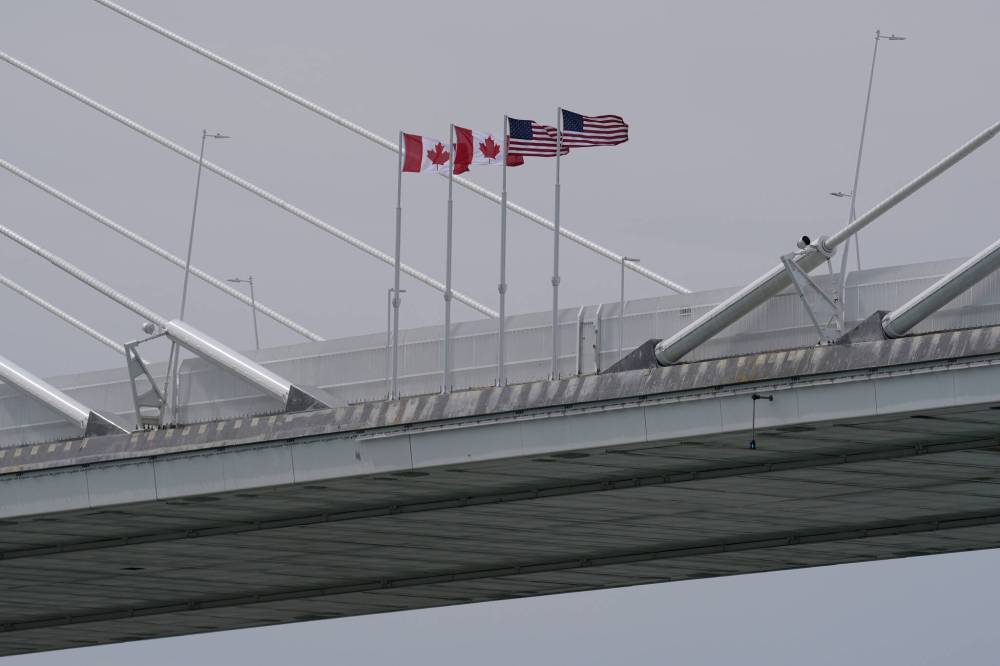
Three weeks after it was supposed to open, the Gordie Howe International Bridge between Windsor, Ont., and Detroit, Mich., remains closed.
This can’t be happening, I said to myself. It’s unprecedented. After studying Canada-U.S. relations for over 40 years, I’m hard-pressed to recall a similar incident ever happening in the post-1945 period.
Since when does an American president give Canada its marching orders? Does this country not have any pride, sense of self-worth or backbone anymore?
During the 1962 Cuban Missile Crisis, U.S. President John F. Kennedy was pressing Canadian Prime Minister John Diefenbaker to raise the NORAD level of alert, to allow hundreds of U.S. Air Force fighters to enter Canadian airspace and to permit the installation of nuclear warheads on Canadian soil. But Diefenbaker told Washington in no uncertain terms: “We were not a satellite state at the beck and call of an imperial master.”
Prime Minister Pierre Trudeau also enraged the Americans (and Albertans) when he announced the National Energy Program in his October 1980 budget document. Subsequently, there were almost endless threats of economic/trade retaliation emanating from official Washington.
To no one’s surprise, though, Trudeau laid things out simply for President Ronald Reagan: “Look, I won an election on this platform. I don’t tell you how to set the figures for your military budget, you can’t tell me that I can’t have my own energy policy in Canada.”
Similarly, prior to Prime Minister Jean Chrétien travelling to Cuba for an official visit in April 1998, the Clinton Administration made it known that it strongly disapproved of the trip. Not one to miss a beat, Chrétien responded curtly to his American friends: “If you want to have an isolationist policy, that’s your business. But don’t tell us what to do. That’s our business.”
So, where was the forceful response from the Mark Carney government to Trump’s bridge pronouncement? Where was the firm pushback? Why is Canada choosing to turn the other cheek, downplaying the significance of this infraction, and dismissing it out-of-hand with a flippant message that there is nothing to see here — certainly no “great drama” to speak of? Are you kidding me?
What message are we sending to Trump’s Washington? How much more abuse are we willing to tolerate — or issues we’re willing to concede ground on? Why, pray tell, would the U.S. take us seriously as a country?
This is all very important because Canada is about to enter into some of the most important trade negotiations that we have been involved in since the end of the Second World War. Indeed, the current CUSMA tariff exemption (or carve-out) for Canada is the only thing keeping our economy afloat right now. And we can’t afford to have our entire economic and commercial space decimated by a failed trade negotiation and costly tariffs (including pending Sec. 301 levies).
All of this reminds me of the time when Canada was first negotiating a free trade pact with the U.S. in the mid-1980s. The Brian Mulroney government was making concession after concession — not unlike what the Carney government is doing today — on foreign investment, energy policy, softwood number and the cultural sector. And the Americans just kept stringing us along until President Reagan’s trade negotiating authority almost ran out in late October 1987.

We ended up with a trade agreement that overwhelmingly favoured the U.S. side. Do you know why? Because the Americans knew that we wanted the deal far more than they did — and thus recognized that Canada was willing to make concessions on just about everything. Is that the Carney strategy today?
At some point, Canada is going to have to stand up to Trump and his acolytes. To do that, we need negotiating leverage and cards to play to get their attention, and to learn from the mistakes of the original Canada-U.S. free trade negotiations. Whether through temporary trade restrictions, an export tax or an outright ban, the Carney government needs to show some spine and to threaten to leverage oil and gas, potash and critical mineral exports to the U.S.
In other words, Carney has to stand up to the Americans as other Canadian prime ministers have done if he hopes to secure a better trade deal for Canada.
That is the only way to give Trump some pause, to show that Canada is serious, and to get some self-respect back.
Peter McKenna is professor of political science at the University of Prince Edward Island in Charlottetown.