‘The damage is done already’ Less-predictable seasons, weather conditions threaten traditional way of life
Read this article for free:
or
Already have an account? Log in here »
To continue reading, please subscribe:

Digital Subscription
One year of digital access for only $205*
- Enjoy unlimited reading on winnipegfreepress.com
- Read the E-Edition, our digital replica newspaper
- Access News Break, our award-winning app
- Play interactive puzzles
*First annual payment billed as $205.00 + GST for one year. This annual subscription will automatically renew at $233.00 + GST every 52 weeks (10% off the regular annual price of $259.35). Offer available to new and qualified returning subscribers only. Cancel any time.
To continue reading, please subscribe:
Add Free Press access to your Brandon Sun subscription for only an additional
$1 for the first 4 weeks*
- Enjoy unlimited reading on winnipegfreepress.com
- Read the E-Edition, our digital replica newspaper
- Access News Break, our award-winning app
- Play interactive puzzles
*Your next Brandon Sun subscription payment will increase by $1.00 and you will be charged $17.95 plus GST for four weeks. After four weeks, your payment will increase to $24.95 plus GST every four weeks.
Read unlimited articles for free today:
or
Already have an account? Log in here »
Hey there, time traveller!
This article was published 23/10/2020 (2173 days ago), so information in it may no longer be current.
Ron Spence looks back fondly on his nomadic childhood in northern Manitoba near Nelson House. The smooth walls of the canoe were his home; he and his grandparents would travel alongside other family members, moving from one community to the next.
“There was no time, we would just go with the flow,” Spence says.
Then in the winter, he and his grandparents moved from canoe to dogsled, working again with other families to move across the land, taking turns breaking trail through the deep snow.

Spence learned the curves and patterns of the rivers from his grandparents, who had met one summer years before on those same waterways. Spence is now a leader in his community of Nisichawayasihk Cree Nation, he’s also the vice-president of the Manitoba Trappers Association. And while he might not be as nomadic as he once was, he is still far from an occasional hunter.
“There’s different seasons for different purposes,” he says. “Like, in the springtime, we go out for the traditional goose hunt, the reason being, we’re not in the flyway for waterfowl, so the only opportunity (we have) is when the rapids are open and the rivers are still frozen. So people go out and get a few geese for the traditional Mother’s Day, Father’s Day feast.”
In the summer, he and his wife continue the practice of harvesting medicinal plants. During the winter, Spence travels along his trapline. This constant presence on the land gives him an intimate knowledge of climate change and how it is affecting central and northern Manitoba.
The challenge isn’t determining whether change is occurring, it’s differentiating between climate impact and the effects of hydroelectric generation in the province.
“We have two challenges. It’s Mother Nature and Manitoba Hydro,” Spence says. “So we have to adapt and adjust as we go.”
Those adaptations don’t come easily. Over the course of his life, Spence has witnessed countless changes that have, in many ways, threatened his nation’s way of life.
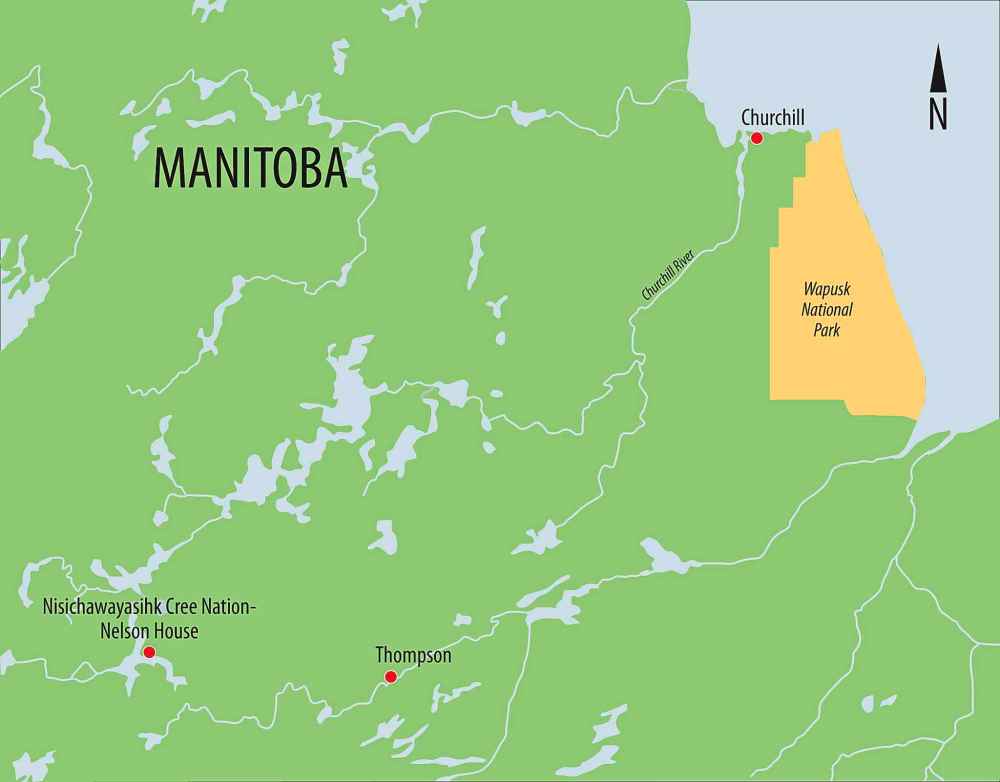
Spence remembers growing up in a time where Nelson House was in the flyway for the migratory geese. The Churchill River Diversion changed that, he says.
Nisichawayasihk means “where the three rivers meet.” The people of Nisichawayasihk Cree Nation have lived on the lands where the Burntwood, Footprint and Rat rivers converge for approximately 10,000 years.
In 1976, when the Churchill River was diverted into the Nelson River, a 9.3-kilometre channel was created for the water to flow through the Rat River–Burntwood River–Nelson River system. By Manitoba Hydro’s own admission, the effects of the diversion were devastating and long-lasting.
“Before the flood, in those days (the geese) were landing because the food was there. The ecosystem wasn’t changed. It was normal habitat and it was good for them. Since the flood, they bypass us. Their migrating route went from one of the routes that went through our community, our traditional territory, now they go around it because there’s no feed for them,” Spence says.
“The habitat is gone. But now we have the weird weather, the climate has really changed.”
“We have two challenges. It’s Mother Nature and Manitoba Hydro. So we have to adapt and adjust as we go.”
– Ron Spence
There are differences now in the amount of snow that falls and its “quality,” and how much and when it rains, he says.
These are first-hand observations that are also backed up by climate modelling and what climate scientists have predicted for decades.
One of Spence’s biggest concerns has to do with the fact that the seasons don’t adhere to the same patterns they once did. In the fall and winter, between two and three degrees of warming will be seen in the Nelson House region between now and 2050 when compared with historical temperatures between 1976 and 2005, according to data provided through the Prairie Climate Centre’s Climate Atlas. These milder winters change how the ground freezes and when snow falls.
“When it’s too warm and you have a snowfall, the snow is cushioning the land. The land, the lakes and the muskeg don’t have time to freeze. A normal winter or fall would be really cold, no snow; it freezes for a couple of weeks, and then it snows. Then you have a strong foundation,” he says.
The trouble, he explains, is that with these changing conditions, travel across the land has become much more dangerous as trappers and hunters must, in some cases, traverse hundreds of kilometres.
“We’ve lost experienced people, experienced trappers, falling through the ice,” he says.
● ● ●
Spence traps on water and on land, looking for muskrats, beaver, weasels, marten and lynx. Fur becomes prime — or reaches peak quality, in terms of colour, length, density and texture — in the coldest part of the year. “The primeness of fur varies depending on the weather,” Spence says, adding that while fluctuations are normal, the downward trend in quality over time is not.
In 2017, researchers at l’Université du Québec drew the same conclusions — climate change is influencing pelt quality, as well as the ability and safety for trappers to traverse the landscape. Additionally, researchers noted that the changes in snow quality favoured some species over others. With fishers and martens preferring different conditions, for example, the impact is felt throughout those critters’ foodwebs.
Spence has also noticed the presence of new animals in the area; white-tail deer, coyotes and skunks. “They’re not local,” he says.
Added to the changing climate, an enduring effect of residential schools on the First Nation is that the new generation didn’t grow up on the land the way Spence did. So, there is an ongoing effort to connect young people with traditional ways of life, he says, but it’s a difficult task when the ways in which they used to live have changed so much.

“We developed a fishing, hunting, trapping curriculum,” he says. The granny/grandpa traditional training program gets high school students in Nelson House involved. “The elders that we have experienced both before and after, right? So they can actually teach (the kids) about it while they’re on the land.
“I’ll give you an example. If the boys are working on how to make snowshoes, the elders would say, there’s a certain age of a birch tree that you use. But if it’s too dry that year, the birch when you bend them, they’re not going to bend properly because of the moisture content; it’s not there because of the climate change.”
This is, again, consistent with what was presented in the findings of the Intergovernmental Panel on Climate Change that indicate that more frequent and intense droughts can be expected across North America, including in Manitoba. Climate change will bring about more extreme weather, bouncing back and forth between too wet and too dry.
“That’s just one teaching,” Spence says. “There’s multiple teachings that we relate to climate change, even the preparation of food, preparation of equipment, how to build your own tools — it affects everything.”
● ● ●
Sitting across the coffee table at the Manitoba Keewatinowi Okimakanak offices in Thompson, Grand Chief Garrison Settee says the devastating impacts of climate change are already among his biggest concerns for the 26 northern Indigenous communities MKO represents, and he expects the worst is yet to come.
“The damage is done already, and it’s only getting worse,” he says. “Ultimately, it has affected the livelihood of a lot of people who still live traditionally. That livelihood and that way of life will be forever changed because of climate change. Now we’re faced with the situation: where do we go from here?”
The challenge is continuing to be resilient in the face of countless hurdles, Settee says. Colonialism threatened the Indigenous way of life, and climate change will test the resolve of Indigenous people yet again.

In Thompson, the fallout from a more inhospitable landscape is already evident as people move in large numbers to the urban centre as traditional ways of life prove to be less accessible, for a number of reasons, but climate change is certainly among them, he says.
“Our citizens are in a desperate situation. They’re no longer able to access the game, the wildlife and the fishing; when that’s affected, it creates chaos in communities,” he says.
“It’s indicative of something that they are moving away from their First Nations, because there’s nothing there to sustain their families, there’s nothing there to develop any kind of economy, so they’re moving into urban areas such as Thompson, Flin Flon and The Pas. So, that is a direct result of the impacts of climate change. Their livelihoods have been impacted. Their livelihoods have been destroyed.”
Settee goes as far as to say he wants to see First Nations compensated for the losses that they are experiencing and will continue to experience in the years to come.
No study has yet been conducted in Manitoba to indicate the number of First Nations people that are moving into urban settings as a result (at least in part) of a changing climate. However, similar studies have been conducted further north.
“Ultimately, it has affected the livelihood of a lot of people who still live traditionally. That livelihood and that way of life will be forever changed because of climate change. Now we’re faced with the situation: where do we go from here?”
– Manitoba Keewatinowi Okimakanak Grand Chief Garrison Settee
“The research on climate change and traditional foods in Northwest Territories and Nunavut has found examples of hunters being no longer able to access traditional fishing and hunting areas due to changes in the timing of formation and breakup of sea ice, unsafe ice, inability to use overland snowmobile trails at the correct time, animals no longer being in the places at expected times,” Wilfred Laurier University professor Robert McLeman tells the Free Press.
“Hunters have tried to adapt, but the adaptations typically involved having to spend more money on equipment, technology — GPS, satellite phones, safety gear, etc. — which makes hunting both less ‘traditional’ in nature but also makes it more expensive.”
That forces families to begin to rely on food from grocery stores which, in the North is notoriously expensive. The fallout impacts human health as well as the networks on which these communities typically operate.
“Historically in the smaller northern communities, there were well established food sharing networks: a hunter who was successful would share food with neighbours, knowing that they’d reciprocate in the future. With fewer households hunting, and with less success, those food sharing networks start to weaken. The degree of weakening varies from one community to another,” McLeman said.
“All this to say, climate change pressures on traditional foods probably don’t act as a direct, primary driver of out-migration from smaller northern communities, but are one of a combination of stressors that make life more challenging in those communities and which together incentivize younger people to consider moving elsewhere.”
● ● ●
Climate change threatens the traditional ways of life that Spence once knew, but he finds comfort in putting these changes in a much bigger context.
“We never look at things negatively,” Spence said. “Mother Nature gives. We take from Mother Nature, but we also have to take care of her. We do need to do our part. … But Mother Nature is going to change, regardless.”
“Every species or animal has a time when there is disease or sickness that’s going to hit them, even humans.”
Spence explains that it’s not as if he wants to see the destruction climate change can bring, but from his perspective, if it isn’t climate change it will be something else. There is a certain serenity that comes with the acceptance that death and sickness come in waves, in cycles and this could very well be one of them, he says.
“We need to be a part of the replenishment, helping Mother Nature; find that balance at the end of the day,” Spence said. “We need to adapt and go with Mother Nature and respect it. We need to stop being so greedy.”
sarah.lawrynuik@freepress.mb.ca