

Community-based care a move in the right direction
Advertisement
Read this article for free:
or
Already have an account? Log in here »
To continue reading, please subscribe:
Digital Subscription
One year of digital access for only $1.44 a week*
- Enjoy unlimited reading on winnipegfreepress.com
- Read the E-Edition, our digital replica newspaper
- Access News Break, our award-winning app
- Play interactive puzzles
*Billed as $5.77 plus GST every four weeks. After 52 weeks, price increases to the regular rate of $19.95 plus GST every four weeks. Offer available to new and qualified returning subscribers only. Cancel any time.
To continue reading, please subscribe:
Add Free Press access to your Brandon Sun subscription for only an additional
$1 for the first 4 weeks*
- Enjoy unlimited reading on winnipegfreepress.com
- Read the E-Edition, our digital replica newspaper
- Access News Break, our award-winning app
- Play interactive puzzles
*Your next Brandon Sun subscription payment will increase by $1.00 and you will be charged $17.95 plus GST for four weeks. After four weeks, your payment will increase to $24.95 plus GST every four weeks.
Read unlimited articles for free today:
or
Already have an account? Log in here »
It’s not a case of reinventing the wheel. It’s a case of recognizing how the wheel actually works and realizing that a symptom can be far away from the whole illness.
And it is a pragmatic, practical, numbers-based solution for a growing problem.
Earlier this month, Health Minister Uzoma Asagwara announced that the province would be funding 103 community-based care spaces in Winnipeg. The spaces will be for patients who need shelter or specialized supports — and can’t be discharged from much-needed hospital beds without it.
The Canadian Press
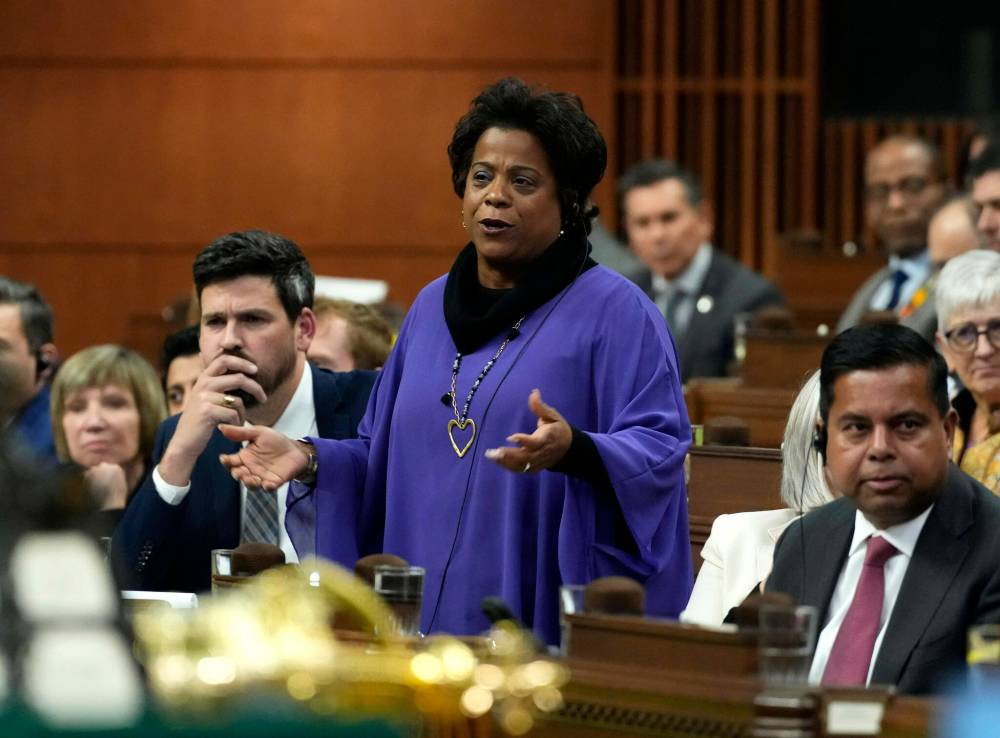
Federal Health Minister Marjorie Michel recently announced funding for Manitoba to hire more doctors.
“We’re talking about, in some cases, some Manitobans, some patients who have been waiting in (hospital) beds for the right place to go in communities for hundreds, if not thousands of days,” Asagwara said. “Some folks with very complex needs are now going to get the care they need in community.”
In some ways, it sounds almost counterintuitive. That’s because the health-care issue that’s always front and centre is that emergency rooms are too crowded — but instead of expanding emergency rooms, the plan is to build something other than an emergency room or increased hospital beds to take the pressure off.
One of the big problems in emergency rooms isn’t emergencies. It’s everything else downstream of the emergency departments themselves — patients can’t move into ordinary hospital beds if those beds are full of patients who should be discharged into other kinds of care, but there simply isn’t space.
The end result is that the entire system gets blocked up. Right now, roughly 600 hospital patients need an alternate level of care while waiting for a long-term care spot, a housing unit or other community supports.
Getting them into alternate care will cost around $7 million but will free up the equivalent of 40,000 days’ worth of bedspace every year.
Clearing up hospital bottlenecks eases pressure throughout the system and, while the current plan is a good one, there are provinces that see the problem even more clearly and are going even further.
In Toronto, the University Health Network opened Dunn House in 2024. The apartment complex was built on a parking lot next to a hospital and was designed to permanently house 51 homeless people who were leaning heavily on emergency room visits. The residents had long-term leases, along with specialized access to medical and social supports.
The numbers told the story: keeping someone in an Ontario hospital costs the health system more than $60,000 a month. Jail? $15,000 a month. Regular supported housing? $6,000. Dunn House? $4,000.
The effects were immediate. The residents had visited emergency rooms nearly 2,000 times before they were housed — that dropped by 52 per cent and, for those who were admitted to hospital from ERs, the length they stayed in hospital dropped by 79 per cent.
Dunn House is working so well that another building with 54 new apartments is being built next door, using money from the federal Rapid Housing Initiative, along with municipal and provincial funding.

In some ways, treating the problem of overcrowded hospitals and emergency rooms can be a little like medicine itself — the symptoms you see most easily may not be the cause of the actual illness.
And the treatment may involve much deeper intervention.
Emergency rooms are open day and night — they are all too often the last resort for people without any options, especially in a city like Winnipeg, where escape from winter’s cold is crucial. There may be nowhere else to go.
Patients who are too ill to be released from hospitals outright, and therefore stay in hospital, suffer from exactly the same problem — they have nowhere else to go.
Solving that problem is a very important step.