

The threat from outside Canada

Advertisement
Read this article for free:
or
Already have an account? Log in here »
To continue reading, please subscribe:
Digital Subscription
One year of digital access for only $1.44 a week*
- Enjoy unlimited reading on winnipegfreepress.com
- Read the E-Edition, our digital replica newspaper
- Access News Break, our award-winning app
- Play interactive puzzles
*Billed as $5.77 plus GST every four weeks. After 52 weeks, price increases to the regular rate of $19.95 plus GST every four weeks. Offer available to new and qualified returning subscribers only. Cancel any time.
To continue reading, please subscribe:
Add Free Press access to your Brandon Sun subscription for only an additional
$1 for the first 4 weeks*
- Enjoy unlimited reading on winnipegfreepress.com
- Read the E-Edition, our digital replica newspaper
- Access News Break, our award-winning app
- Play interactive puzzles
*Your next Brandon Sun subscription payment will increase by $1.00 and you will be charged $17.95 plus GST for four weeks. After four weeks, your payment will increase to $24.95 plus GST every four weeks.
Read unlimited articles for free today:
or
Already have an account? Log in here »
The 10-question referendum being held in Alberta on Monday, Oct. 19, is not the first time the unity of Canada has been threatened by a vote within one province. It is, however, the first referendum of this type to take place in an age of unfettered social media misinformation and deliberate foreign interference.
From mischievous comments by U.S. President Donald Trump about making Canada the 51st state to technology trillionaire Elon Musk’s urgings to Quebec and Alberta to separate, there are clear signs foreign interests are trying to influence Monday’s vote. But there are also less-obvious efforts at work to influence the referendum and destabilize Canada.
The Canadian Security Intelligence Service (CSIS) and independent think-tanks such as the Centre for Artificial Intelligence, Data and Conflict at the University of Regina have documented incidents involving Russian-linked automated content farms posting thousands of misleading articles about the referendum campaign on social media platforms. The content, CSIS has said, focuses on erroneous claims about the benefits of separation and the liabilities of remaining in Canada.
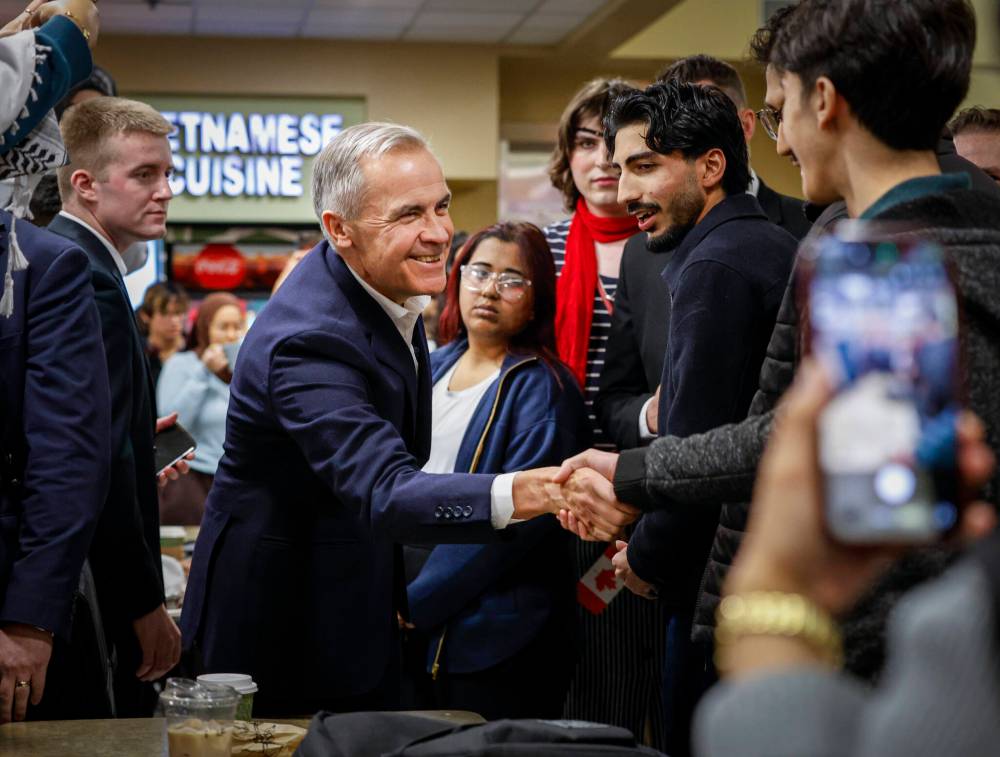
JEFF MCINTOSH / THE CANADIAN PRESS
Prime Minister Mark Carney meets University of Calgary students on Oct. 15.
In the face of all that activity, Prime Minister Mark Carney has been alarmingly unconcerned. Campaigning in Alberta this week, Carney said Ottawa is closely monitoring disinformation campaigns. He added that, in his conversations with foreign governments, all have agreed to stand down from any activities that might be perceived as threats to democracy.
“Our expectation is, to be absolutely clear, on foreign governments, United States included, is we don’t get ourselves involved in their elections, they don’t get themselves in our elections,” Carney said.
However, quite a few voices from across the political spectrum pointed out that officially sanctioned interference is hardly the only form of mischief that could disrupt the Alberta referendum. Yes, electoral interference can come from state-sponsored campaigns, but it also originates from freelance nihilists and digital terrorists who seek only to set fire to any election and then dance around the flames.
The non-partisan Centre for International Governance Innovation (CIGI), based in Waterloo, Ont., this week issued a stark warning that, based on all available evidence, there have been concerted efforts by foreign players to influence Monday’s vote. Despite this evidence, few if any safeguards have been activated to protect the referendum’s integrity

The CIGI noted that Ottawa has tools to not only track but also mitigate foreign interference online. The Security and Intelligence Threats to Elections Task force (SITE TF) is one such tool. However, CIGI noted that despite Carney’s assurances, it appears SITE TF has not been activated in any meaningful way.
Why would Ottawa hesitate to become actively involved in mitigating this kind of mayhem? All provinces, even those which harbour desires of a different relationship with Canada, surely share the same interest in preserving the integrity of elections.
CIGI theorized that the SITE TF had not been more active in the referendum because it is being managed under provincial jurisdiction and Ottawa may be reluctant — in a referendum on possible independence — to be seen to be meddling in Alberta’s affairs.
CIGI recommended that, at the very least, Ottawa commit to a full and public accounting of all instances of foreign interference and its sources, if possible. “Without public transparency about the role played by foreign interference … there can be no confidence in the outcome of electoral processes.”
One can only hope — both for Alberta and for Canada — that foreign interference does not affect the turnout or the referendum results. Further, if it does play a role in the outcome, Ottawa cannot be shown to have been whistling by the social-media graveyard.
Born and raised in and around Toronto, Dan Lett came to Winnipeg in 1986, less than a year out of journalism school with a lifelong dream to be a newspaper reporter.
Our newsroom depends on a growing audience of readers to power our journalism. If you are not a paid reader, please consider becoming a subscriber.
Our newsroom depends on its audience of readers to power our journalism. Thank you for your support.
Born and raised in and around Toronto, Dan Lett came to Winnipeg in 1986, less than a year out of journalism school with a lifelong dream to be a newspaper reporter.
Our newsroom depends on a growing audience of readers to power our journalism. If you are not a paid reader, please consider becoming a subscriber.
Our newsroom depends on its audience of readers to power our journalism. Thank you for your support.
Advertisement Advertise With Us
Advertisement Advertise With Us