

Essential workers ruling raises questions
Advertisement
Read this article for free:
or
Already have an account? Log in here »
To continue reading, please subscribe:

Digital Subscription
One year of digital access for only $205*
- Enjoy unlimited reading on winnipegfreepress.com
- Read the E-Edition, our digital replica newspaper
- Access News Break, our award-winning app
- Play interactive puzzles
*First annual payment billed as $205.00 + GST for one year. This annual subscription will automatically renew at $233.00 + GST every 52 weeks (10% off the regular annual price of $259.35). Offer available to new and qualified returning subscribers only. Cancel any time.
To continue reading, please subscribe:
Add Free Press access to your Brandon Sun subscription for only an additional
$1 for the first 4 weeks*
- Enjoy unlimited reading on winnipegfreepress.com
- Read the E-Edition, our digital replica newspaper
- Access News Break, our award-winning app
- Play interactive puzzles
*Your next Brandon Sun subscription payment will increase by $1.00 and you will be charged $17.95 plus GST for four weeks. After four weeks, your payment will increase to $24.95 plus GST every four weeks.
Read unlimited articles for free today:
or
Already have an account? Log in here »
Ever been to a Dynacare clinic? Most of us have been. It’s an amazing demographic and ethnic slice of the city we’ve become. Old patients. Young patients. New arrivals. Long-time Canadians. People who know the ropes — others who are startled by the crowds and the noise and the lockstep forward motion of professionals doing what they have been trained to do. It seems, all at the same time, both chaotic and diagnostic, as names of patients are steadily called out and thousands of tests are performed.
But Dynacare is at the centre of a new kind of test and this time, we’re all in the test tube together.
It’s the first real test for new labour law put in place by the government of Premier Wab Kinew in 2024 — a law that redefined what essential services are for provincially-regulated workplaces. Under this law, companies and their employee and unions must have an agreement of which employees are essential — which ones must stay on the job during a legal strike for the protection of the health and safety of the public.
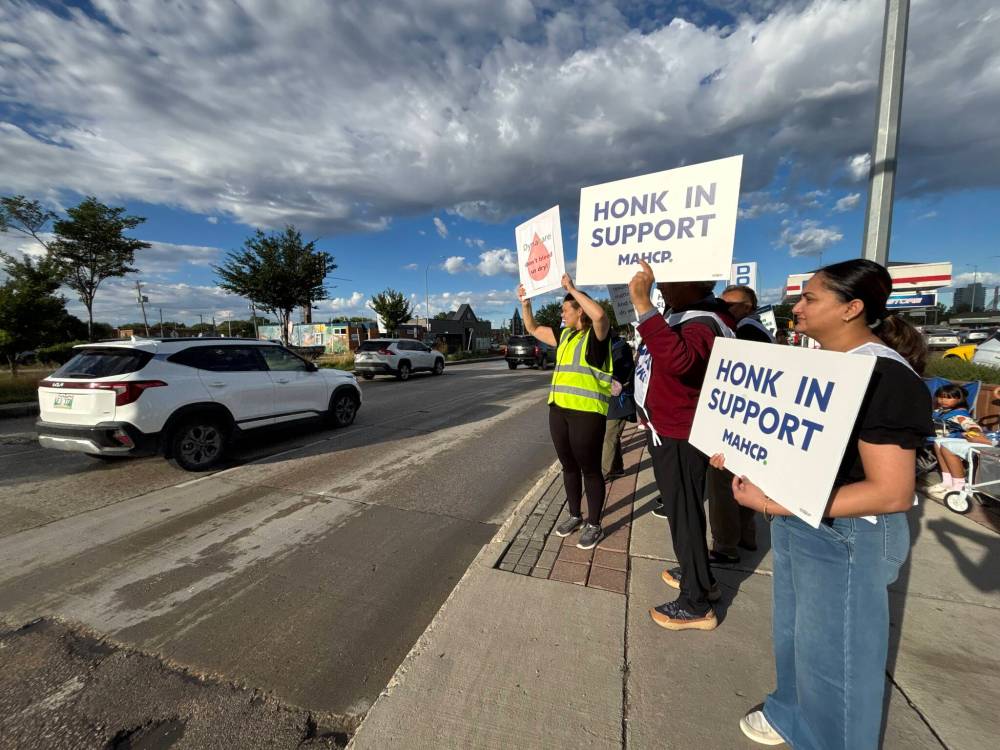
Free Press file photo
Striking Dynacare employees have been declared “essential workers” by the Manitoba Labour Board.
Dynacare had that kind of essential employee agreement with its staff and union — the company and the union had agreed the employees were not essential.
But, when Dynacare employees went on strike in September, the province’s labour minister used a clause in the new legislation to ask the Manitoba Labour Board to set aside the existing essential workers’ agreement — something the labour minister can now do in any strike situation. On Oct. 1, the labour board agreed with the minister, saying essential services “must be maintained in the event of job action involving Dynacare and the (Manitoba Association of Health Care Professionals) in order to prevent a threat to the health, safety and welfare of residents of Manitoba.”
There are definitely reasons why Dynacare employees should be deemed to be essential.
First and foremost, people depend on the private company to provide critical medical testing — and with 5,600 patients a day getting tests at Dynacare, it’s work that could not be picked up by Shared Health labs.
But there’s a missing piece. The problem is that taking away the right for employees to strike takes away the strongest bargaining chip unionized employees have — and it’s not a decision that should be taken lightly.
To make matters more complex, the government which intervened to effectively halt the strike action is also the government that holds a contract with for-profit Dynacare to provide health-testing services. That’s something you could call a clear conflict of interest.
There is normally a trade-off when employees are held to be essential — in exchange for losing the right to strike, unionized employees gain the right to go to arbitration, often binding arbitration, when their demands and those of their employers reach a stalemate.
Winnipeg firefighters, police officers and paramedics, for example, are clearly essential employees — and their contracts specify arbitration will occur when a bargaining impasse occurs.

Dynacare employees say they are paid 20 to 50 per cent less than public service employees doing the same work — and say the wages and working conditions mean it will be difficult for Dynacare to continue to find skilled staff.
If Dynacare staff truly perform an essential service, something will have to change to bring balance back between business and labour at the negotiating table.
There’s a finger on the scales here — and the oddest part of all is that it is an NDP government that’s putting the squeeze on a labour dispute, in favour of an employer.
And, not inconsequentially, in favour of the government’s own interests — politically, pragmatically and financially.
It does not feel like fair treatment.