

Fighting tariffs with the power of boycotts
Advertisement
Read this article for free:
or
Already have an account? Log in here »
To continue reading, please subscribe:

Digital Subscription
One year of digital access for only $205*
- Enjoy unlimited reading on winnipegfreepress.com
- Read the E-Edition, our digital replica newspaper
- Access News Break, our award-winning app
- Play interactive puzzles
*First annual payment billed as $205.00 + GST for one year. This annual subscription will automatically renew at $233.00 + GST every 52 weeks (10% off the regular annual price of $259.35). Offer available to new and qualified returning subscribers only. Cancel any time.
To continue reading, please subscribe:
Add Free Press access to your Brandon Sun subscription for only an additional
$1 for the first 4 weeks*
- Enjoy unlimited reading on winnipegfreepress.com
- Read the E-Edition, our digital replica newspaper
- Access News Break, our award-winning app
- Play interactive puzzles
*Your next Brandon Sun subscription payment will increase by $1.00 and you will be charged $17.95 plus GST for four weeks. After four weeks, your payment will increase to $24.95 plus GST every four weeks.
Read unlimited articles for free today:
or
Already have an account? Log in here »
Speaking this week about an important deadline for a renewal of the Canada-U.S.-Mexico agreement on trade, Manitoba Premier Wab Kinew promised that Manitoba will continue to keep American booze off the shelves of government liquor stores if a fair deal cannot be reached.
“No CUSMA, no booze-ma,” Kinew said with poetic flair.
Manitoba is not alone in this threat.
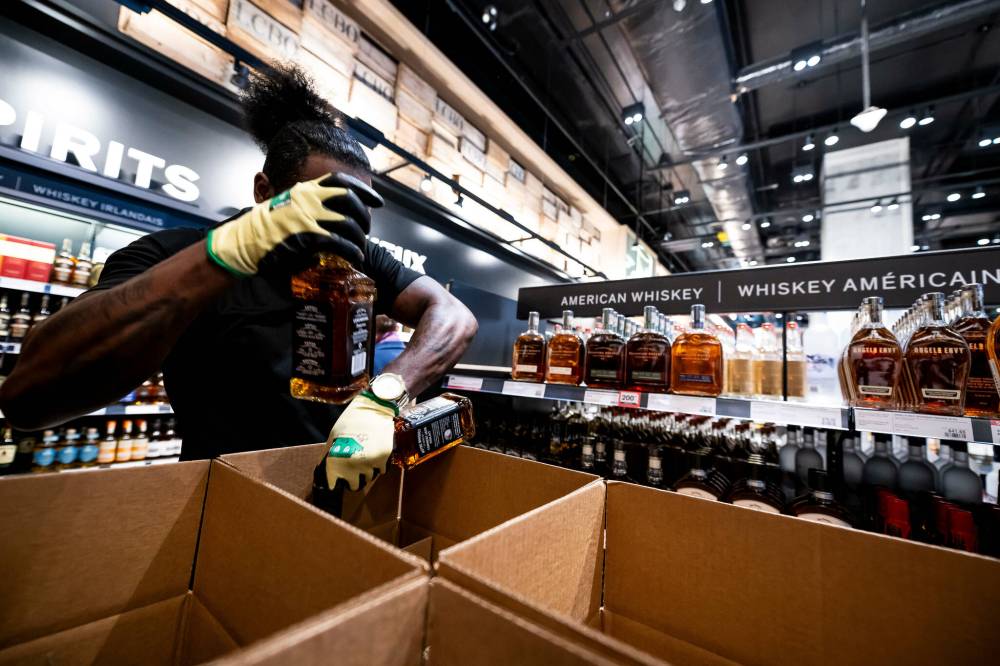
FILE/Christopher Katsar Luna/Bloomberg
A worker removes bottles of American-made Jack Daniel’s whiskey from a liquor store in Toronto.
Although he lacks Kinew’s poetry, Ontario Premier Doug Ford said he was only willing to allow U.S. wine, beer and spirits back onto the shelves of government liquor stores if the U.S. scaled back the 50 per cent tariffs on steel, aluminum and autos U.S. President Donald Trump has threatened to impose on Aug. 19.
Why mention the booze ban? Remarkably, the decision to stop selling American alcohol has become a hugely important bargaining chip for Canadian negotiators seeking to avoid Trump’s newest tariffs. Canada is dangling the end of the booze ban as one of several incentives to get lower tariffs.
Although some of the numbers pale in comparison to the billions of dollars Trump is seeking to exact from Canadian exporters, the impact of the provincial alcohol boycott has not been insignificant. All told, American wine, spirit and beer makers lost a collective $700 million in the first year of the boycott, which began with Ontario pulling U.S. booze from its shelves in February 2025. Manitoba and a host of other provinces followed the next month.
Prior to the boycott, Canada was the world’s single largest purchaser of American booze, consuming up to 30 per cent of all U.S. exports. Along with the grassroots campaign to eschew travel to the U.S., Canadians have put a dent in the Trump tariff policies and generated more than a little anxiety among lobbyists and industry organizations representing the alcohol and hospitality sectors.
In other words, the impact of the booze and tourism boycotts by Canadians — which are high profile and easy for Americans to see — is much greater than its dollar value.

(On a side note, it should be noted the booze ban could have been even more effective if Alberta and Saskatchewan had joined in. Although both provinces briefly participated in the national boycott, they both welcomed American booze back within a few weeks. Given that the boycott has become a hugely important bargaining chip in trade negotiations, both Alberta and Saskatchewan should hang their heads in shame at not making one of the strongest cards in Canada’s trade negotiation hand a little bit stronger.)
Booze or no booze-ma, the stakes heading into the Aug. 19 deadline for a renewal of CUSMA could not be higher. If Trump follows through his threatened tariffs, there would be catastrophic impacts on both sides of the border.
A recent report from the Canadian American Business Council by Oxford Economics estimated that Canada would lose more than 100,000 jobs if CUSMA is not renewed. The U.S. would also suffer blow-back from Trump’s refusal to renew; the same report suggests the U.S. would lose 214,000 jobs.
Analysis like that would prompt rational leaders to rethink their trade policies. Lamentably, rational thought is not necessarily one of the features of Trump’s uber-aggressive trade policy. And that means two things will happen: Canada will not be able to negotiate a reasonable compromise on tariffs; and most Canadians will continue to go without California wine and Kentucky bourbon.
Although that outcome would trigger a bleak scenario for our economy, Canada can still hold its head up high with the knowledge that when we were challenged by a bully, we hit back.