

Helipad imperative for cardiac centre
Advertisement
Read this article for free:
or
Already have an account? Log in here »
To continue reading, please subscribe:
Digital Subscription
One year of digital access for only $1.44 a week*
- Enjoy unlimited reading on winnipegfreepress.com
- Read the E-Edition, our digital replica newspaper
- Access News Break, our award-winning app
- Play interactive puzzles
*Billed as $5.77 plus GST every four weeks. After 52 weeks, price increases to the regular rate of $19.95 plus GST every four weeks. Offer available to new and qualified returning subscribers only. Cancel any time.
To continue reading, please subscribe:
Add Free Press access to your Brandon Sun subscription for only an additional
$1 for the first 4 weeks*
- Enjoy unlimited reading on winnipegfreepress.com
- Read the E-Edition, our digital replica newspaper
- Access News Break, our award-winning app
- Play interactive puzzles
*Your next Brandon Sun subscription payment will increase by $1.00 and you will be charged $17.95 plus GST for four weeks. After four weeks, your payment will increase to $24.95 plus GST every four weeks.
Read unlimited articles for free today:
or
Already have an account? Log in here »
A helicopter brings a critically ill patient from rural or northern Manitoba to Winnipeg. But it cannot land at St. Boniface Hospital, Manitoba’s provincial cardiac centre.
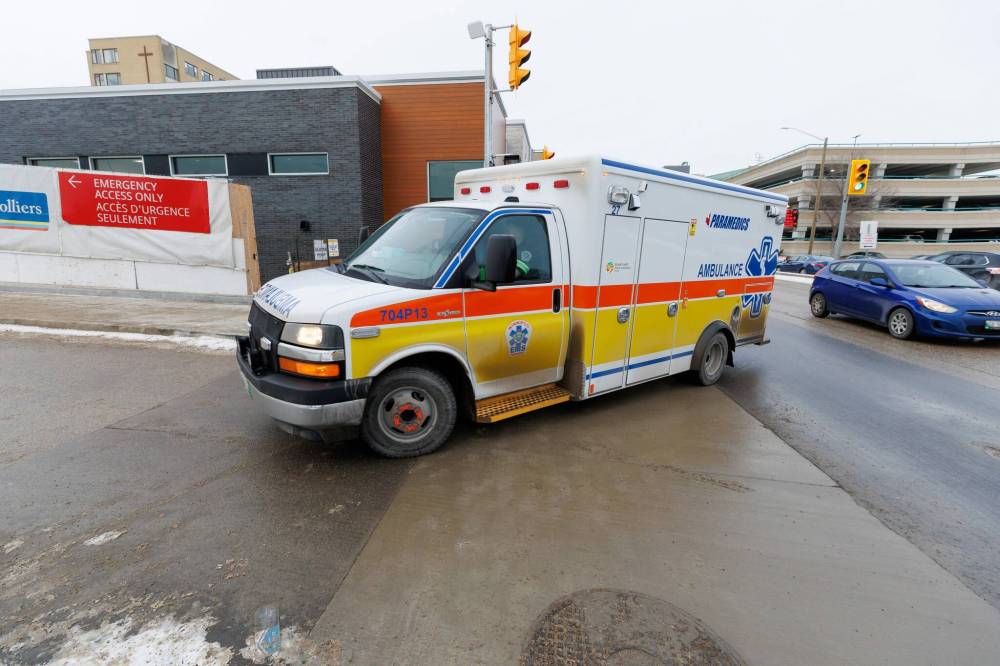
Instead, the patient may land at Health Sciences Centre, be moved through that hospital, transferred into a ground ambulance and driven to St. Boniface for specialized cardiac care. In a major heart attack, those extra steps consume precious minutes.
Many rural hospitals and northern nursing stations have helipads because rapid emergency transport matters. Yet the provincial cardiac centre that receives some of the sickest patients has none. How does that make sense?
MIKE DEAL / FREE PRESS FILES
Helicopters cannot land at St. Boniface Hospital, Manitoba’s provincial cardiac centre; rural patients are transferred by ambulance.
I retired after 44 years as a cardiologist, including years directing the Manitoba Acute Coronary Syndrome Network. Much of my career was devoted to improving the treatment of heart attacks by eliminating unnecessary delays.
We developed systems enabling paramedics to diagnose heart attacks, alert the cardiac catheterization laboratory and transport patients directly for life-saving treatment. We demonstrated that changing how health care is organized can save lives.
Yet a gap remains.
Every minute matters in a major heart attack, especially in cardiogenic shock, when the damaged heart cannot pump enough blood to sustain life.
I recall a tragic case: a rural patient with a severe heart attack was flown to Winnipeg. Following landing, the patient suffered cardiac arrest during the subsequent ground ambulance transfer and died before reaching the catheterization laboratory.
We cannot know whether a hospital helipad would have changed that outcome. But it illustrates why every avoidable delay deserves scrutiny.
The benefits extend beyond cardiology. Patients requiring urgent cardiac or vascular surgery, intensive care and other specialized services at St. Boniface could also benefit.
This is fundamentally an issue of equitable access to health care for rural and northern Manitobans.
The need is hardly new.
In 2018, GroundEffect Aerodrome Consulting recommended a rooftop heliport on the hospital’s E Block. In 2019, Winnipeg Airport Services Corporation identified a possible ground-level alternative near the Red River, subject to further investigation.
A third assessment, completed by GroundEffect in March 2022, identified significant limitations with ground-level proposals. Rather than abandon the idea of a heliport, the consultants recommended pursuing a rooftop design.
That recommendation was made more than four years ago. What happened to it?
I met with successive hospital CEOs, chief medical officers and other health-care leaders. Many were supportive. But with leadership changes, discussions often began anew: meetings repeated, clinical arguments revisited and proposals reconsidered.
I do not question the commitment of these individuals. Rather, I question a system in which an important patient-care initiative can repeatedly lose momentum without a clear decision.
In 2023, more than 30 physicians from cardiology, emergency medicine and critical care supported a renewed appeal for a helipad. The Winnipeg Regional Health Authority subsequently indicated that the proposal would be considered within the hospital’s facilities master plan and the broader provincial clinical services plan.
Yet the project remains unresolved.
Funding has been raised as an obstacle. Yet I was repeatedly advised that philanthropy could potentially cover much, perhaps all, of the capital cost. Responsible planning and ongoing operational support would still be necessary.
Meanwhile, Manitoba continues investing in cardiac care. St. Boniface opened its expanded emergency department in 2025, and in April 2026 the provincial government announced a further $22.1-million investment in cardiac services.

These are welcome initiatives. But there is an inconsistency in investing in faster, better treatment inside the hospital while failing to resolve how critically ill patients arriving by helicopter can reach that treatment without unnecessary delay.
Who has responsibility for making this decision? What happened to the consultants’ recommendations? And when will Manitobans receive a definitive answer?
If a helipad cannot be built, Manitobans deserve a clear explanation. If it can, we deserve a plan to make it happen.
We have spent decades learning how to save minutes in cardiac emergencies. Surely we should not accept losing them in the final kilometres of the journey.
Dr. John Ducas is a retired Winnipeg cardiologist, former head of cardiology, director of the cardiac catheterization laboratories, and medical director of the Manitoba Acute Coronary Syndrome Network at St. Boniface Hospital.