

Not a choice between people, planet
Advertisement
Read this article for free:
or
Already have an account? Log in here »
To continue reading, please subscribe:
Digital Subscription
One year of digital access for only $1.44 a week*
- Enjoy unlimited reading on winnipegfreepress.com
- Read the E-Edition, our digital replica newspaper
- Access News Break, our award-winning app
- Play interactive puzzles
*Billed as $5.77 plus GST every four weeks. After 52 weeks, price increases to the regular rate of $19.95 plus GST every four weeks. Offer available to new and qualified returning subscribers only. Cancel any time.
To continue reading, please subscribe:
Add Free Press access to your Brandon Sun subscription for only an additional
$1 for the first 4 weeks*
- Enjoy unlimited reading on winnipegfreepress.com
- Read the E-Edition, our digital replica newspaper
- Access News Break, our award-winning app
- Play interactive puzzles
*Your next Brandon Sun subscription payment will increase by $1.00 and you will be charged $17.95 plus GST for four weeks. After four weeks, your payment will increase to $24.95 plus GST every four weeks.
Read unlimited articles for free today:
or
Already have an account? Log in here »
The UN Climate Change Conference, COP31, reached an impasse in Antalya, Turkey, on Sunday.
When negotiations stall, our instinct is to concentrate harder on the disagreement: who is right? Who must concede? Who should pay? Who must change first?
There is another possibility: what if the difficulty lies partly in the way we have organized the problem?
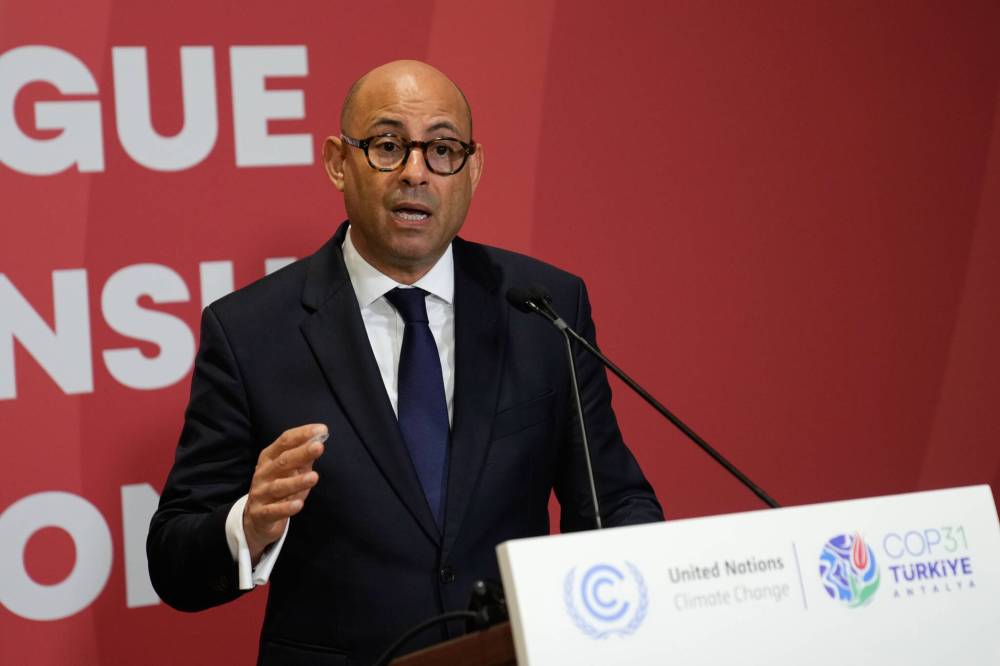
Khalil Hamra / The Associated Press
Simon Stiell, UN climate chief, speaks at the COP31 Climate Summit on Sunday in Antalya, Turkey. Talks collapsed with no deal among countries.
That question led me to develop what I call the Climate Continuity Compact. It is not another climate target or a prescription requiring identical paths. It is an architecture for thinking about transition differently.
Instead of beginning with who must lose, begin by identifying the conditions any credible solution must satisfy.
I propose two: ecological boundaries must be respected, and the continuity of natural persons must be protected.
Neither cancels the other.
The world must reduce its dependence upon fossil fuels and remain within ecological conditions capable of sustaining life. At the same time, people depend upon food systems, transportation, energy, employment and public services that remain directly or indirectly dependent upon fossil fuels.
Workers cannot simply be discarded because an industry must change. Farmers still have to produce food. People still require heat, shelter, health care and transportation. Countries confronting serious climate effects need resources for adaptation and resilience.
These are not competing problems. They are interconnected parts of the same problem.
Protecting economic arrangements by allowing preventable ecological harm to continue is not credible. Neither is protecting the environment by transferring the cost of transition onto workers, farmers, communities or vulnerable populations who possess little authority over the systems being changed.
A transition that creates foreseeable deprivation has not solved the whole problem. It has moved part of the harm somewhere else.
I find it useful to think of climate transition as a puzzle. Before assembling one, we need to know its boundaries and the picture we are trying to make.
Those boundaries can be expressed simply: stop breaching ecological boundaries. Do not create deprivation while correcting the breach.
Once those boundaries are established, every disagreement need not be resolved before work begins. We can separate the larger problem into connected pieces, work where co-operation is possible and continually test each proposed solution against the whole.
Consider fossil fuels themselves. Treating every use as though it presents the same problem pushes us towards two extremes: change everything immediately, regardless of consequence, or postpone meaningful change until every alternative is available.
Neither is necessary.
Some uses may already be readily substitutable. Others depend upon infrastructure or affordable alternatives that do not yet exist. Some are directly connected to human necessities such as food, health, sanitation or essential transportation. Others may be non-essential or wasteful.
That distinction gives us somewhere to begin.
It also imposes discipline. A replacement must be tested too. If eliminating a fossil-fuel-based material increases pressure upon forests, agricultural land, water, workers or another population, we may simply have relocated the harm.
The same reasoning matters with responsibility.
Workers in fossil-fuel industries may be physically close to activities we are trying to change. That does not mean they possessed the authority that created or maintained society’s dependence upon those industries. Farmers may similarly bear responsibility for emissions while having little control over fertilizer markets, packaging, transportation infrastructure, financing or supermarket procurement.
Responsibility should not automatically fall upon whoever stands closest to the harm. It should follow authority.
That produces a chain of accountability: Authority leads to Responsibility, which leads to Obligation, which leads to Correction, which leads to Remedy, which leads to Accountability.
If an institution possesses authority to make decisions producing foreseeable harm, responsibility follows. Where responsibility exists, corresponding obligations arise to prevent, correct or remedy that harm.
The purpose is not punishment. It is to prevent the costs of ecological correction and economic transition from being transferred to people who neither caused the harm nor possessed the authority to prevent it.
Countries need not follow identical pathways. What they can share are boundaries. Progress must reduce ecological harm. Human necessities must remain accessible. Foreseeable deprivation must not be displaced onto those with less power. Accountability must follow actual authority.
Climate change is enormously complicated. That does not mean every part must be solved simultaneously.

We can work on different pieces while continually asking two questions: does this reduce existing or foreseeable ecological harm? Does it preserve people’s ability to access, acquire and maintain their human necessities?
The Climate Continuity Compact asks us to stop designing climate transition as though somebody must necessarily lose.
No legitimate human necessity should remain permanently dependent upon preventable ecological harm, and no institution should be permitted to preserve its own continuity by destroying the human or ecological continuity upon which it ultimately depends.
We may not yet know how to assemble every piece of the climate puzzle. We can still establish its boundaries, agree upon the picture we are trying to make, and start putting the pieces together.
Anne Thompson is a Winnipeg writer whose work examines governance, institutional responsibility and the conditions required for human and ecological continuity.