

Music can be act of remembrance
Advertisement
Read this article for free:
or
Already have an account? Log in here »
To continue reading, please subscribe:
Digital Subscription
One year of digital access for only $1.44 a week*
- Enjoy unlimited reading on winnipegfreepress.com
- Read the E-Edition, our digital replica newspaper
- Access News Break, our award-winning app
- Play interactive puzzles
*Billed as $5.77 plus GST every four weeks. After 52 weeks, price increases to the regular rate of $19.95 plus GST every four weeks. Offer available to new and qualified returning subscribers only. Cancel any time.
To continue reading, please subscribe:
Add Free Press access to your Brandon Sun subscription for only an additional
$1 for the first 4 weeks*
- Enjoy unlimited reading on winnipegfreepress.com
- Read the E-Edition, our digital replica newspaper
- Access News Break, our award-winning app
- Play interactive puzzles
*Your next Brandon Sun subscription payment will increase by $1.00 and you will be charged $17.95 plus GST for four weeks. After four weeks, your payment will increase to $24.95 plus GST every four weeks.
Read unlimited articles for free today:
or
Already have an account? Log in here »
Last Sunday’s performance of Benedict Sheehan’s Ukrainian War Requiem by the Axios Men’s Ensemble at the Ukrainian Catholic Cathedral of Saints Volodymyr and Olha was one of those musical experiences that will stay with me for a long time.
For the last month, I’ve been listening to the requiem on my morning walks, becoming familiar with its music and the range of expression carried by the human voice. Seated in the pew, I began to hear it differently, shaped by the cathedral and those gathered around us.
Earlier that evening, as we approached the cathedral, the stained-glass windows designed by Ukrainian Canadian artist Leo Mol glowed in their rich palette against the November darkness. Inside, a magnificent chandelier illuminated the painted iconostasis behind the assembled choir.
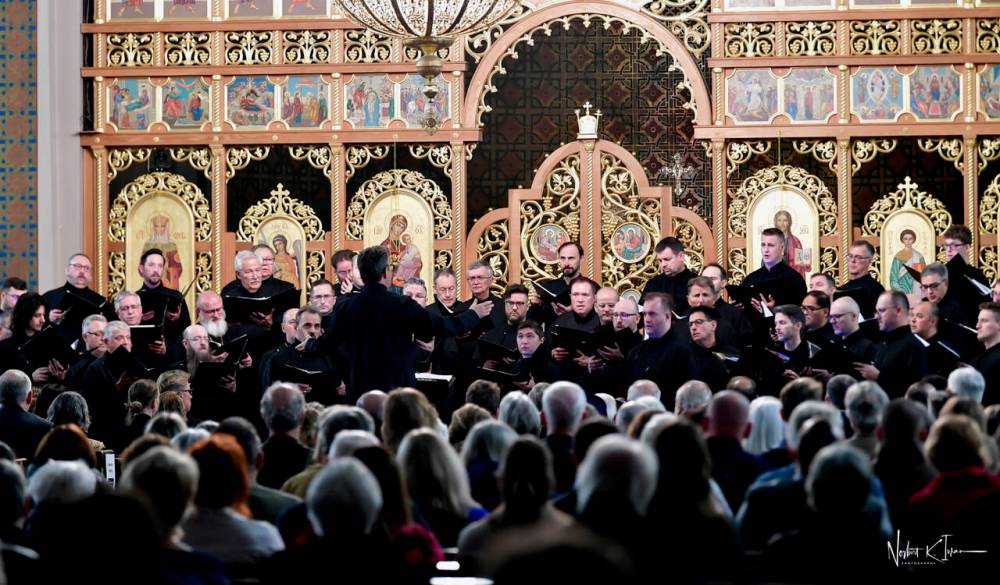
Norbert Iwan Photo
The Axios Men’s Ensemble performed Ukrainian War Requiem at Winnipeg’s Ukrainian Catholic Cathedral of Saints Volodymyr and Olha.
Most of the requiems we hear performed were composed in the 18th and 19th centuries. These profound works of sacred music continue to move audiences, although there is inevitably a historical distance between the circumstances in which they were written and our own experience of hearing them today.
Sunday evening was different. Sheehan’s Requiem was commissioned in 2022, in response to Russia’s full-scale invasion of Ukraine. Drawing upon the traditions of Eastern Christian sacred music, it was written while the tragedy it addresses was unfolding. Four years later, the war continues.
The Edmonton-based Axios Men’s Ensemble, which commissioned the work, brought remarkable sensitivity to the performance. Its singers, Ukrainians and Ukrainian-Canadians, including newcomers, filled the church with powerful harmonies that gave way, at times, to passages of extraordinary stillness.
The precision of the ensemble, the balance of its voices and its expressive range were remarkable.
We often describe ours as an increasingly secular society, one in which organized religion occupies a less prominent place in public life. Yet sacred music continues to attract audiences, inspire composers and bring people together across generations, cultures and beliefs. Its appeal extends well beyond the congregations and religious traditions from which it emerged.
This is part of what makes sacred music so enduring. Even for those who don’t share the faith expressed in its words, it offers contemplation and even respite from lives crowded with competing demands. Hearing it in a place of worship also invites us to consider how its beauty relates to its purpose: music created to accompany people through experiences for which ordinary language may seem inadequate.
Think of the religious paintings and sculptures we encounter in museums. It’s not necessary to share their original devotional purpose in order to respond to them. Sacred music asks something similar of a listener. Its words and forms carry histories that remain available to us, and a public performance creates an opportunity to engage with that tradition through an experience shared with others.
The Cathedral of Saints Volodymyr and Olha was an essential part of Sunday’s experience. For generations, it has been a place of worship for Winnipeg’s Ukrainian community. Its art and architecture speak to the faith and cultural identity sustained here over the decades. On Sunday evening, those surroundings offered a context that no recording could fully reproduce.
Among those gathered were Ukrainian-Canadians whose families had established roots in this country generations ago, alongside newcomers who had fled Ukraine in recent years. Others had come to express their solidarity or simply experience the music. Each person brought a different history to what we were hearing.
The performance of the Ukrainian War Requiem in Winnipeg, only days before Remembrance Day, added another layer of meaning. A memorial plaque in the sanctuary honoured family members and friends of parishioners who had lost their lives defending Ukraine. When singers read aloud the names of people close to them who had died in the war, the connection between the work and those performing it became unmistakable.

In a week devoted to remembrance, these names brought specific lives into focus. They also recalled a purpose that sacred music has served for centuries: giving public expression to grief that is deeply personal. Here was a shared form through which people with different experiences of loss could listen together.
At the conclusion of the requiem, the ensemble sang Prayer for Ukraine. It returned us to a familiar tradition of Ukrainian choral music, offering a sustained moment of hope after the intensity of what we had just heard.
I will continue listening to Sheehan’s requiem, though I expect to hear it differently now. Certain passages will bring back the cathedral experience, along with the faces of the singers and the names spoken aloud.
The music itself has not changed, but my understanding of it has. Like a painting encountered again after many years, a work of music can reveal something we were previously unaware of or not ready to recognize. Sunday’s performance reminded me how much that encounter depends on where we are, who is beside us and what we bring to the act of listening.
Stephen Borys is president and CEO of Civic Muse, an arts and cultural consulting practice based in Winnipeg.