

Len Van Roon showed us what Canada is
Advertisement
Read this article for free:
or
Already have an account? Log in here »
To continue reading, please subscribe:
Digital Subscription
One year of digital access for only $1.44 a week*
- Enjoy unlimited reading on winnipegfreepress.com
- Read the E-Edition, our digital replica newspaper
- Access News Break, our award-winning app
- Play interactive puzzles
*Billed as $5.77 plus GST every four weeks. After 52 weeks, price increases to the regular rate of $19.95 plus GST every four weeks. Offer available to new and qualified returning subscribers only. Cancel any time.
To continue reading, please subscribe:
Add Free Press access to your Brandon Sun subscription for only an additional
$1 for the first 4 weeks*
- Enjoy unlimited reading on winnipegfreepress.com
- Read the E-Edition, our digital replica newspaper
- Access News Break, our award-winning app
- Play interactive puzzles
*Your next Brandon Sun subscription payment will increase by $1.00 and you will be charged $17.95 plus GST for four weeks. After four weeks, your payment will increase to $24.95 plus GST every four weeks.
Read unlimited articles for free today:
or
Already have an account? Log in here »
Len Van Roon kept the boots. Eighty-two years after he splashed ashore at Juno Beach, they were still at his home in Charleswood. So were the more than 1,100 letters he wrote home during the war, most of them to Verna, the girl he’d marry when he got back.
Len died peacefully at home on Oct. 26. He was 104.
He was the only child of Adriaan and Cornelia, Dutch immigrants who came to Charleswood Road in 1928 and started a poultry farm. He was drafted in January 1943. On June 6, 1944, he landed in the first wave at Juno with the 19th Field Artillery Regiment. He fought through France, Belgium and Holland, crossed the Rhine and pushed into Germany.
Steven Fletcher photo
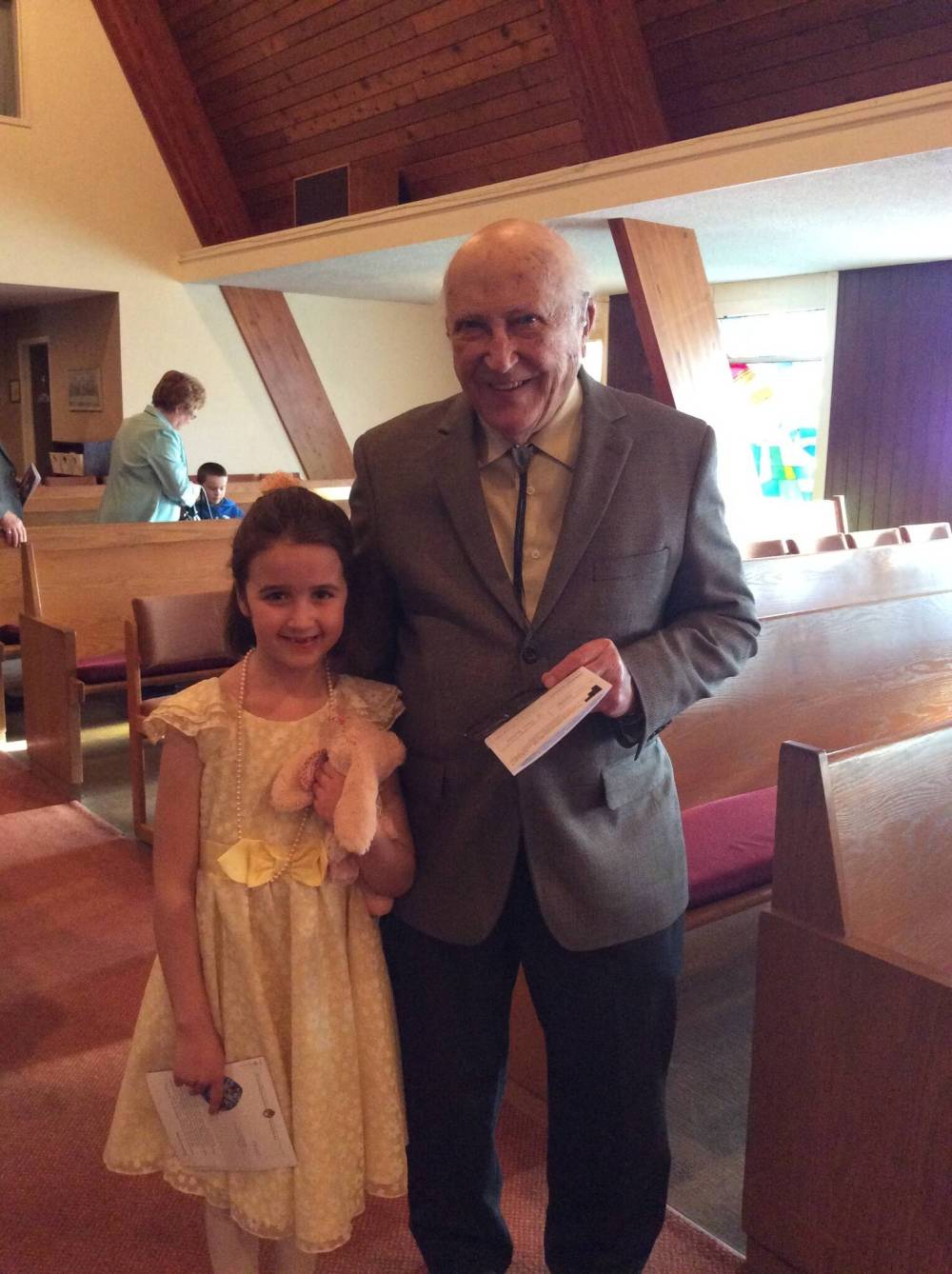
Len Van Roon with the author’s niece Evelyn at Charleswood United Church in 2015
Many of his mates didn’t come home. He never forgot them.
He came back in December 1945, married Verna and raised four kids on that same farm. Then he spent the rest of a very long life making sure the rest of us didn’t forget either. He went into classrooms and community halls and told young people what happened, so they’d understand that someone paid for the freedoms they enjoy.
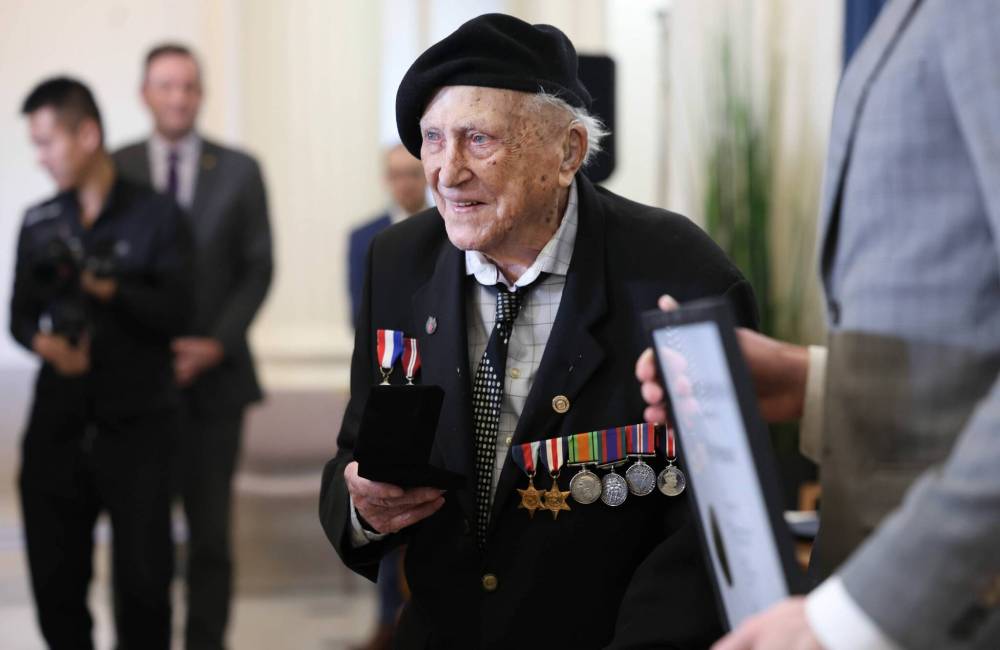
In 2012, as his MP, I had the honour of presenting Len with the Queen Elizabeth II Diamond Jubilee Medal. Last November he was one of the first three Manitobans invested into the Manitoba Circle of Honour. At the Legislature on V-E Day last year, his advice to the rest of us was three words: “Don’t blow it.”
That’s worth thinking about this Remembrance Day. Over the last couple of years Canada has faced threats and pressure from our friends to the south that few of us expected to see.
It’s a good moment to ask what Canadian sovereignty means, and why we have to stand as a sovereign nation and not as anyone’s vassal.
In the war then called the Great War, with all the irony that word carries, hundreds of thousands of young Canadians volunteered for King and country. Newfoundland, which wouldn’t join Confederation until 1949, sent its own regiment, the Blue Puttees. They fought at Gallipoli in 1915. On the first morning of the Somme, at Beaumont-Hamel on July 1, 1916, the regiment was nearly wiped out. Of roughly 800 who went over the top, 68 answered roll call the next day.
In April 1917, Canadians took Vimy Ridge, all four divisions fighting together for the first time. That fall at Passchendaele, Canada suffered even more casualties than at Vimy, about 16,000. And in the Last Hundred Days, from August to November 1918, it was the Canadian Corps that broke the German lines and led the Allied advance.
Canada didn’t yet control its own foreign policy. When Britain went to war in 1914, so did we. But the price Canadians paid, some 60,000 dead, earned Canada its own signature on the peace treaty and its own seat in the League of Nations.
In 1939, Canada made its own choice. Parliament declared war on Germany on Sept. 10, a week after Britain, as a sovereign country. We stood with Britain when it stood alone, more than two years before the Americans came in. About one in 10 Canadians served, roughly 1.1 million people from a country of about 11 million. Len was one of them.
We remember Dec. 7, 1941, as the day of Pearl Harbor. But Japan struck British Malaya more than an hour before the first bombs fell on Hawaii. On that side of the date line it was already Dec. 8. Within hours, Japanese forces attacked Hong Kong, where nearly 2,000 Canadians, including the Winnipeg Grenadiers, were waiting. Canada declared war on Japan before the United States did. Canada is still on the front line. Canadian troops have been in Latvia since 2017, leading a NATO brigade there. If Russia ever pushed west, they’d be among the first to face it. Canada began training Ukrainian soldiers in 2015, a year after Russia seized Crimea, and has trained tens of thousands of them since.
None of this makes Canada anti-American. We share a continent, a defence command in Norad, an alliance in NATO and one of the largest trading relationships on Earth. But Canada has learned to make its own judgments, sometimes apart from its allies. That independence was earned by people like Len. It has to be kept up, with a strong voice and the economic and military strength to back it.
Prime Minister Mark Carney has made that case to Canadians and the world: a strong economy is key to strong sovereignty, and strong sovereignty is key to a strong economy. That means governments in Ottawa and the provinces pulling in the same direction to build the country.
Ruth Bonneville / Free Press Files
Second World War Gunner Leonard (Len) Van Roon receiving the Circle of Honour award in 2025. Van Roon died Oct. 26 at age 104.
Canadians have shown a striking degree of unity in defending our sovereignty, and it reaches across party lines. Stephen Harper gave the closing remarks at Carney’s investment summit in Toronto in September. Conservative Leader Pierre Poilievre took the same approach in the United States. In New York that month, he said Canadians were united against the tariffs and that he wouldn’t “attack my prime minister on foreign soil.”
That’s how it should be. We argue at home. Abroad, we’re Canadian.
That unity rests on what we’ve built together: Parliament and our democratic institutions, the First Nations who were here first, our French and English heritage and the people who’ve come here from every corner of the world. It also rests on the sacrifice of young Canadians like Len, and of the many who never came back.

In 2015, my niece Evelyn, then seven, was visiting from England. She came with me to church; after the service I introduced her to Len and they took a photo together. I wanted her to remember that she’d met someone who landed at Normandy on the first day. Chances were she’d never meet another.
By the time she reaches Len’s age, D-Day will feel like ancient history. That photo will remind her that she once met one of the men who was there. Len was born in 1921. If Evelyn lives as long as he did, she’ll carry that memory past 2110. One picture holds nearly two centuries of living memory.
His memory deserves the thanks of a grateful nation. His memorial service is Saturday, Nov. 14, at 2 p.m. at Charleswood United Church, where he was nearly every Sunday. Go if you can.
Len told us not to blow it. That’s our job now: to keep what his generation won, and hand it on whole to Evelyn’s.
Steven Fletcher was the Member of Parliament for Charleswood from 2004 to 2015 and served as a federal cabinet minister.