

Midterm rout shifts landscape left
Advertisement
Read this article for free:
or
Already have an account? Log in here »
To continue reading, please subscribe:
Digital Subscription
One year of digital access for only $1.44 a week*
- Enjoy unlimited reading on winnipegfreepress.com
- Read the E-Edition, our digital replica newspaper
- Access News Break, our award-winning app
- Play interactive puzzles
*Billed as $5.77 plus GST every four weeks. After 52 weeks, price increases to the regular rate of $19.95 plus GST every four weeks. Offer available to new and qualified returning subscribers only. Cancel any time.
To continue reading, please subscribe:
Add Free Press access to your Brandon Sun subscription for only an additional
$1 for the first 4 weeks*
- Enjoy unlimited reading on winnipegfreepress.com
- Read the E-Edition, our digital replica newspaper
- Access News Break, our award-winning app
- Play interactive puzzles
*Your next Brandon Sun subscription payment will increase by $1.00 and you will be charged $17.95 plus GST for four weeks. After four weeks, your payment will increase to $24.95 plus GST every four weeks.
Read unlimited articles for free today:
or
Already have an account? Log in here »
During a CBC Radio interview yesterday, In terms of what happened stateside, let’s start with Ohio, where I’ve lived since moving here from Montreal shortly before the 2024 presidential election. Donald Trump won Ohio by 11 points that year. A hotly contested battleground in the early 2000s, the Buckeye State, which has close economic ties with Canada, seemed safely Republican.
But Tuesday night, all the usual Democratic voters, including younger people, professionals, racialized people and many low-wage workers, turned out in droves. Independents and moderates broke for the Democrats, and conservative voters showed far less enthusiasm for Republican candidates than they had for Trump.
Take Lorain County, just west of Cleveland. A mostly white county of post-Second World War suburbs and poorer rural communities, Lorain went for the Democratic candidate for Senate, Sherrod Brown, by 11 points, just two years after favouring Trump by six.
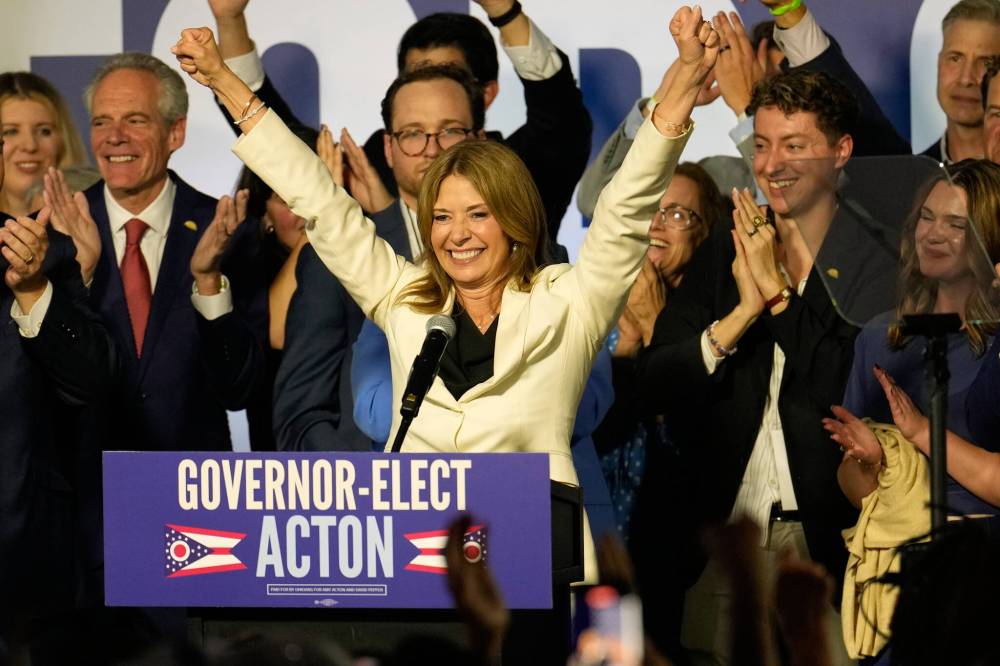
Carolyn Kaster / The Associated Press
Ohio Democratic gubernatorial candidate Dr. Amy Acton triumphed by 14 percentage points over her opponent in the U.S. midterm elections.
Lorain broke for Dr. Amy Acton, the Democratic candidate for governor, by 14 percentage points — an extra jab, perhaps, at her Republican opponent, Trump acolyte Vivek Ramaswamy, who had run a brutal ad that questioned Acton’s honesty regarding the sexual abuse she suffered as a child.
In other traditional battlegrounds like Michigan and in newer “purple” states like North Carolina, the same story played out.
Democrats and independents flooded the polls, while Republicans stayed home or strayed from the party standard.
Voters also registered their disapproval of Republican efforts to redraw electoral districts and of Trump’s “let it ride” approach to AI development.
The Sun Belt
But the bigger story happened farther south, in states like South Carolina, Mississippi, Louisiana and, above all, Texas.
This huge band of rural poverty and suburban comfort — the Sun Belt — was once the place where cotton was king. It was a vast domain for a virulent strain of slavery that emerged in the early 1800s and refused to remain in the same country as Abraham Lincoln and his “Black Republicans” (the Republicans, founded in the mid-1850s, included abolitionists and pledged to contain slavery).
After the civil rights movement of the 1950s and ‘60s, these states shifted dramatically to the right, embracing the Republicans as the party of small government, evangelical piety and proud patriotism. Mostly white Republicans have simply overwhelmed the majority Black and Democratic strongholds of their states.
In 2026, however, historically Black counties in places like the Mississippi Delta turned out in such huge numbers that the weakened Republican vote could no longer hold.
As of this writing, the Democratic candidate for U.S. Senate, Scott Colom, is leading the incumbent Republican by 43 votes out of nearly 950,000 cast.
And then there is the biggest prize of all: Texas, one of only a handful of U.S. states that was once an independent republic, in this case a slaveholders’ cotton-growing frontier called the Lone Star Republic (1836-46).
Home to more than 31 million people, Texas is not shy about being Texas. (My grandfather, a Second World War veteran, proudly told me that he once got into a fistfight with his Texas-born superior when that officer tried to make my grandfather stand and sing, “The Yellow Rose of Texas.”)
Around 40 per cent of Texans are Spanish-speaking voters who generally prefer Democrats but who had veered towards Trump two years ago.
They veered back.
For example,
Webb County — on the border with Mexico — had gone to Trump in 2024 by two points. Tuesday night, the Democratic candidate for U.S. Senate, James Talarico, won it by 47 points.
I repeat: a county moved nearly 50 points in two years.
What happens now depends on whether the Democrats can consolidate Tuesday night’s mighty alliance of moderates, young people, racialized people, professionals and lower wage earners.
To do so, they will have to drop their occasional aversion to piety in public life (Talarico is a devout Presbyterian who gave his victory speech in front of the words “Love Thy Neighbor.”)

They will need to address economic problems. They will need to be disciplined.
If they can do so, then the entire political map of the U.S. will be transformed, with the Sun Belt coloured purple and the Democratic Party capable of the kind of sustained dominance we haven’t seen since Ronald Reagan’s Republicans in the 1980s.
As Canadians have learned over the last two years, and more broadly over the last two centuries, America can always surprise you.
Jason Opal is a professor of history at the Ohio State University.
This article was first published at The Conversation Canada: theconversation.com/ca.