

Can’t have our cake and eat it, too
Advertisement
Read this article for free:
or
Already have an account? Log in here »
To continue reading, please subscribe:
Digital Subscription
One year of digital access for only $1.44 a week*
- Enjoy unlimited reading on winnipegfreepress.com
- Read the E-Edition, our digital replica newspaper
- Access News Break, our award-winning app
- Play interactive puzzles
*Billed as $5.77 plus GST every four weeks. After 52 weeks, price increases to the regular rate of $19.95 plus GST every four weeks. Offer available to new and qualified returning subscribers only. Cancel any time.
To continue reading, please subscribe:
Add Free Press access to your Brandon Sun subscription for only an additional
$1 for the first 4 weeks*
- Enjoy unlimited reading on winnipegfreepress.com
- Read the E-Edition, our digital replica newspaper
- Access News Break, our award-winning app
- Play interactive puzzles
*Your next Brandon Sun subscription payment will increase by $1.00 and you will be charged $17.95 plus GST for four weeks. After four weeks, your payment will increase to $24.95 plus GST every four weeks.
Read unlimited articles for free today:
or
Already have an account? Log in here »
Last month, the City of Winnipeg said it would soon begin to study ways to improve pedestrian and cyclist safety along Osborne Street, which runs between two of the city’s densest neighbourhoods, where residents walk and bike for many of their daily activities. As someone who lives in South Osborne and who has frequented the shops and restaurants of the Village since my university days over 20 years ago, these changes can’t come soon enough.
Imagine my frustration when I read that this study of the street between Broadway and the St. Vital Bridge will take place “over the next year” to find “quick” solutions. We’ve all been through the COVID-19 pandemic, during which cities around the world found rapid solutions to improve safety and encourage more walking, biking and transit. Entire manuals have been published on easy things our city could try, literally this weekend, to improve the safety of Osborne Street.
Perhaps the reason this project is going to take a year can be found in this quote from David Patman, the city’s manager of transportation: “Osborne Street is currently serving multiple, competing functions … It exists in a dense, pedestrian-oriented development area that is close to rapid transit, which is at odds with the high flow of motor vehicles that travel daily along the corridor.”
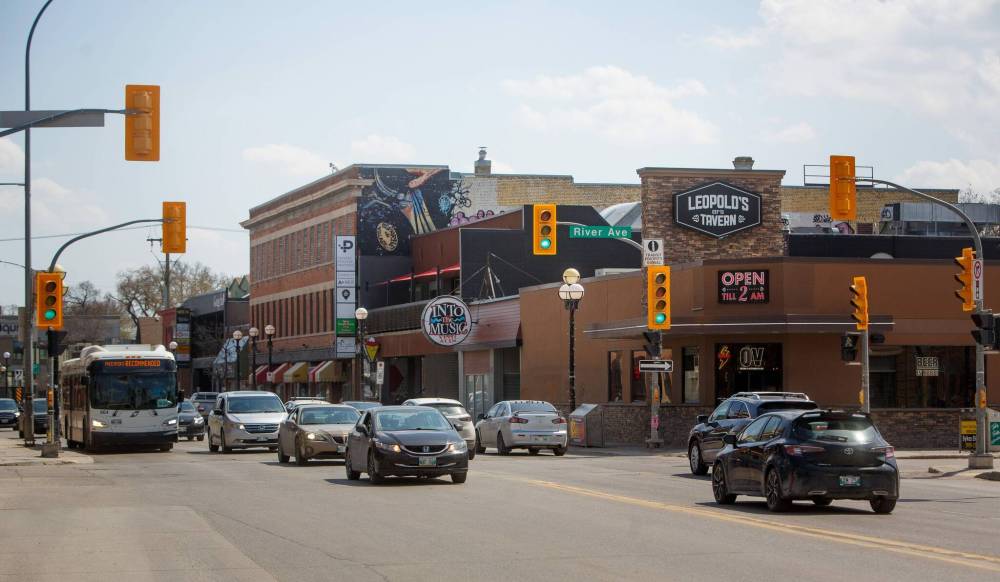
Free Press files
People cross the intersection of River Avenue and Osborne Street. The City of Winnipeg’s public works committee recently approved a study of pedestrian and cyclist safety along Osborne.
Mr. Patman has correctly identified Osborne Street as a “stroad”. A stroad is a dangerous, inefficient combination of a street and a road. Stroads try to be the best of both worlds, and they fail at both. Charles Marohn, author of Strong Towns, offers the best analogy — a stroad is like a futon, which is both a terrible couch and an uncomfortable bed. You try to save money on two functions, but neither is right.
Streets are productive places where people interact with businesses and residences and where community wealth is created, whereas roads are high-speed routes between those productive places (think: railroad). Both streets and roads serve important functions. But problems arise when we mix the two.
Stroads came into fashion after the Second World War, when cities across North America abandoned traditional incremental growth and started building entire car-dependent suburbs on the edges of cities and towns. Suddenly, those streets became congested with automobiles. Instead of rethinking this growth pattern, cities attempted to find ways to manage the traffic by degrading the streets. Streetcar lines were ripped out or paved over, wide sidewalks were shrunk to add lanes, and traffic lights replaced stop signs to “improve the flow”.
It’s obvious now that this was a mistake. I think about this often when sitting on a packed bus stuck in bumper-to-bumper traffic; or when waiting at Osborne and Beresford Avenue as cars fly through the lighted, flashing, beeping crosswalk; and especially when another resident is hit and injured or killed by a vehicle in our neighbourhood. If only those city planners of old could see us “thrive”.
Here is the uncomfortable truth that we need to come to terms with on Osborne, and the many stroads throughout our city — we have to decide if we want a street or a road. We cannot have both.
It’s a pretty obvious choice on Osborne. Osborne is, after all, a Street. It goes through the Osborne Village. It is a high street, not a highway.
Back in 2023, the Osborne Village BIZ and the local councillor proposed making the intersection of River Avenue and Osborne a scramble crossing to calm traffic and make it safer for pedestrians. I will never forget listening to the council discussion. While there was an awareness that the neighbourhood wanted better walkability (it is prominent in the neighbourhood secondary plan), and despite all of the benefits clearly articulated by delegations, at the end of the day the decision came down to “all of the development” on the south side and the “need” to move those vehicles through the neighbourhood as quickly as possible at rush hour.
That’s right, we plan around 10 hours a week of intense traffic (with Jets games and other events, let’s say 20) over the other 148 hours a week, even if it means going against the expressed wishes of businesses and people in the area.
To which I ask — would you say traffic flows well during rush hour on Osborne? The stroad benefits no one. By trying to be both a great place to walk, live, play and shop — and a place that is fast to drive through — you end up with neither.

Here is where we fail as a city again and again. No one likes congestion, and everyone wants their neighbourhoods to thrive. Indeed, we need thriving neighbourhoods to pay for the infrastructure and services we depend on. But, our city does not want to make the tough choices necessary. We cannot continue to serve “multiple, competing functions” and think we’re going to get anywhere.
My fear is that this study, and $75,000, will result in a report of information we already know. We already know which intersections are a problem. We already know the possible solutions. The benefit of quick fixes is that you can test them, adjust them, and if they don’t work, scrap them and move on to something else. The report also won’t solve our analysis paralysis — a state in which we are stuck trying to find the perfect solution to make everyone happy. It does not exist.
Either Osborne is a street, in which case we prioritize the people and businesses in the neighbourhood over the cars that travel through it, or Osborne is a road, in which case we remove the people and businesses so that cars can flow through unimpeded.
Let’s hope the next city council, which will feature many new faces and voices, will also include some strong spines. We must make tough choices to get us off of this lumpy futon once and for all.
Mel Marginet is part of the sustainable transportation team at Green Action Centre and the publisher at Great Plains Press, which publishes The City Project.