

Mark Carney’s campaign for middle powers
Advertisement
Read this article for free:
or
Already have an account? Log in here »
To continue reading, please subscribe:

Digital Subscription
One year of digital access for only $205*
- Enjoy unlimited reading on winnipegfreepress.com
- Read the E-Edition, our digital replica newspaper
- Access News Break, our award-winning app
- Play interactive puzzles
*First annual payment billed as $205.00 + GST for one year. This annual subscription will automatically renew at $233.00 + GST every 52 weeks (10% off the regular annual price of $259.35). Offer available to new and qualified returning subscribers only. Cancel any time.
To continue reading, please subscribe:
Add Free Press access to your Brandon Sun subscription for only an additional
$1 for the first 4 weeks*
- Enjoy unlimited reading on winnipegfreepress.com
- Read the E-Edition, our digital replica newspaper
- Access News Break, our award-winning app
- Play interactive puzzles
*Your next Brandon Sun subscription payment will increase by $1.00 and you will be charged $17.95 plus GST for four weeks. After four weeks, your payment will increase to $24.95 plus GST every four weeks.
Read unlimited articles for free today:
or
Already have an account? Log in here »
“You campaign in poetry. You govern in prose,” said former New York Governor Mario Cuomo forty years ago. Canada’s Prime Minister Mark Carney is now in the poetic phase of his campaign to create an alliance — maybe just a loose alliance — of middle powers who can resist the brutal strength of the great powers.
Carney knows how the world used to work, and how it is changing as the ‘rules-based international order’ fades away under the impact of the three great autocrats, Putin, Trump and Xi. “Middle powers must act together,” he told the Davos conference last January, “because if we’re not at the table, we’re on the menu.”
“The old order is not coming back,” he told them. That should have been obvious to all of them, but many countries in Europe and beyond still clung to the belief that somehow, one of these days, maybe after Trump relinquishes power or dies, the old order can be resurrected.
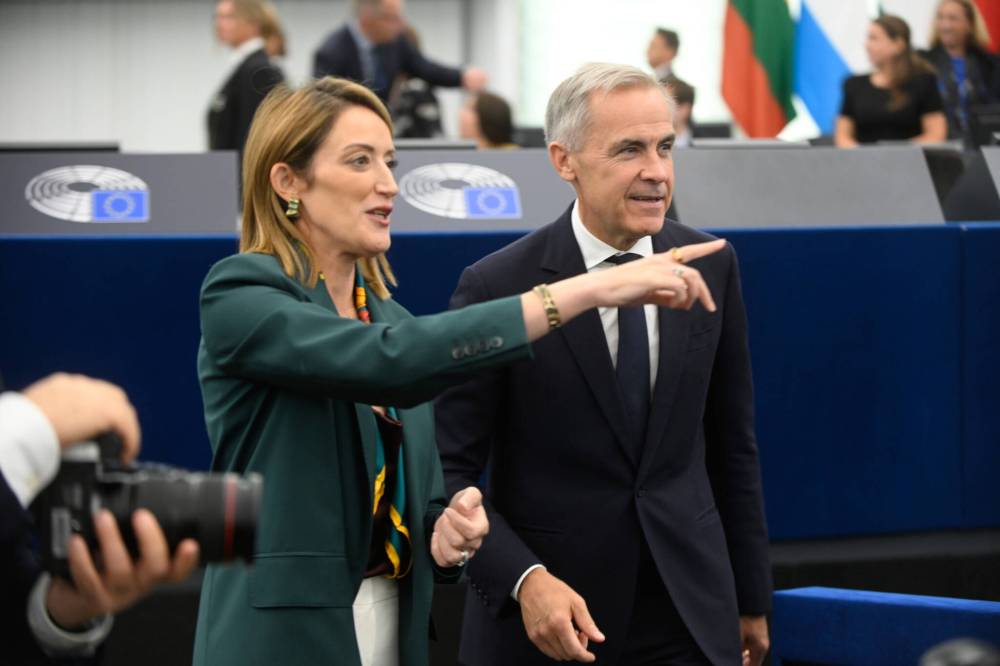
AP Photo/Pascal Bastien
Canada’s Prime Minister Mark Carney, right, and President of the European Parliament Roberta Metsola arrive at the European Parliament in Strasbourg, eastern France, Sept 17
In a single speech that catapulted him into the de facto position of leader of the middle powers, he disabused them of that fantasy and offered them a path to resistance instead. They gave him a standing ovation, a very rare thing at Davos — and he managed to convince them without mentioning any of the problematic powers by name. So I will.
The United States is obviously the most dangerous of the three great powers, having fallen under the control of a man who regards war as a useful tool for subjugating countries or changing their governments. The United States has bombed seven countries since Donald Trump took office in January of last year.
Russia has only invaded one country in the past five years, and by most conventional measures it scarcely even qualifies as a superpower any more. However, it still has over 5,000 nuclear weapons, and Vladimir Putin might choose a high-risk gamble to finish his four-and-a-half year war in Ukraine quickly rather than plodding on endlessly at a dozen metres a day.
China’s Xi Jinping is almost harmless by comparison, although he does reserve the right to invade Taiwan if it won’t ‘reunite’ with the mainland. In fact, China hasn’t bombed anybody in decades, and Xi has even lamented the demise of the ‘rules-based international order.’ In some circumstances, China could be an ally of the middle powers, but don’t count on it.
So this is the political environment in which the middle powers must operate, and Mark Carney was almost bound to emerge as its leader. He had the right personal qualities and experiences, but more importantly he governs the middle power most vulnerable to subjugation in the short run. Most Canadians realize their country’s peril may be existential.
Although Trump is obsessed with the “nasty Canadians,” most still doubt that he would treat Canada like Venezuela, let alone like Iran. But his decline is accelerating so they cannot even be sure of that any more — and they know that at a minimum he wants to turn Canada into a North American version of Belarus.
The ‘middle power’ group Carney is trying to create would ideally include 20 to 30 countries with population ranging from around 40 million (Canada, Spain, South Korea) to 200 million (Mexico, Indonesia, Bangladesh). Their purpose would be to protect the sovereignty of every country that is threatened, including non-members.

It might not even be a membership-based organization, just like-minded democratic countries cooperating on an ad hoc basis. If it were wildly successful and the wind was blowing in the right direction, it might even be the seed from which a new rules-based order might one day grow, but that is certainly not the immediate goal.
And why is this enterprise being launched with a rather non-specific invitation by European Commission president Ursula von der Leyen for Canada to become an ‘associate member’ of the European Union? It’s because you have to start somewhere, and the 27-member EU is a better place than most.
Most EU members belong to NATO, as does Canada, but this is not a military exercise. There will be no European pledge to defend Canada — that would be a pointless provocation — and it is unlikely that the ‘middle power group’, even if it grows far beyond this like-minded and culturally close group, would ever develop into a binding alliance with a military arm.
Mark Carney will probably choose not to remain at the head of this new group for long. It’s a job that requires somebody’s full attention, and he has a country to run. But he and von der Leyen have got the ball rolling, which is a great achievement in a dark time.
Gwynne Dyer’s new book is ‘Intervention Earth: Life-Saving Ideas from the World’s Climate Engineers’. The previous book, ‘The Shortest History of War’, is also still available.