

We used to love a good thunderstorm
Advertisement
Read this article for free:
or
Already have an account? Log in here »
To continue reading, please subscribe:

Digital Subscription
One year of digital access for only $205*
- Enjoy unlimited reading on winnipegfreepress.com
- Read the E-Edition, our digital replica newspaper
- Access News Break, our award-winning app
- Play interactive puzzles
*First annual payment billed as $205.00 + GST for one year. This annual subscription will automatically renew at $233.00 + GST every 52 weeks (10% off the regular annual price of $259.35). Offer available to new and qualified returning subscribers only. Cancel any time.
To continue reading, please subscribe:
Add Free Press access to your Brandon Sun subscription for only an additional
$1 for the first 4 weeks*
- Enjoy unlimited reading on winnipegfreepress.com
- Read the E-Edition, our digital replica newspaper
- Access News Break, our award-winning app
- Play interactive puzzles
*Your next Brandon Sun subscription payment will increase by $1.00 and you will be charged $17.95 plus GST for four weeks. After four weeks, your payment will increase to $24.95 plus GST every four weeks.
Read unlimited articles for free today:
or
Already have an account? Log in here »
Growing up on the prairies, even as a city girl, summertime thunderstorms were always cause for excitement. That first rumble signalled it was time to go search for the sleeping bags.
We’d cuddle under them on the front step, under the awning, as we watched the rain pour. And we’d stay out there until we were soaked.
If the lightning wasn’t bad enough for our parents to call us in, we neighbourhood kids would then throw on our bathing suits and go play in the warm puddles. It was some of the best stuff of summer.
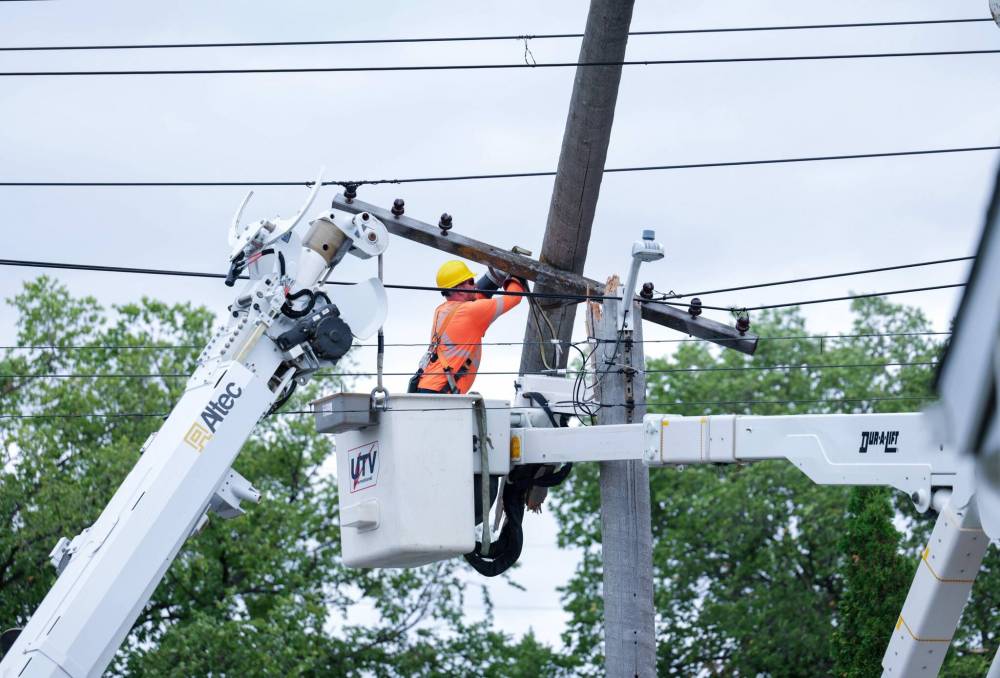
Ruth Bonneville / Free Press
Manitoba Hydro crews work to repair several hydro poles that snapped or fell down after a severe storm tore through River Heights on Sept. 6.
As a mom now, with a little girl of my own, I was excited to watch her growing up loving Winnipeg thunderstorms, too.
I’ve tried to make our own traditions of cuddling up to watch the drama and have encouraged her to dance in the rain. These last few years though, particularly this past summer, it’s become harder to help her find that fun.
Something has changed. Storms aren’t what they used to be. The thrill of that first rumble has evolved into worrying about what will happen next.
Over the September long weekend, my family and I experienced what scientists and media keep describing as unprecedented weather.
From the front window of my River Heights home I listened to what seemed like an invisible train head right toward my front door. I could hear it coming, as I asked my mom, who was over for Sunday dinner, “What is that sound?”
As the noise built, we rushed to close the windows, before a massive wind and flying branches barrelled past our eyes. A shed went flying. A crack of lightning appeared to hit a pole or a tree in the back lane across from us. Then all went dark. The power was out.
We were all fine so we lit candles and reassured the 10-year-old that everything was OK.
But then water started pouring through the patio door and the branches on the boulevard started piling up. I knew we were safe, but for a kid growing up in the midst of climate chaos, that can be hard to believe.
Still fresh in her mind are the shrill tornado warnings, the hail damage and remnants of a wet basement from just June. Her climate anxiety is real. And as my 72-year-old mother, born and raised in Winnipeg recalls, she’s never seen a summer like this.
Even beyond this past summer, Manitoba has been enduring extreme and recording-setting weather for many months.
In 2025, we saw our worst wildfire season in 30 years, with more than 2.38 million hectares burned, 445 wildfires and more than 33,000 Manitobans evacuated, including more than 4,100 people airlifted by the Canadian Armed Forces. That became the largest domestic air evacuation operation in Canadian history.
Wildfires that year were fuelled by extreme dryness and an extraordinarily hot May. In Winnipeg we reached 37°C on May 13 last year, the city’s second-hottest May day ever recorded.
This May it snowed and the May long weekend was the second-coldest on record.
Then came a summer of weather that challenged what most of us remember as normal.
In early June, Winnipeg was placed under a critical red-level tornado warning. Later that month, an actual EF-1 tornado hit the city. Then came the storm this month, which Western University’s Northern Tornadoes Project has confirmed yielded yet another EF-1 tornado — something my mom promised me as a kid could never happen (apart from that one July in 1987).
Today, that’s a promise I can’t make to my daughter.
Scientists have been warning us for decades that the way we live would come at a cost: our dependence on fossil fuels, our industrial farming of animals, our relentless manufacturing, our destruction of forests and our continued car culture.

Extreme weather worldwide, and in our own backyard, is now undeniable.
While two tornadoes in one summer in our city may or may not be as a direct result of our climate changing, scientific consensus is clear: a warming planet is making many types of extreme weather more frequent, more intense and more likely.
What we are experiencing today is a mere glimpse of what will happen if we keep treating climate change as some distant problem or political joke, rather than the reality right outside our door.
For now, I will continue to reassure my kid that we can handle the storms that come our way; I’ll fix my door, dry my basement, keep eating plant-based and try to enjoy the rain when we can.
Jessica Scott-Reid is a Winnipeg journalist and correspondent for Sentient Media.