

A community brought the Trident Press home
Advertisement
Read this article for free:
or
Already have an account? Log in here »
To continue reading, please subscribe:

Digital Subscription
One year of digital access for only $205*
- Enjoy unlimited reading on winnipegfreepress.com
- Read the E-Edition, our digital replica newspaper
- Access News Break, our award-winning app
- Play interactive puzzles
*First annual payment billed as $205.00 + GST for one year. This annual subscription will automatically renew at $233.00 + GST every 52 weeks (10% off the regular annual price of $259.35). Offer available to new and qualified returning subscribers only. Cancel any time.
To continue reading, please subscribe:
Add Free Press access to your Brandon Sun subscription for only an additional
$1 for the first 4 weeks*
- Enjoy unlimited reading on winnipegfreepress.com
- Read the E-Edition, our digital replica newspaper
- Access News Break, our award-winning app
- Play interactive puzzles
*Your next Brandon Sun subscription payment will increase by $1.00 and you will be charged $17.95 plus GST for four weeks. After four weeks, your payment will increase to $24.95 plus GST every four weeks.
Read unlimited articles for free today:
or
Already have an account? Log in here »
A truck pulled up outside Oseredok a few weeks ago carrying more than an exhibition.
Inside were the panels of Ukrainian Voice: A Legacy Mosaic, a monumental artwork built from the printing blocks once used to reproduce the photographs and illustrations in one of Canada’s longest-running Ukrainian newspapers.
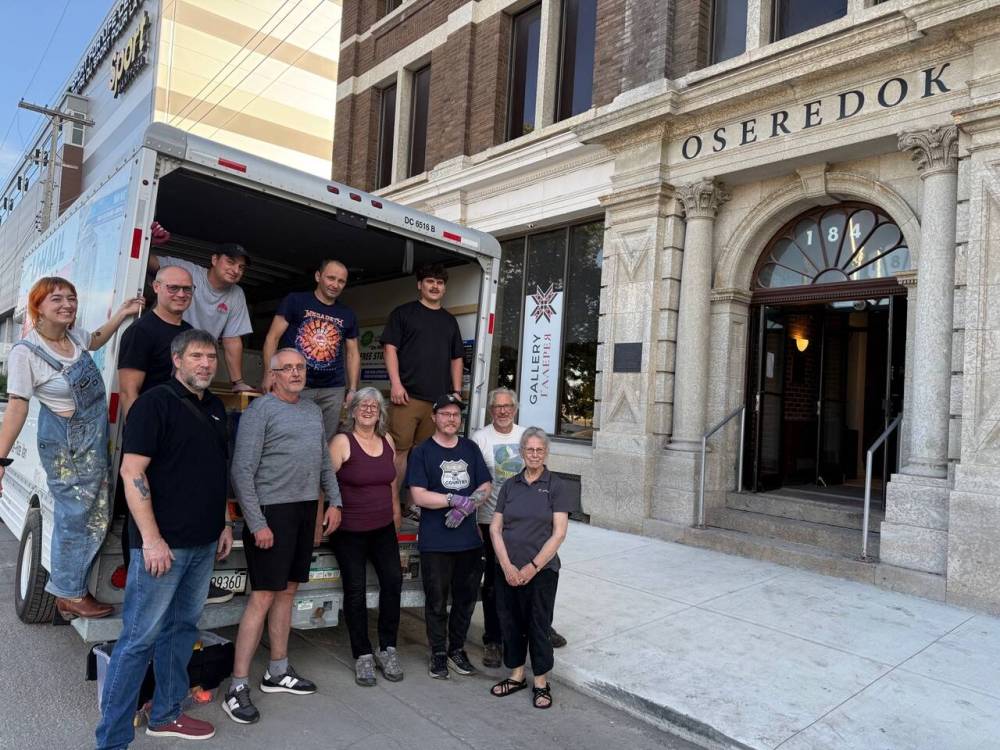
A dozen people gathered to unload it. Some were longtime members of Winnipeg’s Ukrainian community; others were newcomers who had arrived since Russia’s full-scale invasion of Ukraine. Together, they lifted, unpacked and carried the panels through Oseredok’s doors.
Submitted/Stephen Borys
Volunteers with artist Larisa Sembaliuk Cheladyn unloading the Legacy Mosaic at Oseredok.
It was an ordinary act of volunteer labour, but also a fitting final stage in an extraordinary journey. More than a century ago, Ukrainian newcomers created the newspaper whose printing blocks form the mosaic. Now another generation of newcomers was helping bring that history home.
The arrival had particular resonance for me. I am serving as Oseredok’s interim executive director, and Ukrainian Voice: A Legacy Mosaic is one of our fall exhibitions. Created and curated by Larisa Sembaliuk Cheladyn with a small team of volunteers, the project illuminates why Oseredok exists: a community has taken responsibility for preserving its own cultural memory.
Ukrainian Voice began with a community trying to find itself. In 1909, Ukrainian bilingual teachers met in Winnipeg to establish a weekly newspaper. Immigrants were scattered across the country and often identified with the regions and villages they had left behind. The paper could connect them and help shape a shared Ukrainian Canadian identity.
The first issue of Ukraïns’kyi holos — Ukrainian Voice — appeared on March 16, 1910, printed by hand on a platen press in the home of Pavlo Krat. From those modest beginnings, the Ukrainian Publishing Company of Canada, renamed Trident Press in 1949, became one of Canada’s longest-running Ukrainian-English publishing houses.
Its importance cannot be measured by circulation alone, although Ukrainian Voice once reached 22,000 subscribers. It reported news from Ukraine, carried contributions from communities across Canada, advocated for Ukrainian Canadians, and explained Canadian laws and customs. Trident also published the journals Visnyk and Promin, along with books on Ukrainian Canadian history, culture and community life.
For readers separated by great distances, print was connective tissue. Newspapers and books moved between Winnipeg, Prairie towns and Ukrainian communities throughout Canada. They delivered information, but also recognition: familiar names, shared concerns and evidence that Ukrainian life in Canada was not isolated.
Behind every page was another community. Writers, editors, photographers, illustrators and press operators turned experience into print. Many of the printing blocks consisted of photographs etched onto metal plates and mounted on blocks of fir, oak, walnut or spruce. Placed beside lines of type, they brought faces, places and events into readers’ homes.
When Trident Press closed in 2018, those blocks appeared to have reached the end of their useful lives. Thousands had accumulated in the basement of the Main Street premises, some darkened with old ink, others badly corroded. They had once carried images across the country. Now they were headed for a dumpster.
Edmonton artist Larisa Sembaliuk Cheladyn understood that these were not simply obsolete tools. Each block was the surviving trace of a story: a newspaper report, an almanac article, a book chapter, a portrait or a gathering. She salvaged them and assembled a creative team to consider what they might become.
Saving them was only the beginning. Over six years, Sembaliuk Cheladyn, Theodora Harasymiw and Sylvie Ellis, assisted by Mich Cheladyn, Eric Fincham, sculptor Royden Mills, students and community volunteers, identified, cleaned and inked the blocks. Mills designed the mosaic’s modular structure for travel. Others began reconnecting images with their original stories, creating an evolving digital archive.
The finished mosaic contains 2,674 printing blocks and measures over 40 feet long and nine feet high. Inspired by traditional Ukrainian embroidery, it resembles an immense embroidered sleeve. A river of raw, uninked blocks runs from east to west, following the route taken by early Ukrainian settlers across Canada. Clusters of coloured images evoke the communities established by successive waves of immigration.
At a distance, the work reads as a single bold pattern. Up close, it breaks into hundreds of faces and fragments, each carrying its own history.
The mosaic was made not simply by a community, but from the material traces of one. It gathers the labour of the people who created the original publications, the experiences of those who appeared in their pages and the commitment of those who refused to let this history disappear.
This is why its presentation at Oseredok matters. For more than 80 years, the Ukrainian Cultural and Educational Centre has preserved the heritage of Ukrainians in Canada and throughout the diaspora. Its holdings encompass more than 50,000 works of art, artifacts, books and publications, over 500 linear metres of archives, and extensive photographic and audiovisual collections. The Centre also holds the largest collection of pysanky (decorated eggs) outside Ukraine, numbering more than 4,000.
The mosaic belongs within that larger tradition of stewardship. It has travelled, but Winnipeg is where its story began. Trident Press operated here for more than a century, serving the community whose material history Oseredok preserves. Bringing the blocks into public view reconnects the mosaic with the community that gave it meaning.

When the exhibition opens Oct. 2, visitors will encounter a remarkable artwork. But they will also encounter a record of collective effort extending across generations. No single editor, printer, reader, artist or volunteer made this history. Each carried one part of it until someone else was ready to take hold.
That is what I see in the photo of volunteers outside Oseredok: not simply a group unloading an exhibition, but the latest participants in a story that began more than a century ago. It was tempting to show the newly installed Legacy Mosaic, but visitors will have plenty of time to see it at Oseredok.
This story is about the people who brought it here. Among them are Ukrainians who have only recently made Winnipeg their home. They are standing a short distance from Main Street, where generations of printers and editors once gave Ukrainian Canadians a common voice. The first newcomers built the press. The newest helped carry its surviving images home.
Cultural memory does not preserve itself. Someone has to write it, print it, read it, save it — and, sometimes, help unload it from a truck.
Stephen Borys is president and CEO of Civic Muse, an arts and cultural consulting practice based in Winnipeg. www.civicmuse.ca